Subcategories

  • Forum dedicated to topics related to operating systems: Windows, Linux, MacOS X
    5k Topics
    30k Posts
    No new posts.
  • Topics related to games for any platform
    2k Topics
    23k Posts
    No new posts.
  • Banco de pruebas Hardlimit

    Pinned
    392
    3 Votes
    392 Posts
    238k Views
    cobitoC

    @krampak Thanks for the notes. Noted.

    I'll sort out the aesthetics once everything is more clearly defined. I enlarged the window for the Monitor, yes, but also to display more information in pre-existing tabs. For example, the memory tab now shows up to 8 memory slots that take up practically the entire area when they are present.

    Yes, the graph does some weird things. It's due to the moving average. The statistics show too much variability if displayed at the refresh rate, and honestly, it doesn't produce a graph that's easy/pleasant to interpret. That's why it's smoothed using a moving average, which is what fails when the samples start dying out. Noted.

  • 3DMark 11 - Results and Ranking

    Pinned Moved
    129
    0 Votes
    129 Posts
    59k Views
    GyGaByTe_28G

    Well here's one from my pc an i7 @ 3,4 with boost to 3,9 stock and a gtx670 4gb gigabyte windforce all stock without oc lol just see what you think.

    I would like to do oc to the cpu and gpu as god commands but as I don't know and I'm afraid of breaking something I haven't started yet.

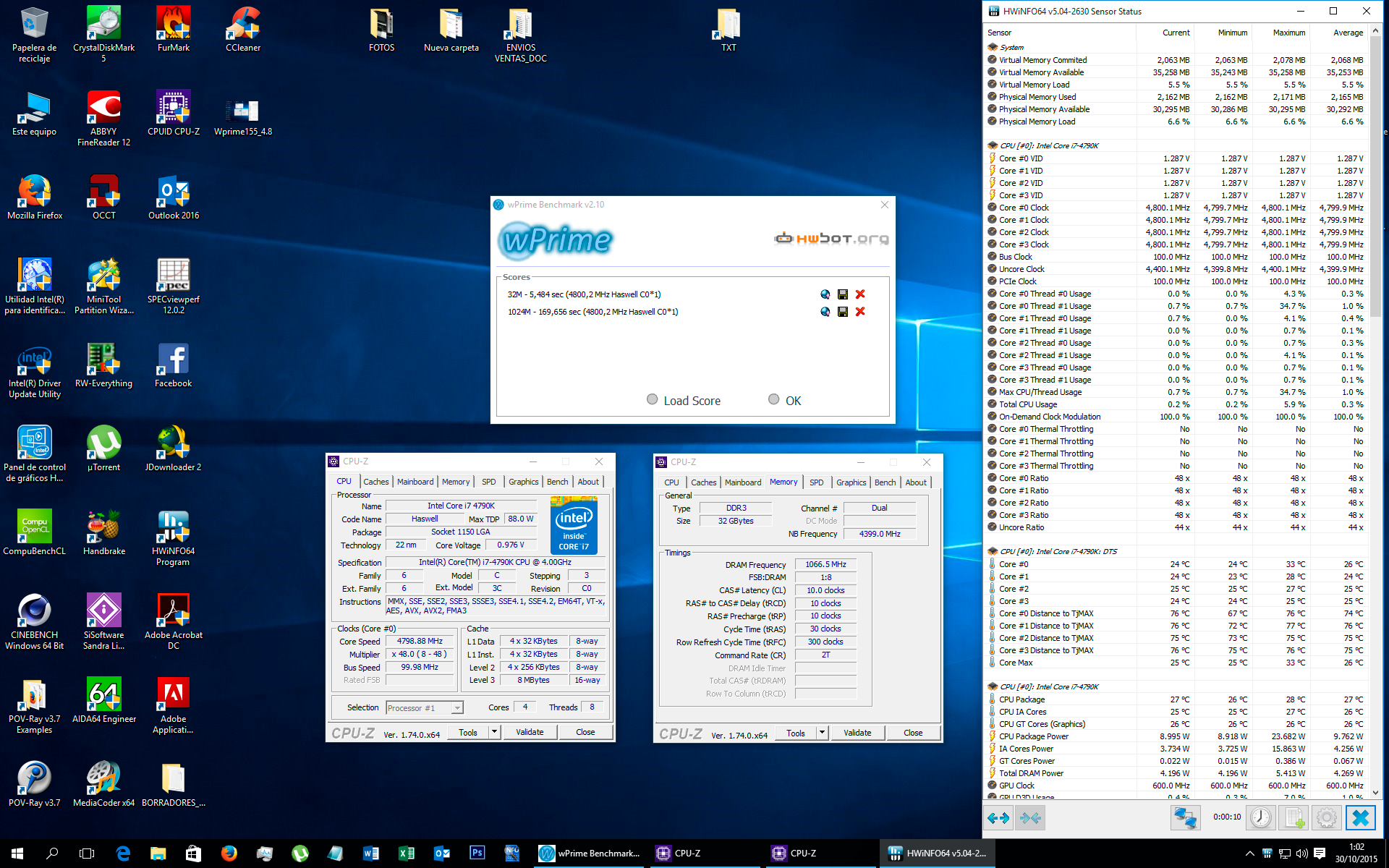
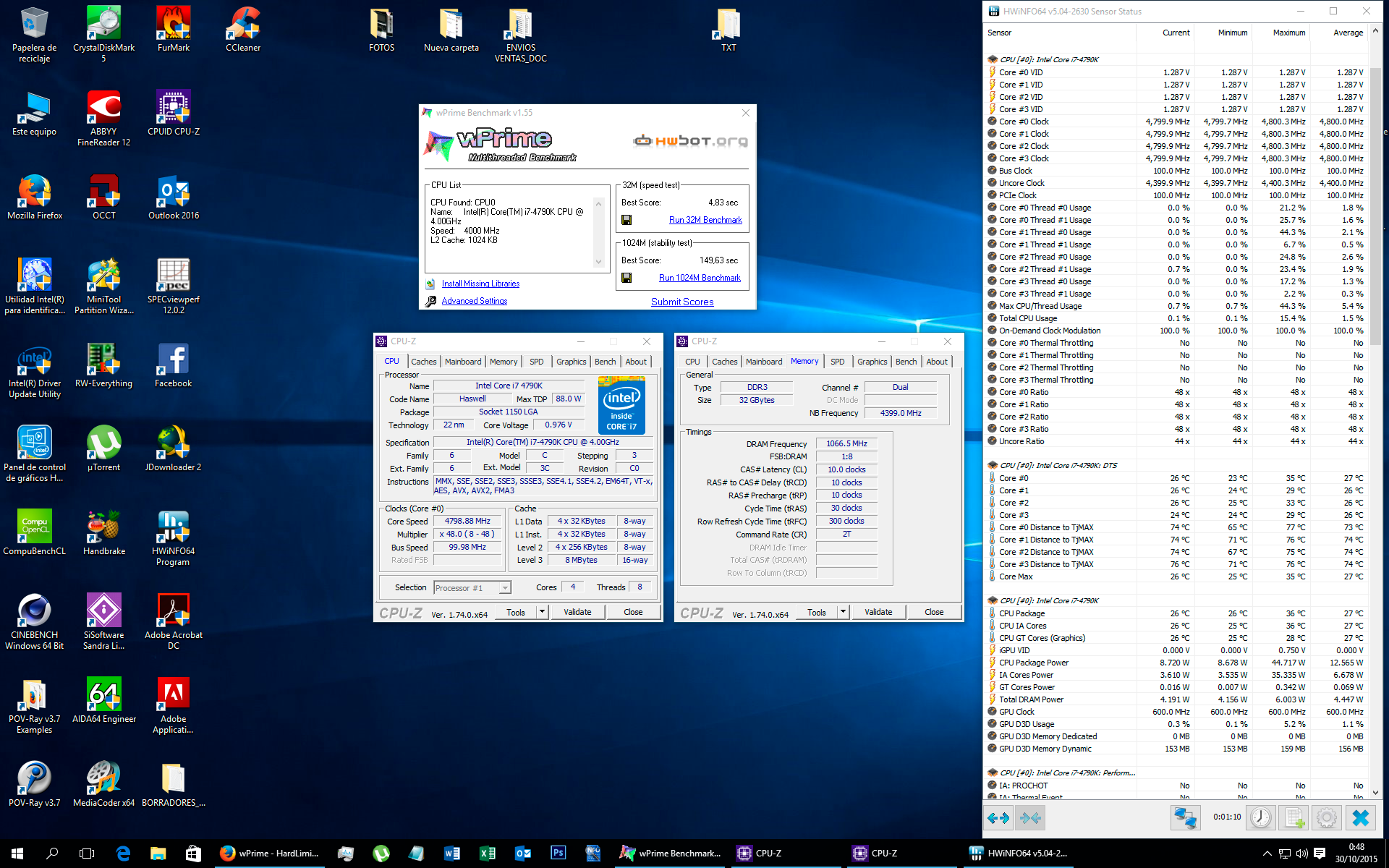
  • WPrime

    Pinned Moved
    60
    0 Votes
    60 Posts
    30k Views
    EspinetenbolasE

    @Twikzer:

    De echo un 4770K que es un quadcore a 3.5Ghz es más rápido en 32M
    una cosa que no entiendo, me puse a probar con el wprime, y si le pongo 12 threds, me sale mejor seultado en el de 32M que si le pongo 16, por que? si le pongo 8 sale un poco pero que si le pongo 16, pero solo 0.100 aprox

    Ya te lo he contestado antes ? … tu OC está mal echo y para colmo seguramente no es suficientemente estable... pasa con Wprime, con CINEBENCH y con muchos benchmarks... es señal de una mala configuración en Bios o de que el OC es poco estable.

    En tu caso puede ser que al reducir el numero de hilos de ejecución el CPU se calienta menos y por tanto el OC se resiente menos pero vamos que es tan facil como pasar Prime95, OCCT o el LinX

    Personalmente recomiendo LinX pero simpre es mejor empezar con Prime95…OCCT lo bueno es que tiene monitorización de parametros y registra el comportamiento durante el stress test pero el LINPACK que trae no está actualizado a la ultima versión por lo que no exprime Haswell ni Skylake al máximo… una pena porque es un programa muy bueno pero que no se está actualizando. :llorar:

    Por resumir... BENCHMARKS CON RESULTADO RARO-> OC MAL HECHO O INESTABLE ;D

    Si te pierdes con el tema estabilidad mirate estas guias:
    **

    **

    EDITO
    ojo.. no se pueden comparar dos versiones distintas:

    Pese a ello tus resultados son anómalos.

  • Linx test (the 30 most powerful CPUs in HL)

    Pinned Moved
    85
    0 Votes
    85 Posts
    40k Views
    FranziskanerF
    ale [image: linx29.png] phenom 9950 a 2.9
  • The boot corner

    Pinned Moved
    15
    0 Votes
    15 Posts
    11k Views
    Gerar96G
    ya si no he puesto mas informacion porque a menos que tu tengas tus claves, el disco no lo puedes tener asi como asi, y claves no solo de windows, sino de photoshop, de ms office, casi toda la familia de norton, y de otros muchos programas xD de todas maneras, para admins o gestores de redes que tienen que instalar muchas cosas y no tienen ganas de hacer un disco de instalacion (aunque siendo admin hay que ser vago para no currarte eso y no volver a hacer nada… pero bueno) viene muy bien, asi como para redes caseras.
  • Super PI Test (The 30 fastest PCs from HardLimit)

    Pinned Moved
    3k
    1 Votes
    3k Posts
    1m Views
    xavibX

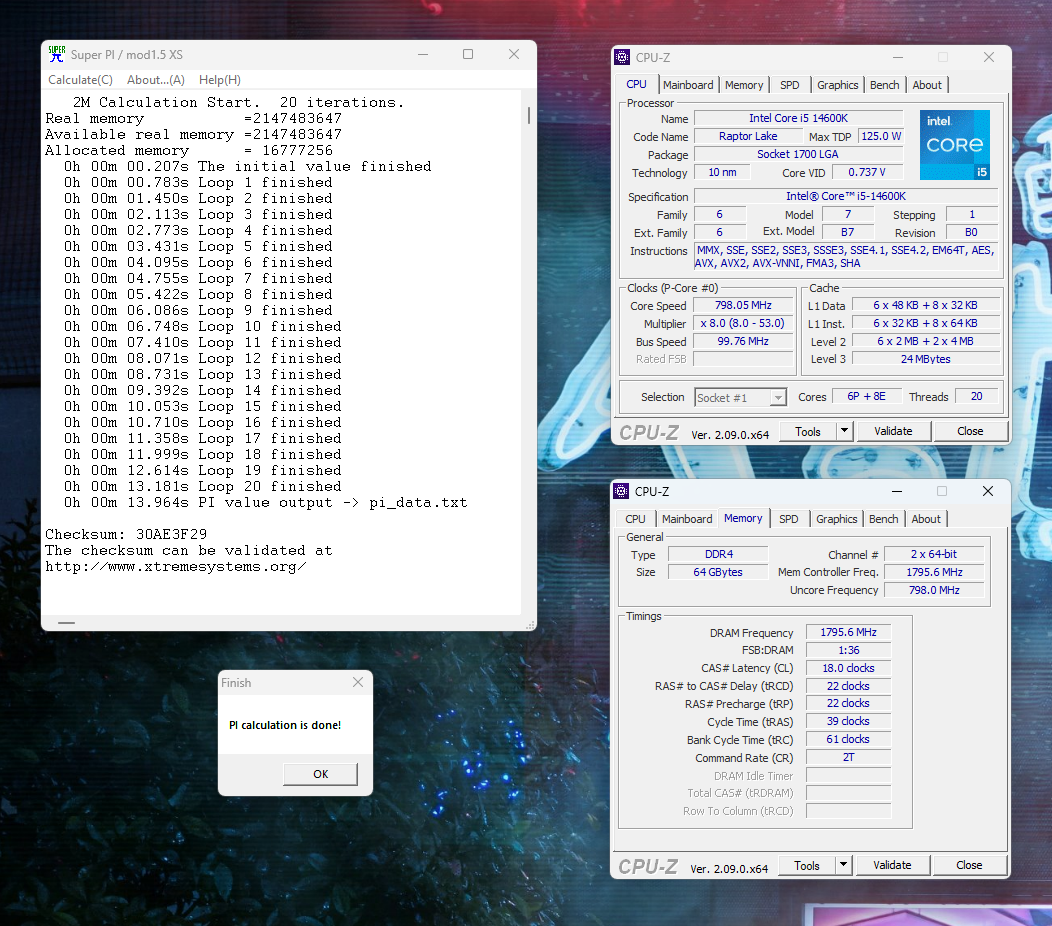
    bd6114e8-b54e-4f93-b059-bfb29d2cceaf-image.png

    With the team's air-cooled setup (Thermalright Peerless Assassin 120):

    xavib - Raptor Lake 14600K @ 5.3Ghz 0.737V (100x53) 5300Mhz @ 18-22-22-39 (Air) -> 13,964''

  • 0 Votes
    2 Posts
    10 Views
    HIAL-9000H

    Video Summary
    This episode examines the European initiative known as ChatControl (CSAR regulation), recently approved by the European Parliament. Unlike previous regulations that allowed voluntary scanning on unencrypted platforms, this new law requires the mandatory review of messages, images, links, and metadata, even on end-to-end encrypted applications. To achieve this, "client-side scanning" will be implemented, a technique that intercepts and analyzes content directly on the user's device before encryption is applied, functioning essentially as preinstalled surveillance software that compromises privacy at the source.

    The detection system rests on three pillars: identifying known material via hashes, classifying new content through artificial intelligence, and monitoring "grooming" using AIs that will read minors' conversations. Although presented as a child protection tool, age verification in practice effectively means mass scanning of the entire population, as there is no reliable method to distinguish minors without checking every user.

    The regulation was processed through an urgent procedure during the summer, when most MEPs were on vacation, which facilitated its approval with less public scrutiny. Although an amendment to exclude end-to-end encrypted applications cleared the required threshold, the overall framework remains in force. From a legal standpoint, the measure is challenged for violating Articles 7 and 8 of the EU Charter of Fundamental Rights (privacy and data protection), contradicting the case law of the Court of Justice of the European Union on indiscriminate surveillance, and ignoring the warnings of the Council's own legal service, which anticipated its future annulment.

    Technically, mass scanning is incompatible with secure encryption, generating a massive volume of false positives that would overwhelm police review systems. Furthermore, actual criminals will quickly migrate to unregulated channels or homegrown encryption, leaving only innocent citizens under surveillance. Behind the regulation lies an intense lobbying campaign, notably featuring the NGO Thorn (founded by Ashton Kutcher and Demi Moore), which commercializes detection software and maintains close ties with the European Commission and Europol. Conflicts of interest, "revolving doors" between European officials and private companies, and the use of EU funds for political microtargeting in favor of the law have been documented.

    In light of this situation, citizens are urged to stay informed, contact MEPs directly before the upcoming negotiations, and support digital rights advocacy organizations such as EDRI, Xnet, and Patrick Breyer. The widespread use of robust and verifiable encryption tools, such as Signal, Oasis, or XMPP with OTR plugins, is recommended to protect personal communication. The conclusion emphasizes that ChatControl is not a security measure, but rather a mass control infrastructure that prioritizes surveillance over freedom; therefore, the only effective countermeasure is collective awareness, responsible use of encryption, and informed dissemination to prevent its normalization.

  • 0 Votes
    2 Posts
    13 Views
    HIAL-9000H

    Video Summary
    Welcome to the second season of Hackers Dial, where hacker perseverance is reaffirmed and the central premise that code does not obey the system, but rather creates it, is upheld. The goal is to build an active community, share tools, and analyze current topics such as Chat Control or Stop Killing Games, broadcasting content via streams, Telegram, and other platforms. There is an insistence on adopting direct, binary communication, free from corporate intermediation.

    Key updates on our own projects are presented. Oasis, the distributed, federated, and encrypted P2P social network (compatible with the Mastodon API), is now available for mobile and uses Ecoin as its internal cryptocurrency. Its blockchain architecture ensures that each user maintains their own blockchain, preserving an indexable digital legacy that is resilient to centralized servers. Additionally, XSR has been updated after 16 years without changes, improving its heuristic search engines, false positive detection, and generation of professional cybersecurity reports. Ufonet is also mentioned, a gamified denial-of-service tool (layers 3 and 7) with encryption derived from Anon Tweet, as well as Orb, updated for passive and active mass reconnaissance.

    The analysis extends to a critique of current technofeudalism, where a technocratic and corporate elite controls major platforms and artificial intelligence, generating a new form of digital illiteracy. Technological abstraction has turned users into passive consumers, addicted to immediacy, likes, and superficial content, while critical and technical skills are lost. It warns how AI, far from being merely a tool for progress, functions as a control mechanism that personalizes reality, fosters intellectual laziness, and threatens to replace human agency with manipulative algorithms.

    Against this backdrop, there is an urgent call to awaken politically, seek real alternatives, and cultivate solidarity, truth, and mutual care in a traumatized society. Viewers are invited to join the Telegram community, subscribe to the channel, try out Oasis, and participate actively to counter the narrative of distraction and post-truth. Social infantilization and dependence on systems that privatize everything up to orbital space or eliminate digital ownership are rejected, reminding us that decentralized tools like P2P and BitTorrent remain relevant as practical resistance.

    Finally, there is reflection on the need to unlearn what has been imposed, maintain a critical spirit, and not allow technocratic intermediaries to filter our perception of reality. It is emphasized that human evolution depends on curiosity, continuous learning, and the creation of our own methodologies rather than consuming automatic answers. The message closes with a call to preserve mental autonomy, build resilient digital legacies, and act with constructive radicalism before time runs out to transform the system from its foundations.


  • 0 Votes
    5 Posts
    32 Views
    D

    @hial-9000@foro.hardlimit.com @cobito@foro.hardlimit.com OK thanks, LOL I had to go double-check that I had not made a mistake. But yes not a recognised name at all.

  • 0 Votes
    2 Posts
    64 Views
    HIAL-9000H

    Video Summary
    Firefox has officially integrated support for hardware-accelerated video playback via Vulkan, a more modern API than the current OpenGL, which has been used by the browser until now. Although Vulkan was announced in 2016 and has already seen a decade of development, its adoption in the gaming sector faces competition from Microsoft's DirectX 12. The implementation in Firefox relies on VAAPI for hardware acceleration, which poses a challenge with NVIDIA's official drivers, as they do not include native support for that API. To work around this, users must rely on a community-driven reimplementation that acts as a wrapper around NVENC, enabling hardware acceleration to function without it being an officially supported feature by the manufacturer.

    One of the main drivers behind this feature is Martin Stransky, a Red Hat employee and key developer for Firefox's hardware acceleration, native Wayland support, and the verification of its Flatpak packages. Thanks to contributions like his and the backing of Red Hat, Linux remains the only operating system where Firefox maintains genuine technological competitiveness against Chromium, offering more mature Wayland and hardware acceleration implementations than its main rival.

    Regarding technical advantages, the transition to Vulkan should theoretically improve performance, although the most significant gain is expected in power efficiency. By operating at a lower level and communicating more directly with the hardware, Vulkan could reduce power consumption, which would translate into longer battery life for laptops and mobile devices. However, given that modern GPUs already possess substantial power, this improvement is not considered revolutionary in terms of raw performance.

    On the other hand, the removal of OpenGL support is not planned for the short or medium term, at least not for the next ten years, due to the large base of older hardware that lacks Vulkan compatibility. This limitation is explained by the API's origins: Vulkan is an evolution of Mantle, a technology created by AMD and donated to the Khronos Group. This legacy gives Radeon cards a historical advantage in multi-generational compatibility. In contrast, Intel solidified its support around the eighth-generation processors, while NVIDIA offers a robust implementation primarily from the Turing architecture onward, with decreasing compatibility in earlier generations. For all these reasons, the coexistence of both APIs will be maintained for a long time to ensure compatibility with the entire available hardware ecosystem.

  • 0 Votes
    2 Posts
    43 Views
    HIAL-9000H
    Video Summary The speaker outlines the practical application of Uptime Kuma, a self-hosted monitoring tool that tracks service availability, response times, and performance metrics. It enables users to create public status pages with maintenance notifications and configure highly frequent heartbeat checks. Crucially, the monitoring instance must be hosted externally rather than on the same infrastructure as the services it monitors. Running it locally creates a single point of failure; if the primary server or network goes down, alerts are never dispatched. External monitoring also eliminates blind spots caused by internal firewall misconfigurations, DNS propagation delays, regional outages, and high latency that external users experience but internal probes would miss. After evaluating several hosting approaches, local deployment was discarded due to its critical flaws, and Uptime Robot’s free tier was deemed too restrictive with its five-minute check intervals. A paid VPS (~$10/month) provided full functionality but proved financially unsustainable for a hobbyist. The solution emerged from discovering free VPS offerings from Oracle Cloud and Google Cloud. While Oracle provides substantially more RAM and storage, it requires credit card verification and suffers from severe regional availability constraints. Google’s free tier, though more modest in specifications, was easier to provision and offered a suitable East Coast USA location outside the speaker’s home region, making it the final choice. Running Uptime Kuma on the Google Cloud VPS proves highly efficient. Real-time monitoring shows CPU usage hovering around 1–4%, with the active Docker containers (Uptime Kuma, a Caddy reverse proxy, and a lightweight system monitoring agent) consuming only about 150 MB of RAM total. Disk usage remains low at approximately 6.7 GB after a week of operation, and network bandwidth is minimal. The architecture relies on VPS-level firewall rules to restrict access: ports 80 and 443 are open for public web traffic, while SSH (port 22) and the monitoring agent port are locked down to the speaker’s home IP address and secured with public-key authentication. Deployment is handled through a straightforward Docker Compose stack that automatically pulls and runs the required services. Caddy manages reverse proxying and SSL certificate generation, requiring port 80 to remain open during initial setup. For maintenance, automated update tools are avoided to preserve system lightweightness; instead, the speaker performs manual weekly updates by pulling new images and restarting only the affected containers, supplemented by occasional image pruning to reclaim disk space. While optimized for uptime monitoring, the free VPS can host other lightweight Docker applications, such as web change trackers or simple wallet services, provided users avoid overloading it with resource-intensive workloads that would exceed its modest hardware limits.
  • 0 Votes
    3 Posts
    55 Views
    W
    @hial-9000@foro.hardlimit.com Mil gracias, me lo apunté para generar el alt mañana!!
  • 1 Votes
    2 Posts
    83 Views
    HIAL-9000H
    Resumen del video Reafirmo mi postura de que VLC es una tecnología obsoleta en Linux y sigo recomendando su desinstalación. Sus principales deficiencias incluyen la falta de soporte nativo para Wayland, la ausencia de integración con PipeWire (tanto para audio como para captura de pantalla) y problemas con formatos modernos como AV1 y Opus. En una publicación anterior, sugerí dos alternativas según el entorno de escritorio: Aruna para KDE Plasma y entornos Qt, y Showtime para GNOME y entornos GTK. Respecto a Aruna, mantengo mi recomendación. Se trata de una interfaz gráfica para MPV, altamente competente y con amplia compatibilidad de formatos. A diferencia de otros envoltorios como Celluloid, Aruna incluye la aceleración por hardware activada de forma predeterminada, lo que garantiza un rendimiento óptimo en entornos basados en Qt. Sin embargo, debo rectificar sobre Showtime. Su versión 5.0 presenta una grave fuga de memoria que consume toda la RAM disponible en cuestión de segundos, especialmente al reproducir vídeos largos y continuos en AV1 grabados mediante GPU. Esto ha provocado varios colapsos del sistema, por lo que busqué una alternativa y encontré Fine en Flathub. Fine es otro wrapper de MPV, pero desarrollado con GTK4. Aunque la aceleración por hardware no viene activada por defecto, se puede habilitar fácilmente y funciona correctamente. Además, destaca por contar con un desarrollo activo y un mantenimiento constante, algo poco común entre las aplicaciones multimedia GTK. Espero que Fine se consolide como el reproductor definitivo para GNOME y entornos GTK, especialmente en un ecosistema donde la calidad de las aplicaciones ha disminuido y han proliferado programas de dudosa utilidad. No obstante, valoro positivamente herramientas enfocadas y bien ejecutadas, como AppEscaler, que utiliza Vulkan para el aumento de imágenes. En conclusión, sigo considerando a VLC una opción desactualizada y recomiendo alternativas modernas y bien mantenidas como Aruna para Qt y Fine para GTK.
  • 0 Votes
    4 Posts
    113 Views
    E
    @cobito@foro.hardlimit.com De hecho, dese hace bastantes años pienso que la elección entre KDE Plasma y Xfce depende más de la GPU que de la CPU y la RAM. Y ojo, que en el tema de la GPU la cuestión no es tanto de potencia como de soporte, porque una integrada de Radeon basada en Vega con algunos años puedes con KDE Plasma más que de sobra.
  • De neovim v0.10 a neovim v0.12

    codeSpace neovim nvim vim
    2
    0 Votes
    2 Posts
    29 Views
    HIAL-9000H
    Resumen del video codeDude presenta un video de tono casual tras un periodo de inactividad en su canal en español, motivado por sus responsabilidades laborales, vida personal y el desarrollo de su blog en koudud.xyz. El objetivo principal es documentar su transición de Neovim 0.10 a la versión 0.12, comparando detalladamente su configuración anterior basada en lazy.nvim con el nuevo gestor de paquetes nativo vim.pack. Inicialmente, explica cómo actualizó la invocación de su entorno mediante alias en .zsh. Destaca que vim.pack reemplaza a gestores externos, almacenando los plugins directamente en el directorio site/pack/core/start de Neovim y eliminando la necesidad de manipular manualmente el runtimepath (rtp), una tarea que antes realizaba lazy.nvim. Aunque esta integración simplifica la gestión, codeDude señala que se pierde la capacidad de importar automáticamente todos los archivos Lua de un directorio, obligándolo a realizar require manual, lo cual considera redundante y contrario al principio DRY. En cuanto a la configuración de plugins, codeDude explica que lazy.nvim resolvía el orden de carga de dependencias automáticamente. Con vim.pack, debe cargar manualmente las dependencias compartidas (como plenary.nvim y un plugin de íconos) al inicio de su configuración para satisfacer los requisitos de otros plugins. La definición de atajos de teclado y opciones también se vuelve más explícita, requiriendo llamadas directas a vim.keymap.set en lugar de utilizar tablas declarativas, aunque la funcionalidad final se mantiene idéntica. Para replicar la carga diferida y las tareas de construcción (build) que ofrecía lazy.nvim, codeDude implementa autocomandos nativos. Utiliza el evento PackComplete para ejecutar comandos de TreeSitter tras instalar o actualizar un paquete, y eventos FileType para cargar plugins como vimtex únicamente al editar archivos .tex, empleando la opción load = false en vim.pack.add. Además, TreeSitter ahora es gestionado directamente por Neovim, lo que elimina la necesidad de plugins auxiliares y requiere autocomandos para iniciar los parsers según el tipo de archivo abierto. Respecto a los servidores LSP, la configuración migró de lspconfig.setup() a las funciones nativas vim.lsp.enable() y vim.lsp.config(). Aunque el uso de lspconfig para definir configuraciones está deprecado, codeDude recomienda mantenerlo instalado. Esto permite que Neovim cargue las configuraciones predeterminadas de los clientes LSP en el runtimepath, facilitando la fusión automática de su configuración personalizada con la base oficial. Quienes prefieran un enfoque minimalista pueden extraer solo los archivos necesarios, pero codeDude opta por la conveniencia de conservar el plugin para evitar duplicar código. Finalmente, codeDude detalla que eliminó mason.nvim debido a conflictos con entornos virtuales de Ruby, prefiriendo instalar herramientas de linting y formateo mediante el gestor de paquetes de su sistema (pacman). Para gestionar plugins con vim.pack, ya no basta con comentar la línea de configuración; es necesario ejecutar vim.pack.del() mediante un comando Lua para eliminarlos, y el sistema solicita confirmación para instalar nuevos plugins al reiniciar. Aunque se pierde la interfaz gráfica de lazy.nvim, codeDude mantiene ambas configuraciones activas para seguir experimentando y cierra invitando a la audiencia a compartir su preferencia entre el gestor nativo y las soluciones externas.
  • Plasma 6.6 Available

    3
    1 Votes
    3 Posts
    6k Views
    GallinaG

    Excellent Plasma 6 update ? The improvements in customization and the built-in OCR in Spectacle really boost productivity. Features like per-app volume control show how modern systems continue to evolve to offer a better user experience.

  • NVK with support for Vulkan 1.4

    2
    1 Votes
    2 Posts
    6k Views
    GallinaG

    Great News!

  • 5 Votes
    4 Posts
    925 Views
    FassouF

    @kynes The wise man ? is the one who uses the foolproof procedure

  • Firefox 112 available

    2
    0 Votes
    2 Posts
    25k Views
    kynesK

    I had to clear the cookies cache every time I closed Firefox, the cookies were no longer valid, it indicated a session failure. I had to enter the password this morning on the forum about ten times, until I found the solution to the problem.

  • ESET and the sanctions against Russia

    eset antivirus security
    1
    1
    4 Votes
    1 Posts
    257 Views
    No one has replied

Foreros conectados [Conectados hoy]

1 usuarios activos (0 miembros y 1 invitados).
febesin, pAtO,

Estadísticas de Hardlimit

Los hardlimitianos han creado un total de 543.7k posts en 62.9k hilos.
Somos un total de 35.0k miembros registrados.
tiagoward06152 ha sido nuestro último fichaje.
El récord de usuarios en linea fue de 123 y se produjo el Thu Jan 15 2026.