Usage statistics: Mac is down, Linux is up
-
Every so often, data appears about the market share of the different operating systems for the desktop. As has been seen with the Linux share, it has been increasing slowly but steadily for years.
Read more...
Toda la actualidad en la portada de Hardlimit
Mis cacharros -
Linux users are very different from Windows users. A Linux user uses the PC to do their things but also likes to tinker and that makes the complications of Linux not only not a nuisance but also fun. Plugging in a graphics card and having it work the first time is boring. Having to configure a text file to make it work is fun. Installing a program with an installation wizard is boring. Having to download the source code and compile it is fun. Very few people understand this and almost no one is willing to learn or to dedicate time to do these tasks.
Linux (when talking about Linux I refer to the distros in general, not the kernel in particular) is an easy-to-use operating system where ALMOST everything works the first time. But Windows is much easier to use and in Windows EVERYTHING works the first time. People want everything now and without effort. They don't want to hear about consoles, configuration files or compilations. They don't even know what any of that is or want to know. Linux could be as easy to use as Windows. It takes a long time to mature and in functionality operating systems have evolved very little in recent years. There are hardly any differences in the internal functioning of a Windows or a Linux from 10 or 15 years ago to a current Windows or Linux. Only the tools and programs that come standard on those systems have evolved and not even those have brought great changes in so much time.
But the Linux community and open source do not want Linux to be as easy and boring as Windows. A clear example is KDE. KDE is a desktop environment that is on its fifth version. But why has a fifth version been necessary? Couldn't changes in Plasma 5 have been introduced in KDE 4? Of course they could. But having such a stable environment with such small changes is boring. Desktop environments in Linux are fun because they are constantly changing and evolving. And they are radical changes that break functionalities that were very mature and destroy visual aspects that we were accustomed to. Every time a new major version of KDE or Gnome comes out, there are rivers of tears from the heartbroken cries of all those users who can't find things where they should be. But over time the crying calms down and they discover that this new way of doing things is just as good as the old one. There are also stories of failures but that is inevitable in experimentation. In fact, they can't be considered failures because you always learn from them. You learn how not to do things.
Moreover, why do we need 700 million desktop environments? If all developers joined forces on one, we would have the definitive environment. The same with distributions. 500 distributions? Seriously? It seems like a joke. With such a brutal available workforce and everything unified, it would be technically unbeatable. A Windows user wouldn't get confused thinking that Linux is Gnome or KDE. Linux would be Linux. And it would also be boring.
Another good example: package managers. Is it necessary for each base distribution to have its own damn package manager? Moreover, is it necessary for there to be different package formats? Can you imagine if in Linux there were a single unified package manager that handled a single format? Installing a program would be as easy as in Windows. Developers wouldn't have to waste time unnecessarily creating 20 versions of their program, one for each distribution. All distributions could share their packaging efforts and there would be a macro repository with all the programs you could possibly want. No company could compete with such a repertoire of programs. But it would be boring. Always the same, no changes, no surprises. Click and it's installed. Absurd.
On the other hand, we have Libreoffice. LO is a very boring project. It barely introduces radical changes or breaks things. But it is very stable. No one who has used the program in the last many years would have been surprised. That is boring. In the Linux world there is a tendency to break things and then have to fix them. They love fixing things. And that is something that a Windows user will never understand.
It's like those who like to tinker with their car. Someone who uses the car to go from point A to point B every day will think it's absurd to keep messing with it, running the risk that one day it will leave them stranded. For someone who is passionate about mechanics, using a car for what it is supposed to be used for is an unbearable boredom.
There are also cases where Linux users, after a long time, have decided to switch to Windows. The moment has come when they have stopped having time to tinker and need to use all their time to perform tasks on their computer. It is the moment when it is no longer acceptable to have to dedicate three days to making very specific hardware work. Or where it is no longer acceptable to have to dedicate a week to finding and compiling all the dependencies that a niche program needs, when in Windows it installs in a matter of minutes with a couple of clicks. That is the death of the Linux user and I am sure that for those who go through it, they find that something is missing in their daily life (I know a couple of cases).
IT WILL NEVER be the year of the desktop in Linux because Linux is not just an operating system. It is a philosophy that affects all open source software. And that philosophy clashes head-on with the idea of turning on, using program X and turning off cyclically every day of the year, from when you buy the PC until the end of its useful life. Reaching a market share of 2 and a half percent, by the way, does not indicate anything positive (or negative). It only indicates that in PC use now there is a 2% of enthusiasts who like to tinker with their computer. And yes, there will be developers who are forced to use Linux, but those are a tiny fraction of that 2%.
-
@palotes Buff tremendous reflection, I don't know if you got it from somewhere or if you made it "on the go", if it's the latter, a round of applause!
MAIN: Ryzen7 3800X + RTX2070Super + Asus x470 StrixF + KFA2 HOF 16GB DDR4 4000 + NVMe Samsung 970 EvoPlus 500GB + Samsung 850Pro 512GB + Samsung 860QVO 2TB + Asus Xonar STX + Phanteks Enthoo Pro M Se + Seasonic Focus+ 650W
LAPTOP: Asus Strix G531GT Intel i5 9300H + GTX1650 4GB + 16GB DDR4 2666 (8x2) + NVMe 256GB + 1TB HDD
-
Very good @palotes. In part it has reminded me of this image:
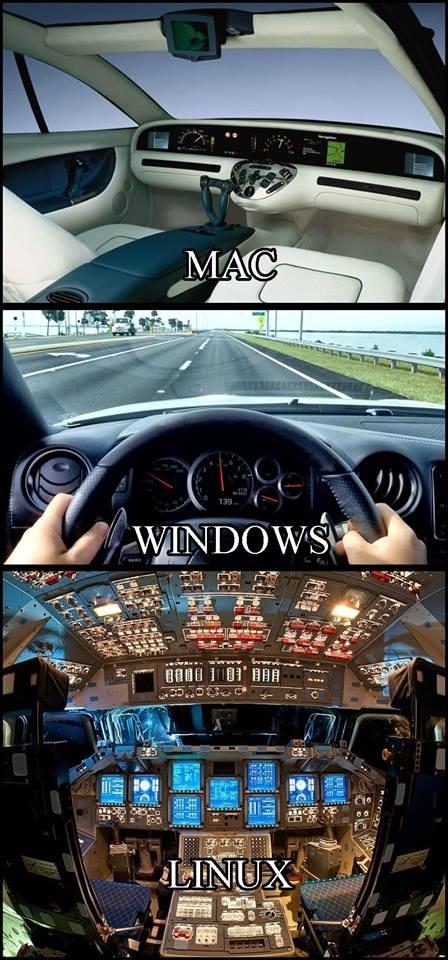
An autonomous car could never take you to the Moon no matter how well you know how to use it. Linux is much more versatile than Windows but the question is whether the average user takes advantage of all that potential. Having a space shuttle to go to the supermarket doesn't make sense and neither does having to learn how to drive it. Although it's an exaggeration, it's a way of seeing that Windows and Linux are two different systems in many aspects apart from those we are used to seeing when they are tried to be compared.
Distros have evolved a lot and today using any system based on Linux thought for the desktop is extremely easy. But there are still important reminiscences of what really hides under the hood. As I read somewhere once "What is easy in Linux, is easy in Windows. What is difficult in Linux, is impossible in Windows". The problem comes when not everything that is easy in Windows, is easy in Linux, something that happens quite frequently.
Although I don't agree that all that 2% are only enthusiasts and developers. I know people without knowledge who are using some distro for everyday tasks: browsing, watching videos, listening to music, doing some office work, etc.
Toda la actualidad en la portada de Hardlimit
Mis cacharros -
@Rules I have been using Linux for a long time after having used Windows for a long time. In all this time I have had several "crises of faith" with which I have not been able to avoid wondering what am I wasting my time with this? When I see how the rest of people use their computers many times I question why I can not use mine like that without complicating my life. On several occasions I have wanted to get rid of Linux and return to the comfort of Windows. But every time I see a pc with windows started I let out a yawn. What I have written has been on the fly but it is something I have been thinking about for quite some time.



Hello! It looks like you're interested in this conversation, but you don't have an account yet.
Getting fed up of having to scroll through the same posts each visit? When you register for an account, you'll always come back to exactly where you were before, and choose to be notified of new replies (either via email, or push notification). You'll also be able to save bookmarks and upvote posts to show your appreciation to other community members.
With your input, this post could be even better 💗
Registrarse Conectarse