[Short entry] The end of Moore's Law, an opportunity for new architectures
-
David Patterson, a luminary in the processor world, has made some interesting reflections. That Moore's law is dead is something we have known for years. Before, the performance of computers doubled approximately every 18 months. In the last year, performance has increased by around 3%. That translates to the fact that to double the performance, two decades are now necessary.
This, which is a setback for the advancement of computing, is an opportunity for new architectures. We have spent 30 years basing PCs on x86, simply because it has been possible to increase performance by simply increasing the frequency and density of transistors. Now that this is over, other ways have to be found and everything goes through using more efficient architectures and ways of programming.
The full article can be found in this entry of the IEEE blog/magazine.
Toda la actualidad en la portada de Hardlimit
Mis cacharros -
But this was already foreseeable years ago. There will come a time when lithography can no longer be reduced, because the insulators between transistors will be so narrow that they will have an electromigration problem. Now we have to see if all these new technologies that IBM says it has can be turned into reality. And with quantum processors, which are still in their infancy, I believe that when they are mastered, we will reach incredible levels. Another thing is that they find a superconductor at room temperature, or almost, and we build PCs with phase change cooling.
-
Speaking of new architectures, what we may see is this:
https://forums.anandtech.com/threads/via-zhaoxin-kx6000-benchmark.2554199/
Is VIA making a comeback?
-
And to add more fuel to the fire:
It seems that they won't be cruising at 10nm node until 2020, and according to what I've read elsewhere, they might be looking at TSMC to lend them a hand, as they are testing 7nm, with which AMD is rumored to release the new Ryzen 2. It's going to be very interesting indeed
-
In a presentation held in New York, Intel has introduced its new processors made with the 14++ architecture. As they have explained, there has been nothing new, due to the leaks of the new batch. The most interesting thing, apart from having the HIS soldered, are the prices:
i5-9600K: 6/6, 3.7/4.6 GHz, 9 MB L3, Intel UHD 630, 95 W, 262$
i7-9700K: 8/8, 3.6/4.9 GHz, 12 MB L3, Intel UHD 630, 95 W, 374$
i9-9900K: 8/16, 3.6/5 GHz, 16 MB L3, Intel UHD 630, 95 TDP, 488$They also presented the new i9 LGA2066, their HEDT range, which brings more of the same:
better manufacturing to achieve better frequencies, changing the name so as not to confuse the consumer.To sum up, they are going to charge us more, for the same thing we had before, for a change in the box and supposed better speeds in the cores that can reach more, which will be 2 at most, with their Turbo 2.0 system.
And with all this I wonder, if they don't update the integrated graphics, they don't add more instructions, they don't change the socket, but if they do change the chipset for the supposed ¿improvements? (they talk about networks at 2.5gbps. We'll have to see the price of the routers, because if you connect a switch to the router, no matter how 2.5gbps it is,), wouldn't it be more correct to keep them as i7-8700k, and create an i7-8900k, with a new stepping, as was done before?Note that AMD is doing the same thing with its RX480/580/680. They could have called them RX585, and stop the nonsense.
But then they wouldn't sell more -
And they fixed the security flaws, or do they come out with the same thing and on top of that with the same holes?
Salu2!
Intel i5 3570k / ASRock Z77 Extreme 4 / G.Skill F3-12800CL9D-8GBRL / Sapphire HD5850 / Samsung HD103UJ / TR TrueSpirit / NZXT Source 210 / OCZ ZS550W
Intel i5 4570 / ASRock H87 Pro 4 / 2x G.Skill F3-14900CL8-4GBXM / Samsung 850 EVO 250Gb + ST1000DM003 + ST2000DM003 + HGST HDS723020BLA642 + Maxtor 6V250F0 / CM Seidon 240M / Zalman MS800 / CM MWE 550
AMD Ryzen 7 1800X / B350 / 2x8GB Samsung DDR4-2400 CL17 / NVIDIA GTX 1070 8GB / SSD 120GB + ST4000DM004 + ST6000DM003 / EVGA Supernova 650 G2 -
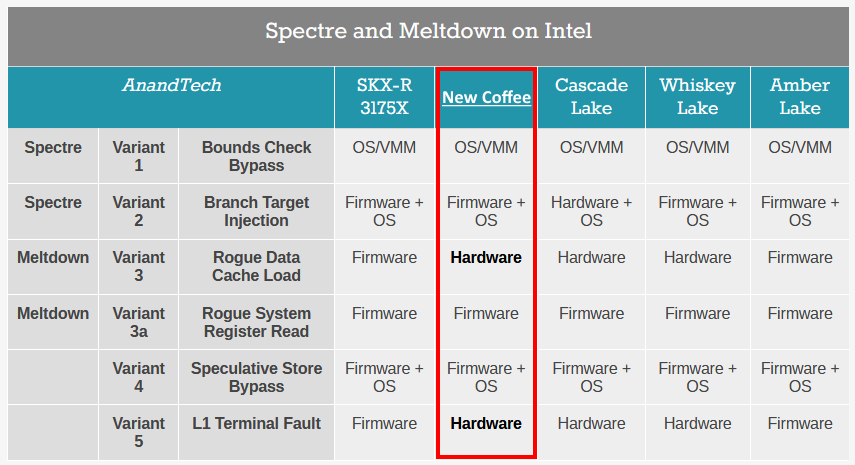
Curious that you ask, because I have searched several sites, and in none of them have I seen which part of the vulnerabilities are patched. It was supposed that the 1 of meltdowd and spectre should, but it is not known if these would already have the new instructions implemented. I don't think so, because these micros are not designed overnight, and from memory, it was in the whiskey lake (or something like that) that they were going to modify it:
https://www.anandtech.com/show/13301/spectre-and-meltdown-in-hardware-intel-clarifies-whiskey-lake-and-amber-lake
https://www.tomshardware.com/news/whiskey-lake-mitigations-in-silicon-intel,37723.htmlBut I have no idea about these. It may be that this increase in speed is due to the fact that they need to cover the loss of performance of the firmware-level patches. We will see in the coming days, that we will start to see tests. I don't know if there was an NDA on the tests, but we will soon know. That or that someone from the forum gets hold of one of these micros and runs the tests.
-
-
Thanks for the link :thumbsup_tone1:
Intel i5 3570k / ASRock Z77 Extreme 4 / G.Skill F3-12800CL9D-8GBRL / Sapphire HD5850 / Samsung HD103UJ / TR TrueSpirit / NZXT Source 210 / OCZ ZS550W
Intel i5 4570 / ASRock H87 Pro 4 / 2x G.Skill F3-14900CL8-4GBXM / Samsung 850 EVO 250Gb + ST1000DM003 + ST2000DM003 + HGST HDS723020BLA642 + Maxtor 6V250F0 / CM Seidon 240M / Zalman MS800 / CM MWE 550
AMD Ryzen 7 1800X / B350 / 2x8GB Samsung DDR4-2400 CL17 / NVIDIA GTX 1070 8GB / SSD 120GB + ST4000DM004 + ST6000DM003 / EVGA Supernova 650 G2 -
@fassou Thanks to you for working on the table, I am very lazy :rofl:




Hello! It looks like you're interested in this conversation, but you don't have an account yet.
Getting fed up of having to scroll through the same posts each visit? When you register for an account, you'll always come back to exactly where you were before, and choose to be notified of new replies (either via email, or push notification). You'll also be able to save bookmarks and upvote posts to show your appreciation to other community members.
With your input, this post could be even better 💗
Registrarse Conectarse