The 8-core Zen could appear in February
-
Initially planned for the end of this year, AMD's top-of-the-line desktop microprocessors could finally go on sale in February, although the company has not yet confirmed this.
Toda la actualidad en la portada de Hardlimit
Mis cacharros -
This is looking good. I hope it doesn't fall by the wayside and that AMD doesn't forget about those of us who use Linux, although I know they are trying to improve that point.
-
In fact, AMD has gone from being the worst option for graphics cards for Linux to one of the best in terms of support. Intel is getting worse by now requiring proprietary firmwares that not all distros include. Nvidia continues with its monstrous drivers that give good performance but nobody knows what they do.
AMD has released AMDGPU with which it has divided the graphics driver into two parts: a free one for 2d graphics (desktop, effects, and other) and a proprietary part for 3d graphics from which open options are starting to emerge thanks to the large amount of documentation it has published.
That's for modern graphics. For older models, things have also become interesting thanks to the published documentation. According to some benchmarks, the free drivers for HD7000 and earlier offer superior performance to the proprietary ones.
And all this without counting the great contributions it is making to open source such as this or this.
Except for one, all my PCs are Intel and that one has a C-60 with such poor performance that I get tired of using it. Since my Athlon XP 2000+ I have not had a main PC with AMD.
It is likely that the boring x86 world will get excited again in the coming months.
Toda la actualidad en la portada de Hardlimit
Mis cacharros -
Yes, I have experienced Intel firsthand with some low-power Celerons, which run horribly on Linux and are surprising on Windows.I have two AMDs, the one from the AM1 platform that I didn't have the guts to run properly with a couple of distros and the K6-2, hehe. In the PC for everything, I haven't used any since the Athlon 64 x2 4850e... and I want the next time to make me doubt between one and the other, Intel and AMD.
-
But the funniest thing is that they are bringing them out to compete with the Kaby Lake! :fuckyea:
As cobito has mentioned, the comeback that AMD is making is remarkable.
It has gone from being the bastion and resource of the low cost "hooligans" (and some misguided ones), to the busty blonde that everyone wants to take to the garden; and all in one go.It is also true that the "good" Zens (the Ravens) will come out later; with their support for HBM (which we will see what happens with) and their GPU based on GCN 4.0 (this is not official, but it is like the banana riddle) will be the favorite Christmas gift next year; but I have no doubt that the "Summits" will dominate sales as soon as the first reviews come out, in a direct showdown with the boosted version of the Skylakes.
We will see what happens with all this but for now, "let's see, things are heating up". :ugly:
Edit: Before you think it, no. I am not an AMD "fanboy".
!

-
I think ZEN will close the gap but it won't get anywhere near closing the huge distance that separates it from Intel right now.
For starters, the manufacturing process used of 14nm FinFet is inferior to Intel's 14nm... in fact, it's equivalent to Intel's 22nm, only a little better.
The reason is that Intel has a 3.5 year advantage and you can't close that in 2 days:
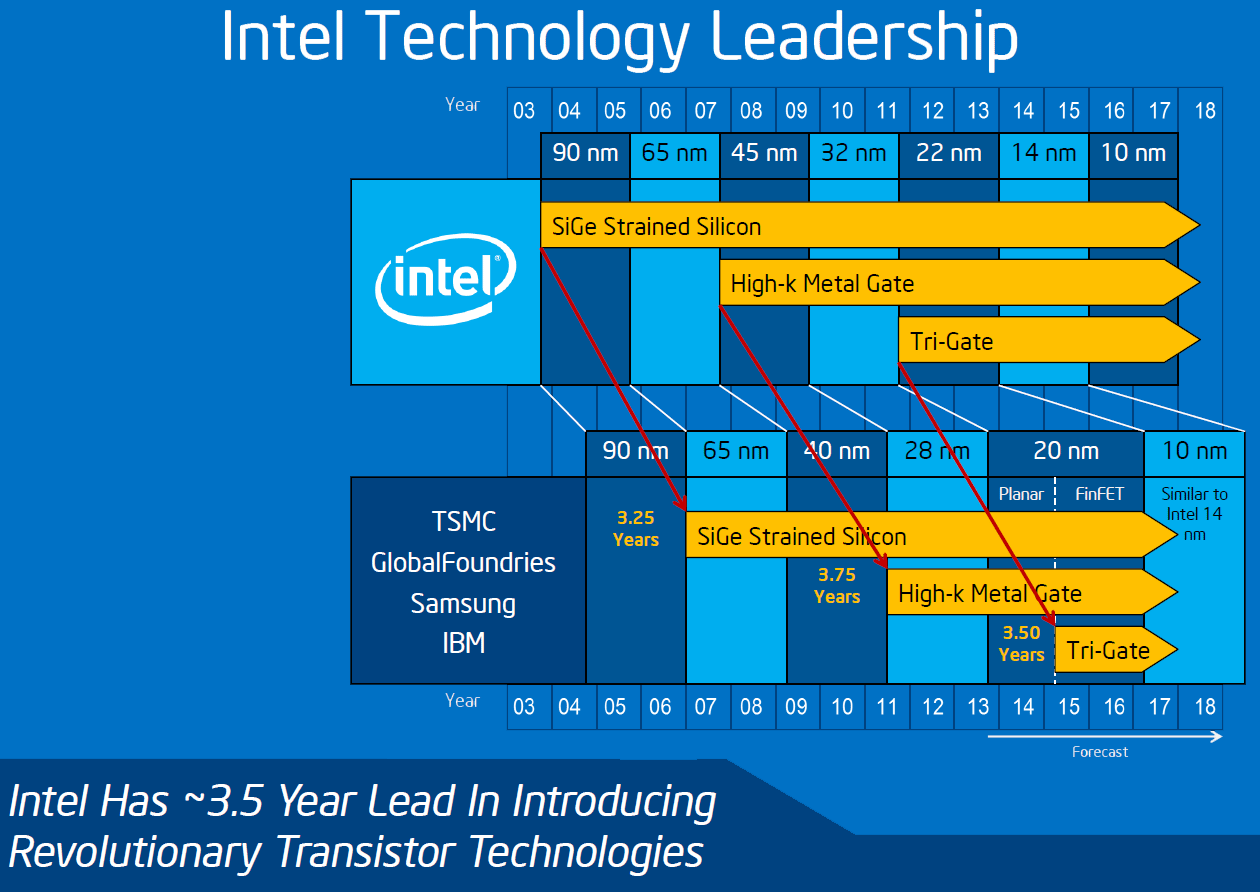
An advantage that allows them a higher yield per wafer than their competitors, which means not only more powerful chips but also higher dividends for their investors, in addition to a greater capacity to invest in being more competitive:

On the other hand, Intel has already been manufacturing for 3 generations with 14nm... Broadwell (which were a disaster), Skylake (which are currently killing it) and Kaby Lake (coming out in December)... and I'll tell you more because by 2017 they'll be hitting the ground running with 10nm:

Kaby Lake, besides being polished Skylakes with 2-3% more IPC, scale up 10% more without increasing TDP... which is amazing.
With all this, AMD may pull out some top-of-the-range multi-tasking micros with 8 cores (16 threads) that are very cool but unfortunately in games and many normal applications, the performance per core will continue to be a bit poor without surpassing Haswell.
That is to say... if you're looking for a lot of multitasking power, they may be an interesting option against Intel's top range, which has prohibitive prices, but if you're looking for power per core (games or applications that don't accept more than 2-4 execution threads), AMD won't even touch the nuts there.
They've been obsessed with putting many cores since they released the FX line (even at the cost of lowering IPC) but common software is not only not optimized, but in many cases it's not possible to use multitasking... so why do you need so many cores?... it's not that it gets me so many points in the chorramark2055... so it's better... okay, that's clear :facepalm:
Perhaps the only good thing is that they're going to skip 10nm and go directly to 7nm for 2018... the idea is to create a processor with 48 cores and 96 threads... a crazy idea.
We'll see what happens in the end but honestly, that 40% improvement won't be enough from my point of view and I don't see the strategy of putting many cores because it hasn't worked for them... besides, if it were as simple as putting many cores, Intel wouldn't bother to increase IPC between 3 and 10% in each generation and on top of that, increase Mhz.
-
Before they can outperform anyone, they will have to get closer, and it seems that fortunately AMD is starting to get back into the game

Even if only so that Intel does not lift its foot again in improving performance between generations, we are interested in AMD not being too far behind.
Salu2!
Intel i5 3570k / ASRock Z77 Extreme 4 / G.Skill F3-12800CL9D-8GBRL / Sapphire HD5850 / Samsung HD103UJ / TR TrueSpirit / NZXT Source 210 / OCZ ZS550W
Intel i5 4570 / ASRock H87 Pro 4 / 2x G.Skill F3-14900CL8-4GBXM / Samsung 850 EVO 250Gb + ST1000DM003 + ST2000DM003 + HGST HDS723020BLA642 + Maxtor 6V250F0 / CM Seidon 240M / Zalman MS800 / CM MWE 550
AMD Ryzen 7 1800X / B350 / 2x8GB Samsung DDR4-2400 CL17 / NVIDIA GTX 1070 8GB / SSD 120GB + ST4000DM004 + ST6000DM003 / EVGA Supernova 650 G2 -
Well, any competition will be welcome. People who bought an Intel 2500K - 2600K years ago still have a very competent computer thanks to Intel's few advances. Which is good, because it means you don't have to change your computer every few years, but it's also bad, because it advances more slowly, and the development that has been seen in graphics, for example, has not been equivalent to the development in micros, although they are different technologies and are not comparable.
In my case, I have had Intel almost always, except for the current micro, an FX 8350, because it was on sale; but I think I still have a few years before I need to change my micro, because honestly, for the use I give to the computer, I have more than enough. But I understand the frustration of those who use the computer to work, or simply like to be at the cutting edge, of seeing the few advances of recent years.
So if AMD manages to come out with a micro that performs not too far from Intel, it will be good for the market, because AMD has been selling the same thing for years.




Hello! It looks like you're interested in this conversation, but you don't have an account yet.
Getting fed up of having to scroll through the same posts each visit? When you register for an account, you'll always come back to exactly where you were before, and choose to be notified of new replies (either via email, or push notification). You'll also be able to save bookmarks and upvote posts to show your appreciation to other community members.
With your input, this post could be even better 💗
Registrarse Conectarse