Debunking the myth of the thermal paste on Ivy Bridge S1155
-
I believe that we should once and for all settle the issue of the thermal paste used in Ivy Bridge S1155 (3570K, 3770K and their variants).
To begin with, we all know how much of a stir it caused when it was discovered that Ivy Bridge processors ran excessively hot when overclocked. All the blame was placed on the TIM that Intel uses between the HIS and the core.
After seeing some tests conducted by users of Anandtech, in my opinion the myth of the thermal paste has been debunked.Everyone said that the culprit for the high temperatures in Ivy Bridge was the low-quality TIM... in fact, it's quite the opposite, it's a good quality paste, on par with the TIM of Noctua (NT-H1)
This is the link to the thread where he demonstrated his tests:
AnandTech Forums - View Single Post - Delidded my i7-3770K, loaded temperatures drop by 20°C at 4.7GHzThe test consists of recreating the processor measurement with the IHS attached with the black adhesive that we see in an Ivy Bridge when it's open, along the edges.
Here he shows us the measurement of the processor without opening the IHS, in its original state.

Then, he removes the lid, eliminates all traces of the black adhesive, creates a gasket with paper and simulates the thickness of the processor.
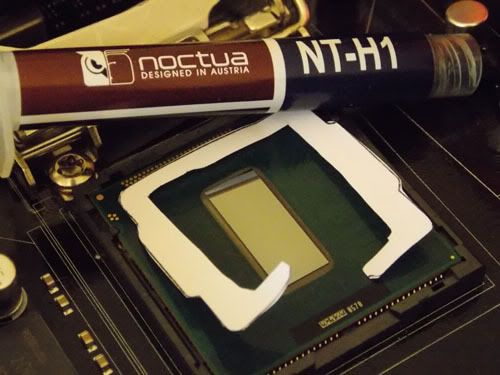
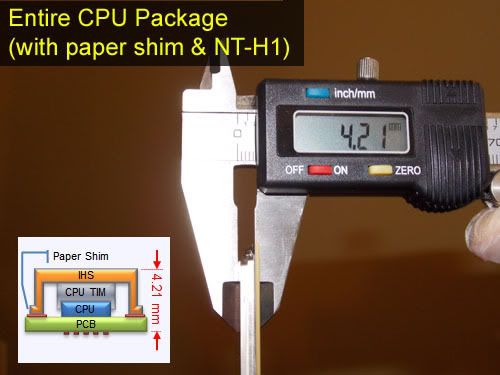
The results he obtained:
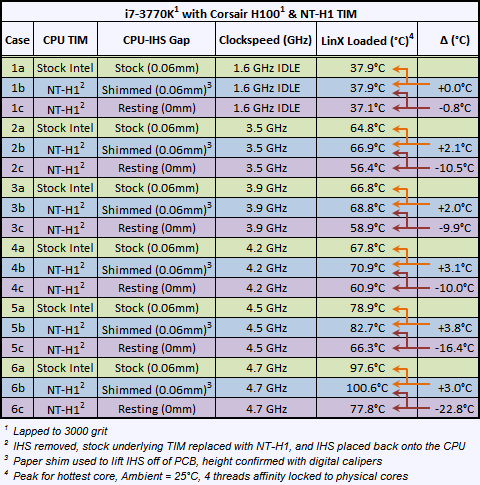
According to these results, the conclusion reached is that the TIM is not to blame for the poor thermal performance of overclocked Ivy Bridge processors. Rather, it could be said that the reason is the poor pressing of the IHS onto the DIE. What is happening is that the black, gummy adhesive leaves a space between the IHS and the core, which is what causes the paste to lose its effect.
Courtesy ANANDTECH FORUMS
-
If the problem wasn't the thermal paste, it's the DIE that is very small and doesn't dissipate well, because the contact surface is very small.
Maybe applying paste manually will improve the temperature a little, but it's because manufacturers put a blob of paste, but it's because of the small DIE they have.
There's no problem by default, the problem comes with OC and with more voltage that can't dissipate well.
Although maybe it's also the IHS, because Intel has a reputation for having some warped IHS or that don't make good contact.
regards
-
They should do like AMD/nVidia on their GPUs, put a metal frame around the edge of the CPU so that when you put the heatsink on the die doesn't get damaged and leave the die exposed, instead of covering everything with an IHS. -
They should do like AMD/nVidia on their GPUs, put a metal frame around the edge of the CPU so that when you put the heatsink the die doesn't get damaged and leave the die exposed, instead of covering everything with an IHS.
Well I don't like the DIE like that exposed, CPUs use very beastly heatsinks, what they should do is make the IHS well, make sure they make good contact, anyway the ivies are CPUs like those for laptops, that is, Intel maybe doesn't even adapt them anymore, just like the 2011 are for servers or workstations, it seems that Intel has adapted little the processors to desktop computers, let's see if with Haswell they do it better.
regards
-
The DIE in the open is not very secure, it's fine for OEM but not for sale. I thought the issue was strange and I would never remove the IHS unless I was going to make the oc very strong, but it could also be that the paste was not so good in the first units... Still, it would be very strange because the cost of the paste for Intel has to be very low.
-
I think we should finally settle the issue of the thermal paste used in Ivy Bridge S1155 (3570K, 3770K and their variants).
I don't remember anyone in this forum commenting on the poor quality of the paste contained in the IHS, but rather the fact of using paste instead of being soldered as in the previous Sandy Bridge.
Regards!
Intel i5 3570k / ASRock Z77 Extreme 4 / G.Skill F3-12800CL9D-8GBRL / Sapphire HD5850 / Samsung HD103UJ / TR TrueSpirit / NZXT Source 210 / OCZ ZS550W
Intel i5 4570 / ASRock H87 Pro 4 / 2x G.Skill F3-14900CL8-4GBXM / Samsung 850 EVO 250Gb + ST1000DM003 + ST2000DM003 + HGST HDS723020BLA642 + Maxtor 6V250F0 / CM Seidon 240M / Zalman MS800 / CM MWE 550
AMD Ryzen 7 1800X / B350 / 2x8GB Samsung DDR4-2400 CL17 / NVIDIA GTX 1070 8GB / SSD 120GB + ST4000DM004 + ST6000DM003 / EVGA Supernova 650 G2 -
The DIE exposed is not very safe, it's fine for OEM but not for sale. I thought the issue was strange and I would never remove the IHS unless I was going to make the OC very strong, but it could also be that the paste was not so good in the first units... Still, it would be very strange because the cost of the paste for Intel must be very low.
That's why I was saying, I've already fried some processor that didn't have IHS when tightening the heatsink, although in the new graphics cards they have a metal top that wouldn't let you tighten much, but I still feel more confident with an IHS.
I don't remember that in this forum, anyone commented on the poor quality of the paste that contains the IHS, but the fact of using paste instead of being soldered as in the previous Sandy Bridge.
Salu2!
Source : Ivy Bridge LGA1155 calentorros - HardLimit
It must be said by other websites, where it was recommended to change the thermal paste, but the problem must be a very small DIE and an IHS that doesn't make good contact with the DIE.
saludos
-
That's why I was saying it, because I've already fried a few processors that didn't have an IHS by tightening the heatsink, although in these new graphics cards they have a metal stop that wouldn't let you tighten it much, but I still feel more confident with an IHS.
Of course, it's that the Pentium III copermine/tualatin and all AMD up to the K8 had the die exposed but with nothing to stop it apart from 4 crappy little legs:

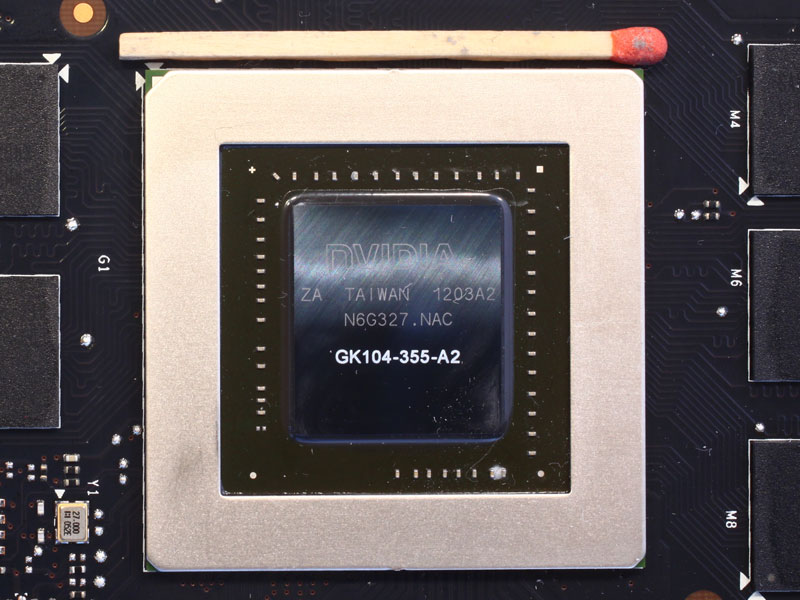
But current GPUs have the metal edge so that even if you tighten the heatsink a lot you can't damage the die, and look that at least nVidia has sold GPUs with IHS (See the G80, GT200..), but currently they sell them exposed and with the metal edge:
-
The DIE is what it is, it can't be changed. It's true that the Sandys came with a kind of solder (a joke for those who wanted to remove the IHS je) and the Ivys come with paste as was typical before, I suppose precisely because in this type of micro that consumes very little and has margin up to more than 100 degrees they didn't see it as necessary. Normally when temperatures tend to skyrocket it's when increasing the vcore and these micros go up well to a point, from there you have to raise the voltage a lot, those who want to push them to the limit would have to remove the IHS, which with the Sandys you couldn't do... Anyway, every cloud has a silver lining, or the other way around...
I think the uproar came because people often don't know how to control temperatures, sometimes they don't even know the real temperature of the micro and they see in the speed fan 80 degrees and think that it's going to burn and it turns out that maybe the micro is at 70 degrees and it's going like crazy. Although this is speculation that I have Sandy

-
Sure, the Pentium III copermine/tualatin and all AMD up to K8 had the die exposed but with nothing to stop it apart from 4 crappy pins:
But current GPUs have the metal edge so that even if you press the heatsink hard you can't damage the die, and look that at least nVidia has sold GPUs with IHS (See the G80, GT200..), but currently they sell them exposed and with the metal edge:
I've fried an AMD K7 Thoroughbred like that, trying to tighten the heatsink, it just died, then the last Nvidia series from the G80 had IHS, the ones that don't have it are the kepler, anyway I feel more confident with the IHS because it won't be as sensitive to thermal paste, if applied well it's harder for something to happen, because with the die exposed you have to be more careful with the thermal paste you apply.
Regards
-
Without a doubt, if the IHS is well mounted and aligned, I prefer IHS; otherwise, serve them naked and we save ourselves the DIY to correct their incompetence :ugly: I still have nightmares with the FX-55 that I ruined by removing the IHS :facepalm:
-
Uh I didn't know that lol, I only took it off my P4 when I changed my computer and it wasn't easy, but I hated the AMDs that you could see the corners peeling off :@
Anyway, the more secure the micros are, the better, I was happy when they removed the pins, I'd rather fry a micro due to overvoltage than anything physical





Hello! It looks like you're interested in this conversation, but you don't have an account yet.
Getting fed up of having to scroll through the same posts each visit? When you register for an account, you'll always come back to exactly where you were before, and choose to be notified of new replies (either via email, or push notification). You'll also be able to save bookmarks and upvote posts to show your appreciation to other community members.
With your input, this post could be even better 💗
Registrarse Conectarse