Hardlimit test bank
-
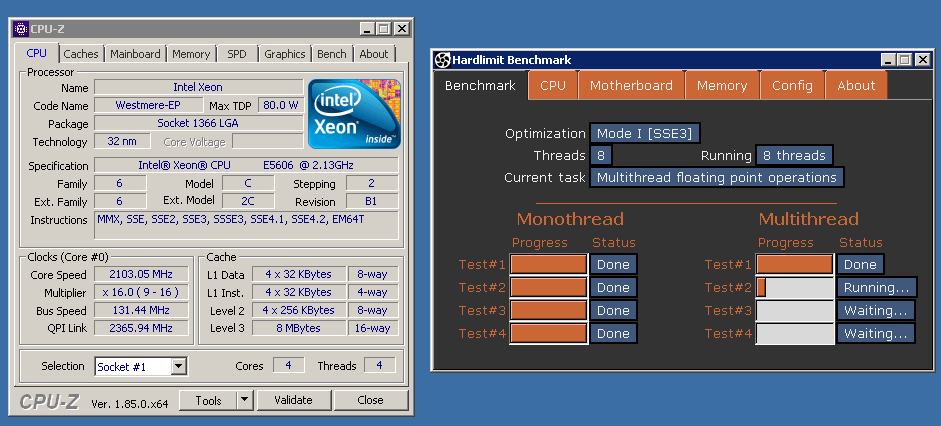
I've run it again and took a screenshot while it was running, I really haven't seen it go over 2105Mhz.
-
@krampak Thanks for the info. I'll have to add a fix for that particular model.
Toda la actualidad en la portada de Hardlimit
Mis cacharros -
@krampak brought us a few models a few days ago and once again, a bug has been exploited although this time from the central that is noted for when the new season of changes returns.
The first one is an i5-2300. It is a 2011 micro with 4 cores and no HT. Removing the 2xxx series from the comparison, its multi-thread performance is similar to the 7200-U which only has 2 cores although it is a year and a half newer. As for single-thread performance, it looks like the i3-6006U also from a couple of years ago.
Another model is the i3-3220 of which there is only one result in AVX. There is no particularly interesting comparison because there are quite a few models from its fifth. It is an Ivy Bridge of 2 cores with HT.
The latest novelty is a Pentium G3220, a Haswell of which there are no comparisons because the two results apparently were sent with the micro clocked at 3.2GHz when the stock frequency is, according to Intel, 3GHz without turbo.
Toda la actualidad en la portada de Hardlimit
Mis cacharros -
For the first time in just over a month, we have received a new CPU once again, from the hand of @krampak. When I saw the model, I thought "umm, how strange". Then I went to create the entry and lo and behold, I couldn't complete it with the current structure of the database. And all because it has a level 4 cache! Well, it is an i5-5675R, a Broadwell from 2015 of which we have received tests in all modes. As I have no idea what this series is about, I had to search San Google. The first thing is that it seems to be a desktop CPU. It comes in a BGA package so it should come soldered on a board although I have seen that they sell (sold) it separately. To finish this paragraph, it has an Intel Iris Pro Graphics 6200 integrated GPU that allows resolutions of up to 4k. Well, looking at one of the validations, it seems that it comes from a Mac, specifically a 21.5-inch Retina 4K iMac from late 2015. I suppose that explains some of the strangeness. But in order not to lose the reader's interest, I will return to mention that which has made the database obsolete: its 128Mb level 4 cache. It is something that I had never seen before and that I imagine will be an external memory to the chip. Looking a little more, it seems that this cache has received the commercial name of "Crystal Well" and indeed it is in an independent die from the CPU although it goes in the same package. The thing is that it is a memory used by both the integrated GPU framebuffer and the CPU. Regarding performance, it is similar to the i5-8250U and the i7-4790K. Basically they are three micros from different eras and intended for very different purposes but in summary it can be said that with its 65W it has reached the 88 of the 4790K and that without HT, it has almost reached the 8250U being the latter two years younger (although with a TDP of only 15W). In summary, it is one of the most interesting validations received in quite some time, difficult to compare and with some rather exotic characteristics.Toda la actualidad en la portada de Hardlimit
Mis cacharros -
@cobito Correct! it's an iMac retina that arrived at work with BootCamp and which I didn't hesitate to use to run the test
 By the way, are you messing around with the comparator? I was about to enter a hard drive but I get screen options instead of drives.
 -
@krampak said in Hardlimit test bench:
By the way, are you messing with the comparator? I was about to enter a hard drive but I get screen options instead of drives.
Yes but you should be able to choose whether to add a screen (I still don't recommend it, that's why I haven't said anything) or a hard drive. That is, there are two tables: one above for hard drives and another below with the screens.
Toda la actualidad en la portada de Hardlimit
Mis cacharros -
We have two new micros: a Xeon from @krampak and a Celeron from @Namiga. The latter has actually been in the back room for 10 days, but I had forgotten about it.
The Celeron is a 3855U, which is a Skylake from late 2015. Being a Celeron and part of the U series, you can't expect great achievements and indeed, you have to go to Core 2 Duo to see similar micros in FPU. But this one has something special and it is that although it doesn't have recent sets like AVX1/2, its SSE3 performance exceeds expectations after seeing the performance in the most basic mode. And here, it is comparable to an i7-860 in single-thread, a somewhat old CPU but mid/high range.
About the Xeon, it is a E3-1220 v3. It is a somewhat older micro; from 2013. It is a Haswell with 4 cores that practically matches the performance of an i7-4720HQ. Considering that the latter is a portable CPU with half the TDP and only 2 years newer, the Xeon doesn't seem too spectacular. It is also true that we are comparing a basic Xeon with the top of the range of Intel's portable CPUs.
Toda la actualidad en la portada de Hardlimit
Mis cacharros -
@krampak brings us back a couple of fairly recent processors and both are very similar.
The first one is an i5-8500; a Coffe Lake from 6 months ago. It has 6 cores without HT and runs at 4.1Ghz. The most similar is another recent CPU (although not as much): the i7-7700. Basically they have the same TDP and go to almost the same frequency. But the Coffee Lake has 6 bare cores and the Kaby Lake has 4 with HT. In essence, the evolutionary improvement seems to be in AVX2 where the i7-7700 seems to puncture in front of the i5-8500 only in multithread. Probably because that performance per extra MHz is getting it thanks to HT and this one doesn't go so well with more complex repertoire.
The other is an i5-8500T, the low-power twin brother of the previous one. Comparatively speaking, with a TDP of 30W less and a frequency reduced 600Mhz, the performance per MHz almost matches in both (same architecture and same cache) while the efficiency of the T series surpasses the i5-8500 by quite a bit.
Toda la actualidad en la portada de Hardlimit
Mis cacharros -
@cobito said in Banco de pruebas Hardlimit:
@krampak brings us back a couple of fairly recent processors, and both are very similar.
The first one is an i5-8500; a Coffe Lake from 6 months ago. It has 6 cores without HT and runs at 4.1Ghz. The most similar is another recent CPU (though not as recent): the i7-7700. Basically, they have the same TDP and go to almost the same frequency. But the Coffee Lake has 6 bare cores and the Kaby Lake has 4 with HT. In essence, the evolutionary improvement seems to be in AVX2 where the i7-7700 seems to puncture against the i5-8500 only in multithreading. Probably because that performance per extra MHz is getting it thanks to HT and this one doesn't do as well with more complex repertoires.
The other is an i5-8500T, the low-power twin brother of the previous one. Comparatively speaking, with a TDP of 30W less and a frequency reduced by 600Mhz, the performance per MHz is almost the same in both (same architecture and same cache) while the efficiency of the T series surpasses the i5-8500 by quite a bit.
I think I remember that in the 8500T it gave me a better result in SSE3 than in AVX, can that be? I repeated it several times and it came out the same.
-
Hello again, I was able to make a symbolic entry of a 9900k, but it gives me an error with the entry of the 7980XE.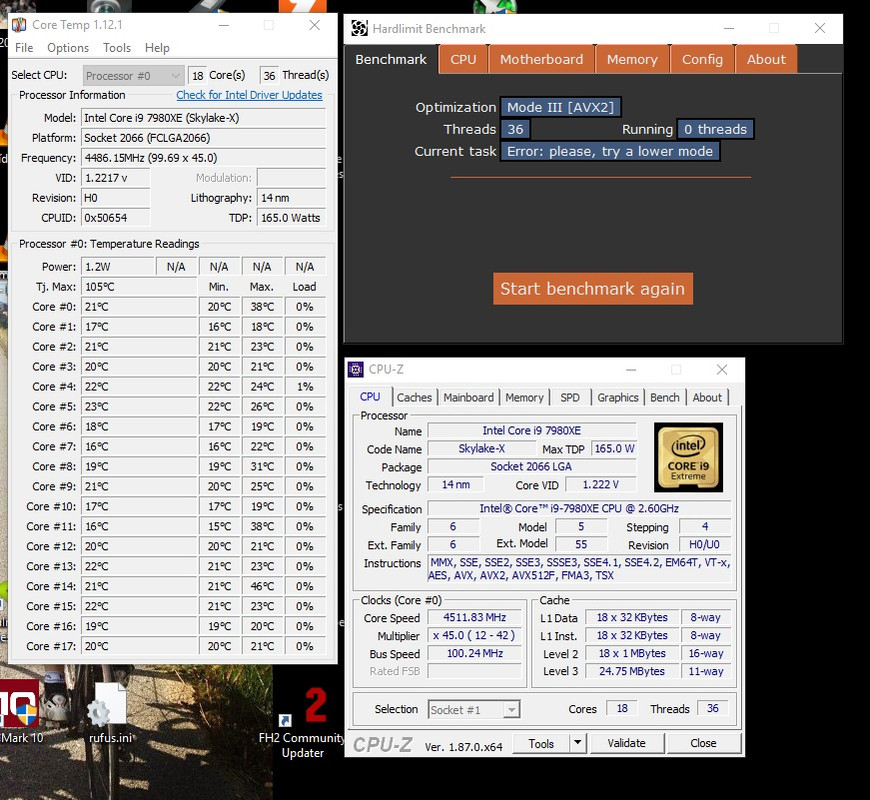
-
@xevipiu I'm going to have to set aside a few days to get my hands on the test bench :man_facepalming_tone1: Maybe I'll have to do something with the comparator, because this can't be.
You yourself reported that bug a while ago. The problem is that there is a limit of 32 threads. If you run those 32 threads (or 18 even, to evaluate each core separately), it should work.
By the way, thanks for continuing to feed the database.
Here is the datasheet for the i9-9900K that I see you've overclocked to 700MHz. Since it's overclocked, there are no comparisons, but doing a quick calculation, it would be number 1 of all the micros registered at stock frequency. I'm surprised that with that number of cores, that frequency and offering that performance, it has a TDP of "only" 95W.
Toda la actualidad en la portada de Hardlimit
Mis cacharros -
@cobito said in Hardlimit test bench:
@xevipiu I'm going to have to reserve a few days to tinker with the test bench :man_facepalming_tone1: Maybe I have to do something with the comparator, because this can't be right.
That bug was reported by you a long time ago. The problem is that there is a limit of 32 threads. If you run those 32 threads (or 18 even if it's to evaluate each core separately), it should work.
By the way, thanks for continuing to feed the database.
Here is the datasheet for the i9-9900K that I see you've overclocked by 700MHz. Since it's overclocked, there are no comparisons, but doing a quick calculation, it would be number 1 of all the micros registered at stock frequency. I'm surprised that with that number of cores, that frequency and offering that performance, it has a TDP of "only" 95W.
You will never get the real TDP. To start with, Intel gives 95w in its technical sheet as a reference, but in truth this amount can vary a lot depending on the base plate or the same VID of the processor.
Yes, that 9900 has delid and lappind on the same DIE

-
I have already posted the results of the 7980XE at only 4.5Ghz capped at only 16 cores + HT
-
@xevipiu said in Hardlimit test bench:
I have already posted the results of the 7980XE at only 4.5Ghz capped at only 16 cores + HT
When you say you have capped at 16 cores + ht do you mean that in the test bench you have manually configured 32 threads or that you have disabled 2 cores of the processor?
In any case, @Xevipiu has brought us a beast born a year and a half ago. And with this, it breaks the million-point barrier for the first time.
It is the i9-7980XE, an 18-core, 36-thread Skylake with more than 1Mb of L1 cache, 18 megs of L2 cache and 24 megs of L3 cache. With this obscene amount of resources, at stock speed it has reached 1,200,000 points in multithread, which is almost triple that of the second in the queue.
In single-thread its performance seems ridiculous in comparison, but the reality is that it is in the top5 of all registered CPUs, very close to the first which is the i7-8700k.
The comparison is impossible except in single-thread and as I said, in this case it is one of the most powerful registered.
Toda la actualidad en la portada de Hardlimit
Mis cacharros -
Correct, I have disabled two of the physical cores that give me more problems
Today I received the 40p hole to be able to lap the DIE, as it has a convex surface of the DIE, no matter how much I do the delid, there is little improvement in temperatures, especially I have two cores that spike in temperature.
By the way, the test passed at 4.65Ghz at 1.23v with two of the cores at 102º (at 105º the thermal protector acts)
[b]Delid Direct[/b]
[i][b]x299[/b][/i]
[center][img]https://i.postimg.cc/nc6C7199/1.jpg[/img][/center][center][img]https://i.postimg.cc/v8KBFvz2/2.jpg[/img][/center]
[center][img]https://i.postimg.cc/W1L1tbxM/3.jpg[/img][/center]
[center][img]https://i.postimg.cc/FRR9wfJQ/4.jpg[/img][/center]
[center][img]https://i.postimg.cc/SxhY3rQF/5.jpg[/img][/center]
[center][img]https://i.postimg.cc/bYSGvMsf/6.jpg[/img][/center]
[b][i]For the 4/5/6/7/8/9 series [/i][/b]
[center][img]https://i.postimg.cc/pV40T9Vs/MSI-direct.jpg[/img][/center]
[center][img]https://i.postimg.cc/JnyNVqXM/Hielo-CPU-Opener-Protector-Delid-Die-para-LGA115X-para-Intel-CPU.jpg[/img][/center]
[url=https://es.aliexpress.com/item/Hielo-CPU-abridor-abierto-Protector-de-la-cubierta-de-Delid-morir-para-LGA115X-para-Intel-CPU/32858889426.html?cv=47843&af=358162&aff_platform=aaf&mall_affr=pr3&cpt=1542529725642&afref=&sk=VnYZvQVf&aff_trace_key=86aa289337064a34a537bd7912d68b2c-1542529725642-07505-VnYZvQVf&dp=d4c6ba8922752d89b0d23ffbe9212627&terminal_id=9e40d863efaf4ff0af0090ace35179df]Direct Direct on Aliexpress 4/5/6/7/8/9 series[/url]
[url=https://www.caseking.de/en/der8auer-skylake-x-direct-die-frame-fsd8-021.html]Skylake-X Direct Die Frame[/url]
[url=https://es.aliexpress.com/store/product/Delid-Die-Guard-Cover-Protector-IceMan-Cooler-Intel-LGA-2066-CPU-X299-CPU-Opener-Support-7820/3518027_32884067927.html?spm=a219c.search0604.3.10.68ac5e0a0x4nU2&ws_ab_test=searchweb0_0,searchweb201602_4_10065_10068_10547_319_10891_317_10548_10696_10924_453_10084_454_10083_10927_10618_10920_10921_10922_10307_10820_10301_10821_10303_537_536_10059_10884_10887_100031_321_322_10103_5727015_5727515-5727015,searchweb201603_51,ppcSwitch_0&algo_expid=43e16902-b123-49d1-936d-4bf052793d82-1&algo_pvid=43e16902-b123-49d1-936d-4bf052793d82]Aliexpress Direct Die Frame[/url]
..[b]Lapping DIE[/b]
[img]https://i.postimg.cc/wBg4pSxH/portada.jpg[/img]
[center][img]https://i.postimg.cc/bwTWszBd/distancia-1.jpg[/img][/center]
[center][img]https://i.postimg.cc/26fZMDCF/lapping-2-mini.jpg[/img][/center]
[center][img]https://i.postimg.cc/KvnvpMRV/Laping-3.jpg[/img][/center]
[center][img]https://i.postimg.cc/T3f2z3bP/lapping-3-extender.jpg[/img][/center]
[center][img]https://i.postimg.cc/mk7Rnv2M/lapping-4.jpg[/img][/center]
[center][img]https://i.postimg.cc/m2r88QXZ/lappng-5.jpg[/img][/center]
[center][img]https://i.postimg.cc/T13qN6cN/lapping-6.jpg[/img][/center]
[center][img]https://i.postimg.cc/x13GQ8Fp/distancia-2.jpg[/img][/center]
Intel 8088 7.15Mhz, 512Kb RAM, CGA 4coleretes, HD 10Mb
-
Do you still have the 9900k @Xevipiu? it would be good to pass the test to the serial frequency so that it appears in the table
-
@krampak said in Hardlimit Test Bench:
Do you still have the 9900k @Xevipiu? it would be good to run the test at the stock frequency so it appears in the table
Yes, it's the one I'm posting now, then I'll post it at stock
Tomorrow I'll do the lapping on the 7980XE
Now I'm going to deal with the paperwork for my new GT Turbo Phase1 xD
-
I have already posted the results with the processor fully in stock
-
@xevipiu The truth is that they are interesting results. Comparatively speaking, the closest processor found is the Ryzen 7 2700X. As usual, AMD scores in AVX2 but at the lowest mode, Zen has a slight advantage over Coffee Lake.
The base frequency of both is similar as well as the cache, the number of cores and the HT/SMT (although, the Ryzen has double the L2 cache than the i9). The 5GHz boost frequency doesn't seem to help much for Intel's micro compared to AMD's 4.3Ghz since the single-thread performance differences are not very noticeable. In fact, in AVX2 those extra 700MHz are doing absolutely nothing.
For optimized software, the Ryzen gets 25% less performance so in games and other, the i9-9900K is clearly superior to the 2700X. Here it is important to know what the micro will be used for. If it's for a server, for example, Zen is probably the best option. If it's for gaming, video editing, rendering... Coffee Lake is superior without a doubt.
Considering that the i9 costs double the Ryzen 7, it seems that Intel hasn't come out with a very competitive CPU this time.
Toda la actualidad en la portada de Hardlimit
Mis cacharros -
The differences are in the architecture, the AMDs go up to 4.3/4.35Ghz is their physical barrier, while the Intels have no limit :women_wrestling:
Today I have raised the 7980XE again after Lapping on its DIE, I have lost some small transistor, but it works perfectly
 image url)




![https://i.postimg.cc/nc6C7199/1.jpg[/img][/center]](https://i.postimg.cc/nc6C7199/1.jpg%5B/img%5D%5B/center%5D)
![https://i.postimg.cc/v8KBFvz2/2.jpg[/img][/center]](https://i.postimg.cc/v8KBFvz2/2.jpg%5B/img%5D%5B/center%5D)
![https://i.postimg.cc/W1L1tbxM/3.jpg[/img][/center]](https://i.postimg.cc/W1L1tbxM/3.jpg%5B/img%5D%5B/center%5D)
![https://i.postimg.cc/FRR9wfJQ/4.jpg[/img][/center]](https://i.postimg.cc/FRR9wfJQ/4.jpg%5B/img%5D%5B/center%5D)
![https://i.postimg.cc/SxhY3rQF/5.jpg[/img][/center]](https://i.postimg.cc/SxhY3rQF/5.jpg%5B/img%5D%5B/center%5D)
![https://i.postimg.cc/bYSGvMsf/6.jpg[/img][/center]](https://i.postimg.cc/bYSGvMsf/6.jpg%5B/img%5D%5B/center%5D)
![https://i.postimg.cc/pV40T9Vs/MSI-direct.jpg[/img][/center]](https://i.postimg.cc/pV40T9Vs/MSI-direct.jpg%5B/img%5D%5B/center%5D)
![https://i.postimg.cc/JnyNVqXM/Hielo-CPU-Opener-Protector-Delid-Die-para-LGA115X-para-Intel-CPU.jpg[/img][/center]](https://i.postimg.cc/JnyNVqXM/Hielo-CPU-Opener-Protector-Delid-Die-para-LGA115X-para-Intel-CPU.jpg%5B/img%5D%5B/center%5D)
![https://i.postimg.cc/wBg4pSxH/portada.jpg[/img]](https://i.postimg.cc/wBg4pSxH/portada.jpg%5B/img%5D)
![https://i.postimg.cc/bwTWszBd/distancia-1.jpg[/img][/center]](https://i.postimg.cc/bwTWszBd/distancia-1.jpg%5B/img%5D%5B/center%5D)
![https://i.postimg.cc/26fZMDCF/lapping-2-mini.jpg[/img][/center]](https://i.postimg.cc/26fZMDCF/lapping-2-mini.jpg%5B/img%5D%5B/center%5D)
![https://i.postimg.cc/KvnvpMRV/Laping-3.jpg[/img][/center]](https://i.postimg.cc/KvnvpMRV/Laping-3.jpg%5B/img%5D%5B/center%5D)
![https://i.postimg.cc/T3f2z3bP/lapping-3-extender.jpg[/img][/center]](https://i.postimg.cc/T3f2z3bP/lapping-3-extender.jpg%5B/img%5D%5B/center%5D)
![https://i.postimg.cc/mk7Rnv2M/lapping-4.jpg[/img][/center]](https://i.postimg.cc/mk7Rnv2M/lapping-4.jpg%5B/img%5D%5B/center%5D)
![https://i.postimg.cc/m2r88QXZ/lappng-5.jpg[/img][/center]](https://i.postimg.cc/m2r88QXZ/lappng-5.jpg%5B/img%5D%5B/center%5D)
![https://i.postimg.cc/T13qN6cN/lapping-6.jpg[/img][/center]](https://i.postimg.cc/T13qN6cN/lapping-6.jpg%5B/img%5D%5B/center%5D)
![https://i.postimg.cc/x13GQ8Fp/distancia-2.jpg[/img][/center]](https://i.postimg.cc/x13GQ8Fp/distancia-2.jpg%5B/img%5D%5B/center%5D)