AMD Ryzen 7000 (Zen 4)
-
@defaultuser said in AMD Ryzen 7000 (Zen 4):
@clipper well, it seems that some are more limited in terms of how much you can tighten them and would have a little less pressure even if they are touching.
But it distracted me, the truth is, what Der8auer was saying was also something about the anchors I don't remember, those that come with their own backplate can cause problems with the new AM5 mounting system, some will have to buy the adapter kit, and others will make the necessary piece
If I show you the anchor I made for the Armageddon for am4, without means without place in the worst conditions, let's say like stark kidnapped but without shots jjj, you would laugh, but here it is solving the problem.
PD: The AM5 socket now has 8 holes, and its backplate also since it must allow the mounting of the heatsink, but it must also fix the CPU mounting plate. This means that AM4 heatsinks that come with their own backplate can no longer use it directly, and if you leave the AMD one, the heatsink screws may not be the same thread or may not meet the same dimensions as in their original mounting.
The clip-on ones don't work directly since the plastic support for the clips has disappeared.The only thing that matches is the distance between holes, everything else has to be checked carefully, and many of those who are not into modding will have to buy an adapter or a new heatsink.
Regards.
Oh, that they do keep the famous clip, my mistake!!!
They keep it to make things a little easier I imagine. -
@kynes I'm really happy to read you here
 I totally agree with what you're saying, I was actually imagining this these days. But it's hard to accept that for an i5/Ryzen 5, which is mid-range, they ask for 300-400€ keeping in mind that these were processors that used to be around 180-250€. I know everything has gone up in price, we can't look at last year's prices with this year's, but with the economy the way it is, people can't afford it. Besides, if we always go through the hoop, we'll end up paying 600€ for a "normal" CPU any day. Anyway, we'll have to wait for the sales and especially if the law of supply and demand works, which is usually something that puts prices in their place. The same thing happens with GPUs, now it's hard for stores/wholesalers, users and miners to sell them, people aren't buying and there's nervousness on the part of Nvidia and AMD that they have to sell the pending stock. It's crazy!!
@fassou said in AMD Ryzen 7000 (Zen 4):
This wouldn't happen if manufactured in Europe
The 7600X looks good, but new motherboard, DDR5 that better not pay for the novelty that are still expensive, graphics cards that much better but what a joke that is too. Playing on PC is for the rich!

Cheers!
We're in a somewhat "complicated" time, unfortunately the economy is very affected and nothing looks good... and on top of that in the east things are getting harder and harder. I won't complain, because there are people who are having a hard time, but I do think that they have turned the world of PC for those of us who like to tinker and/or play, into something that's getting more and more expensive. But if you look at consoles... it's laughable, because either there's no stock or the price they ask for a PS5 is mind-blowing.
Anyway, the best thing will be to wait for prices to normalize, but if by some chance they go up more in price, then there's nothing left to do but continue with what we have!
@clipper said in AMD Ryzen 7000 (Zen 4):
I don't think it's necessary to start from scratch to switch to the new AMD.
After all, we only need the basics:
Micro
Motherboard
RAM ddr5
SSDs are backward compatible (we won't have the same performance but... It's not essential in the second mn2 either)
About the R.L they say they use the same socket as the 4 series.
And the one with more or less we have a decent F.A to support the new platform.
If we get into a new GPU Corsair has announced a new cable compatible with their "old" F.A (high-end) so that wouldn't be a problem either.
RegardsBut most of what a PC costs is in the CPU-Motherboard and Memory. I wouldn't even include the GPU, since if we count people who don't play, they wouldn't need it. And about cooling... as I'm reading, it's better to have a good system with that much more € than if you didn't already have it.
But anyway, if one can't afford to switch to AM5, they can always opt for an Intel Gen15 or a Ryzen 5000 that certainly continue(and will continue) to give a great battle!! -
@_neptunno_ from what I have read, AMD has abandoned Intel's XCM profile and opted for its own. The problem is that from what I read on another site, DDR5 RAM on AMD will be automatically capped if you install 4 modules.
For most people (32 gs) this is not a problem, but for those who want to install 64 gs...
It will be expensive.
Regarding the integrated graphics, from what I read, it was so that in specific cases you could continue using the PC if the external graphics card fails.
But personally, I consider it an extra cost on the motherboard if you don't plan to use it (most cases)
In my particular case, I doubt it would be useful for gaming and less for work. Since the files I move in AutoCAD with rendering and so on would be moved by an integrated one.
For a PC for calculations, it may be more viable.
Regards -
@clipper said in AMD Ryzen 7000 (Zen 4):
@_neptunno_ from what I've read, AMD has abandoned Intel's XCM profile and opted for its own AMD profile. The problem is that according to what I read on another site, DDR5 RAM on AMD will be automatically capped if you install 4 modules.
For most people (32 GB), this doesn't pose any problem, but for those who want to install 64 GB...
It will be expensive.
Regarding the integrated graphics, from what I read, it was intended to allow you to continue using the PC in specific cases if the external graphics card fails.
Personally, I consider it an unnecessary expense on the motherboard if you don't plan to use it (in most cases)
In my particular case, I doubt it would be useful for gaming and less for work. Since I move files in AutoCAD with rendering and so on, an integrated one would move them.
For a PC for calculations, it may be more viable.
Best regardsThere are differences between the two systems, you have to look at the final result. These don't cap your speed when using 4 modules, what happens is that from what they get maximum with 4, they are then able to improve it more when there are only 2 (normal)
You will have to look at the final results but AMD's idea is to be able to improve the use of RAM for its specific architecture using its own specific performance profiles, and adding new functionalities (if the news were correct) such as being able to have different latencies per module, and they will surely be more squeezed and utilized than if they continue to use XMP which is not optimized for their current architecture or for advances they have achieved in its use and which are not possible with XMP.
Supposedly AMD seeks to gain in latencies and not so much in bandwidth, and that "capping" to 4 modules would have to be looked at closely to see what result it really gives and in what parameters it really moves (it could even be dynamic), so look at empirical and synthetic tests.
-
@clipper For me, the graphics card uses between 10 and 12 watts in total rest, I don't know what a pepinon will do in rest. And in small tasks, like the browser or maps, those things that do at reduced frequencies, there is almost certainly more consumption than if the integrated one does it, and more so from within the I/O and without using any more bus.
Moreover, before the integrated meant a reduction in capabilities and now it is integrated in the base design considering all maximum capabilities plus the graphics from the beginning.
It is a premium price for those who strictly seek the maximum price/performance ratio in the micro with a separate graphics card, but it is still interesting because:
If the dedicated one breaks; nothing happens. You are not left stranded, and you can look for a new one with much less stress.
If the dedicated one gives you problems; you don't waste time checking why the PC restarts or strange things, the relevant checks would be much easier and it would take you much less time to solve the problem.
Assuming that the dedicated one turns off completely when it is not necessary, there must be an energy saving to take into account, at least for those who do not use the dedicated one 100% of the time, and the more powerful the dedicated one, the greater the saving.
Considering the failure rate of VGA, the average life of these, and the cost they represent, I don't dislike the idea that it is turned off when it is not necessary, and I will consume its life expectancy by making it sweat in frantic skirmishes

You can take out the dedicated one, for a mod, to put a block on it,....even to clean it.....and while you can use the PC.
You can take advantage of a very good selling opportunity, without having to wait to have the new one listed to start. Yes, without gaming in the meantime, but it is feasible.
The day you renew the platform, if it coincides that the dedicated one you have is a gem that you don't want to replace, if you want you can sell your complete equipment directly with the integrated one, which is more comfortable and faster than selling pieces.
I don't have a commission jjj but it just seems more interesting to me like this, well as long as the integrated one is limited to the power for office work, multimedia and the usual chores. Because if they insist on wanting to stand out with the capacity of the integrated one what they do is exacerbate the point that they are more expensive, and that they take away available current for the rest of the CPU.
-
MSI shows its B650 motherboards, price from 200 for the most basic to 330 for the most advanced
-
Well, looking at the glass as half full, someone might be using the two M2 Gen5 X4 slots associated with a 670's cpu right now to test a RAID0 with two of those fast drives.
For fun, or for a review. -
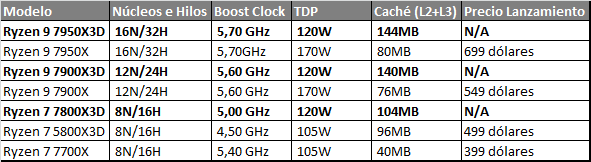
AMD announces the AMD Ryzen 7 7800X3D, Ryzen 9 7900X3D and Ryzen 9 7950X3D (CES 2023):Finally, AMD has officially presented the processors that succeed the Ryzen 7 5800X3D. The latter managed to position itself as an optimal processor for gaming above all, and now it is the turn of the Zen 4 processors with an extra of cache memory. The leaks spoke of a performance increase of 30% thanks to the second generation of V-cache memory.
The processors presented today are the Ryzen 7 7800X3D, Ryzen 9 7900X3D and Ryzen 9 7950X3D. The top-of-the-range model is the AMD Ryzen 9 7950X3D, with 16 cores and 32 threads with up to 5.7 GHz of boost speed in single core. The TDP is 120 Watts with 144 MB of L2 + L3 cache.
AMD claims that it is up to 24% better than the Intel Core i9-13900K in gaming. We will have to wait for independent benchmarks, but it seems that AMD will surpass the flagship Raptor Lake in gaming performance.
The AMD Ryzen 9 7900X3D comes with 12 cores and 24 threads, with 140 MB of cache in total, with 5.6 GHz boost and TDP of 120W. The Ryzen 7 7800X3D comes with 8 cores and 16 threads and a TDP of 120W with 5.0 GHz boost.
These processors will be available in February, with a price that has not yet been confirmed.
Source: N3D.
AMD Ryzen 7 7800X3D vs Ryzen 7 5800X3D: first performance test of a Ryzen 7000X3D

The Ryzen 7 7800X3D was compared to its predecessor, the Ryzen 7 5800X3D and, in the best case, the new CPU offers 30% more performance. On average, the improvement is 24%.
Source: El chapuzas informatico.
-
"This performance difference was only compared in eSport titles where it is vital to run them at a Full HD (1080p) resolution to get the highest number of FPS. With these performance improvements, the extra cost of the platform can be justified, and that is the most basic model of the new range. "
El Chapuzas InformaticoThat is, the percentage increase in frames at 1080p in games with low graphic load.
They don't mention the graphics card, but you can imagine it.
At first, just looking at the values they seem tampered with, of course these are the specific test conditions to get the biggest difference in frames, it's not an average of what you'll find.Even so, extrapolating, on average it will still be a cucumber.
-
@defaultuser said in AMD Ryzen 7000 (Zen 4):
"This performance difference was only compared in eSport titles where it is vital to run them at a Full HD (1080p) resolution to get the highest number of FPS. With these performance improvements, the extra cost of the platform can be justified, and that is the most basic model of the new range. "
El Chapuzas InformaticoThat is, the percentage increase in frames at 1080p in games with low graphic load.
They don't mention the graphics card, but you can imagine it.
At first, just looking at the values, they seem tampered with, of course, these are the specific test conditions to get the biggest difference in frames, it's not an average of what you'll find.Even so, extrapolating, on average, it will still be a cucumber.
As a certain Galician singer said:
They sell us things we don't need, but they sell us that we need them...
90% of people don't need 16 cores, much less 32, let's not even talk about RAM but here we are.
They sell us motherboards of the latest generation with RAID support.
But better not do it (with mn2) because the disappointment is big, proven on my own skin.
But we keep buying things "better"
Regards -
@clipper Huffff the ram no creas, the annoyance is that when you zoom in you multiply X2 if or if, 32 excessive, but 16 just right

Ryzen 5 3600 - Tuf B550 pro - 2x 8g 3600c18 - Strix rtx 2060 - M2 1TB
-
@defaultuser Too bad about triple channel... How well it was going for these things

-
@defaultuser I have colleagues who talk about expanding to 64 gs of RAM...
And I said to them, why? And note that I have 64 gs, but I change them for 32gs at a higher speed.
It's the same old story.. -
@clipper yes but, while you are far from occupying it all, when you are close the understanding gap between fast filled and slower but very full of space starts to close.
In games while you have mnve disk and you do not get excessively close to filling the ram it is worth holding on to fast memories, but later there will come a time when even those gamers who hold on with 16gB will have to configure the system to maintain the situation, and it will start to become necessary 32gB for the majority. -
The AMD Ryzen 9 7900X3D and 7950X3D only have 3DV-Cache in one of the two chiplets
AMD presented the new Ryzen 7000 series with extra L3 cache known as 3DV-Cache and with it three processor models such as the 7800, 7900 and 7950 with the X3D suffix.
As we can see in the announcement, the total amount of cache memory (L2+L3) is left at 104 MB for the Ryzen 7 7800X3D (8 MB L2 cache + (32 +64) MB L3 cache) while the Ryzen 9 are configured with a total of 140 MB and 144 MB instead of the supposed 204 MB and 208 MB respectively. After noticing this detail, two possibilities opened up, that the two high-end models had half the 3DV cache in each chiplet or the theory that has ended up prevailing when seeing AMD's official high-quality images: only one of the two chiplets will have that extra stacked cache.
Thus, the Ryzen 9 7900X3D will have 12 MB of L2 cache, 32 MB of L3 cache in each chiplet and then the 3DV module on top of the first chiplet that adds 64 MB of L3 cache, thus adding up to 140 MB of total cache. For its part, the Ryzen 9 7940X3D adds a total of 144 MB by adding 2 MB of L2 cache for each extra core.
It is assumed that adding 3DV-Cache to both chiplets would raise costs for an increase in performance that is difficult to appreciate and in practice, the games or applications to which they are directed do not use so many cores and it is expected that said tasks are executed by the chiplet with that extra L3 cache while the rest of the cores can be dedicated to lightening the load of the first one taking care of the rest of the necessary aspects of any team.
Thus, the management of loads in the two chiplets by the Operating System will be vital for this to work properly. That is something that at this point should not be very complicated seeing that we have already carried years with AMD chiplets where it was prioritized that an entire game was executed by a single CCD and more recently with Intel's hybrid architectures that debuted with Alder Lake. It is more than likely that AMD's recommendation to get the most out of these processors will be to use Windows 11.
Another doubt that has not yet been resolved is the reason why AMD has not given the working frequency on all threads with the AMD Ryzen 7 7800X3D, but we have days to discover that data.

Source: N3D.
When they come out in February we will see how their performance is and above all how they will be priced. Right now the one that would fit me would be the 7800X3D, but if I could I would go for the 7900X3D “for fun, not out of necessity".
What I do think is that it would be a good top seller a 7600X3D. I imagine it won't be profitable for AMD or it will be difficult to implement.
Greetings!!
-
@_neptunno_ said in AMD Ryzen 7000 (Zen 4):
What I do think is that a 7600X3D would be a good top seller. I imagine it won't rent to AMD or it will be difficult to implement.
Right now it would be wild cannibalism, or it would have to have an inappropriate price (too expensive).
Later, with a supposed batch of zen4 being sold, maybe something like this would have room, in a similar line to the F and AF.
But I do think it would be the unicorn of users with limited budgets in general, or at least gamers and a good part of professionals. -

Source: overclock3d.net
-
This will be the serious release date....
Ryzen 9 7950X3D, February 28 - $699.
Ryzen 9 7900X3D, February 28 - $599.
And the Ryzen 7 7800X3D is delayed to April 6 - $449
-
And lisa recommends using an AIO of at least 240 mm for cooling, she does not recommend using conventional heatsinks.
Some pseudo "computer experts" have been up in arms...
Saying that many people do not know how to maintain an AIO.
Maybe mine is an odd case, but it has no maintenance option .
.
Best regards -
@clipper said in AMD Ryzen 7000 (Zen 4):
And Lisa recommends using an AIO of at least 240 mm for cooling, she does not recommend using conventional heatsinks.
Some pseudo "computer experts" have been up in arms...
Saying that many people do not know how to maintain an AIO.
Maybe mine is an exception, but it does not have a maintenance option.
RegardsHaha, I know something about that. There's one who makes an entire video rambling on the subject, only to conclude at the end that the manufacturer doesn't provide either o-rings or liquid refill.
The line where it's worth reading is getting further and further away, and the usual media crossed an embarrassing line a long time ago.
Even Google is selling positioning to anyone without running their proprietary antivirus, and for some time now, the top positions of their search engine have been filled with ransomware.For more specific topics, you should go to well-known foreign websites, even if you have to use a translator.




Hello! It looks like you're interested in this conversation, but you don't have an account yet.
Getting fed up of having to scroll through the same posts each visit? When you register for an account, you'll always come back to exactly where you were before, and choose to be notified of new replies (either via email, or push notification). You'll also be able to save bookmarks and upvote posts to show your appreciation to other community members.
With your input, this post could be even better 💗
Registrarse Conectarse