Raspberry Pi
-
I have wanted to buy one for a long time. I think it's a very interesting gadget that could replace many functions of a PC emule. In addition, the pins for connecting low-level peripherals are very practical for me when connecting microcontrollers and so on.
Out of curiosity, how is the operating system installed? Can it be installed on a hard drive instead of on the SD card? Can any operating system compiled for ARM be installed?
Toda la actualidad en la portada de Hardlimit
Mis cacharros -
Ah, perfect then, I will ask among friends for a group order, although without haste, of course.
-
I've wanted to buy one for a while now. I think it's a very interesting gadget that could replace many functions of a PC emule. Also, the pins for connecting low-level peripherals seem very practical to me when connecting microcontrollers and such.
Out of curiosity, how do you install the operating system? Can it be installed on a hard drive instead of on the SD card? Can any operating system compiled for ARM be installed?
Right now you have to install it on the SD, although then you can use a USB drive to store things which is what I do.
Regarding the OS, I understand that if the OS is compiled for ARM it could work, but there are some official images of Debian and Arch, which are specifically designed for the Raspberry Pi. I use raspbian (raspbian.org) which is currently the most up to date.
It can replace an emulePC as you say, but with certain limitations. The main drawbacks I see are:
- Just enough RAM: It only has 256 MB. For a Linux CLI only it can work, but when you add X things are more limited
- Shared USB/NETWORK chip: We are having some problems with the number of P2P connections and USB. They will probably be fixed in the future with some new firmware.
But it has its advantages:
- Very low consumption: 5V/700A
- No noise at all
- Very small size
- More than acceptable performance for the price
Regards
-
-
Ummm, the limitation of the number of connections is a problem although I am sure that over time it will be solved via software. The issue is that I have been doing things with the ATMega328P using the arduino bootloader for a while and the Raspberry would be perfect for doing certain tasks whose complexity cannot be addressed by a microcontroller such as obtaining a sound of certain quality or access to the network with all the functions and protocols that one wants. On top of that it is TTL which guarantees electrical compatibility.
Surely one will fall in a matter of one or two months.
Toda la actualidad en la portada de Hardlimit
Mis cacharros -
hello. well, here's my little contribution to this interesting topic.
what alternatives do we have to the Raspberry pi B? well, I'll detail that below.
Via APC
FXI Cotton Candy
MK802
BeagleBoard
Mele A1000
initially I did this in word but in the copy paste it came out as crap, so here's a picture.

best regards -
I think an Atom board has many more possibilities than a more advanced ARM-based platform, the consumption is a bit higher and the price is similar and even quite lower compared to some alternatives you've shown.
The interesting thing about Raspberry Pi is the size, the consumption and the price. If any of those things are sacrificed, at least for me, it ceases to be interesting. The RasPi is already the cheapest and as for the price, it's not very succulent either because between the board and an 8gb card (the minimum to function), the joke mounts up to about 65€ and let's not even talk if we want an independent power supply from a PC, but well.
Toda la actualidad en la portada de Hardlimit
Mis cacharros -
I believe from my ignorance (and note that I am about to buy the Rapsberry Pi (B) which you need to use it:
the board (for the sake of it, right?)
the power supply (not included. but if you have a mobile charger or similar with mini usb output that gives 5v and e W it works (the 3w are maximum peaks according to the manufacturer) otherwise 5 to 9 euros
the SD card I haven't looked much just this 5.10
an SD card reader on the PC (necessary to install the S.O.) this same 10.76
now, option A and B
option A I plan to use via monitor keyboard etc add a HUB and possibly an HDMI cable
option B I plan to use via ethernet, you need a router plus the cable.
result that comes out really expensive I almost think the VIA APC or the MK802 are better ¿more expensive? yes undoubtedly but in both you save having to buy many "accessories" for example the MK comes with EVERYTHING
the VIA APC is also not bad, maybe its biggest flaw is the size, but it's not that big and it's quite balanced. APC
regards -
more toys for Rasoberry pi
RasPiComm – a Raspberry Pi piggyback board 1/2 « Daniel Amesberger
regards -
If you're a regular on this website, you'll be familiar with this name. Gert van Loo, a fine chap and a thoroughly decent bloke, designed the original alpha hardware that the Raspberry Pi Model B is based on. Many of you will be aware of the Gertboard, a little desk add-on designed by Gert for the Raspberry Pi, that extends the Raspberry Pi's GPIO pins and allows you to interface with the outside world.Gertboard is now available exclusively through element14 (UK link) - you should be able to find it on your local element14 website. For Singapore and other Asia-Pacific countries please order here, for Australia please order here, for the USA please order here.
Gertboard (left) and a Raspberry Pi - Photograph courtesy of element14
If you want to use the Raspberry Pi to drive motors to open doors, lift things, or power robotics, if you want to sense temperature and switch devices on and off, if you want to blink lights, and if you want to teach it to play the glockenspiel, or if you want to learn about electronics from scratch, then the Gertboard is for you. (This is the stuff I'm talking about when I blither on about physical computing here.) It comes with an assembly manual and a user manual (both of the above are direct download links to PDFs), which also act as a couple of teaching guides, included with lots of programs that show you how to put things together.
Gertboard is packaged as a kit. It doesn't come pre-assembled, you'll have to solder it together yourself. Soldering is easy, as we've said before (seriously - if you can solder, so can you), and we encourage you to have a go. If mistakes are made they are easy to correct, and once you've finished building your Gertboard you'll have a very useful piece of hardware, a new skill, and a lovely warm sense of achievement.
Gertboard is not an official Raspberry Pi Foundation product, but it's designed and produced by someone who is at the heart of the Foundation, it fits the Foundation's goals perfectly, and it's endorsed wholeheartedly, we hope to see lots of kids using it as a learning platform alongside the Raspberry Pi. Go to a presale now (lead times should be short), they're only €30, and I predict it's going to go like hot cakes.
-
Hello,
I came to recommend this to you:
I have it (this other version) and for things that do not require sound or video, I think it is a better option than a Raspberry Pi, as it is even cheaper, smaller and integrates wifi. OpenWRT works great.
-
Hello,
I came to recommend this to you:
I have it (this other version) and for things that do not require sound or video, I think it is a better option than a Raspberry Pi, as it is even cheaper, smaller and integrates wifi. OpenWRT works great.
Blessed are the eyes.
Toda la actualidad en la portada de Hardlimit
Mis cacharros -
Dichosos los ojos.
+1
Justo lo que acababa de comentar en un punto verde
Todo un placer leerte de nuevo tilt

-
-
well yes, since February 17
very expensive to read
greetings ;D -
I didn't expect that welcome! I usually just come to read, but I prefer not to write if there's nothing to contribute. I've seen that the website I linked to is down, so I'll leave you the ebay link, for 18€ including shipping: [http://www.ebay.es/itm/Mini-Portable-Nano-TP-LINK-TL-WR703N-150Mbps-WiFi-for-iPhone-4S-Wireless-Router-/300726391177?pt=COMP_EN_Routers&hash=item4604b09189#ht_3434wt_1186](http://www.ebay.es/itm/Mini-Portable-Nano-TP-LINK-TL-WR703N-150Mbps-WiFi-for-iPhone-4S-Wireless-Router-/300726391177?pt=COMP_EN_Routers&hash=item4604b09189#ht_3434wt_1186) @cobito: The thing is that I've been doing things with the ATMega328P for a while using the arduino bootloader and the Raspberry would be perfect for doing certain tasks whose complexity can't be handled by a microcontroller like getting a sound of a certain quality or access to the network with all the functions and protocols you want. On top of that it's TTL which guarantees electrical compatibility. Surely one will fall in a matter of one or two months. I'm using the tp-link for that... you have direct serial-ttl connectivity and even 3 gpios if you're up for soldering it and if not, for openwrt there are already drivers compiled for the most typical usb-ttl chips, as well as a version of avrdude, which allows you to program the atmegas via internet for example... needless to say that you can also plug things like usb sound cards and webcams into the router, although you can't work with video, but for 18 euros that's too much. -
-
Hello
First, I did a quick search, and I didn't get any results for "raspberry", if there is any branch out there hiding, delete this! ;D
Well, that's it, has anyone here got a Raspberry Pi?? It's not the most advanced equipment in the world, but looking for minimum space and minimum consumption, it has no competition.
I have it running 24/7 for BitTorrent, and it's going pretty well.
Here I leave you a little photo of the creature:

Cheers!
I bow to the Lego box you've made! I've been wanting to do a Lego mod for years :troll: :ugly:
Regarding the Raspberry thing, the truth is that it's not bad at all. Where did you get it? How much?
-
Very interesting, although not available yet.
While we're at it, some real open hardware:
OLINUXINO is completely open source - including hardware and software, this means you have access to all CAD files and sources and you can reuse them for your own personal or commercial project. There are NO restrictions to manufacture and sell these board for your own use or resale.
OLINUXINO use widely available microcontroller iMX233 which cost USD 5.50 in 100 pcs quantity, this means that people can spin off their own boards and manufacture them cheap as the processor is in TQFP easy to assembly by hobbyist package.
RASPBERRY PI have no released CAD files nor complete schematics, RPi uses processor from Broadcom which is not available for sale in small quantity, it uses BGA package which require expensive setup to assembly. RPi is designed to be home gadget, OLINUXINO will work in industrial environment -25+85C and will be designed to be low cost but NOISE immune.
BeagleBone have open source CAD hardware files but uses BGA processor and BB board is very complex and hard to manufacture in small quantities.
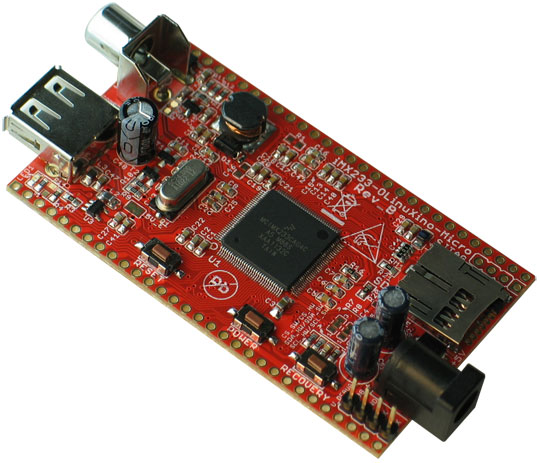
Olinuxino Micro, 24 euros:
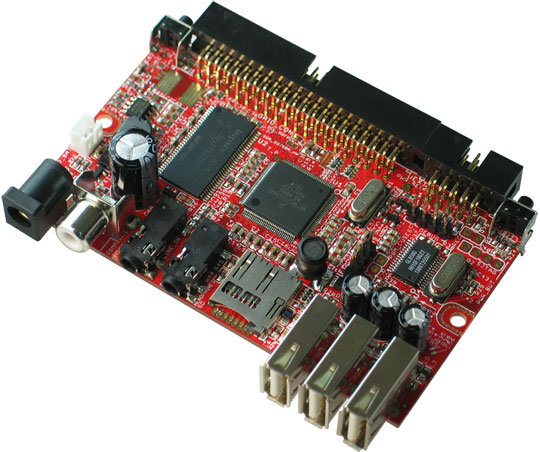
Olinuxino Mini, 35 euros, 45 with wifi or ethernet:
-
This branch is becoming really interesting. I had no idea about the existence of Olinuxino and the truth is that for implementing very specific designs, it is perfect. As for the plans being available, it is interesting as a curiosity, but it does not add anything special.
Toda la actualidad en la portada de Hardlimit
Mis cacharros




Hello! It looks like you're interested in this conversation, but you don't have an account yet.
Getting fed up of having to scroll through the same posts each visit? When you register for an account, you'll always come back to exactly where you were before, and choose to be notified of new replies (either via email, or push notification). You'll also be able to save bookmarks and upvote posts to show your appreciation to other community members.
With your input, this post could be even better 💗
Registrarse Conectarse