The transition to 10nm begins
-
When the latest 14nm innovations from the two x86 giants have not yet been released, 10nm could see the light in a few months from Samsung.
Read more...
Toda la actualidad en la portada de Hardlimit
Mis cacharros -
I don't understand it. They spend years on 28nm, avoid 22nm because it didn't give the results they expected, and when they have been only a few months with 14/16nm everyone is rushing to get to 10nm as soon as possible. There is one thing and that is that they will be 10nm with light of 193nm, so it will be a very expensive process, with multiple lithographies and with a prohibitive initial cost except for the top ranges. 14 and 28nm will accompany us for a long time yet, especially in the medium and low ranges.
You only have to see that the snapdragon 653 are still going to be manufactured in 28nm, because economically it is not viable to do it in 14nm, it would be a medium range that is too powerful and expensive to manufacture, and it would eat up many sales of the high range, where a lot of money is made.
-
@kynes It's a matter of manufacturing process patents: whoever gets it first will have as a "client" anyone who wants to do the same thing afterwards.
AMD's "partner" already announced that it would have a 12 nm technology ready for 2019, while Intel, for its part, delayed the release of 7 nm until 2022, AMD promised them two years earlier, for 2020.
What has happened for them to step on the gas and announce (the 7 nm) for 2018?
Is it a bluff to put a collar on Intel, or is it really a big challenge?
Because we must remember that GlobalFoundries is AMD's "partner"...It's really strange, because what we're used to is having to deal with all those transition technologies that only exist so that the company of the moment can amortize the investment in R&D.
But as I say, with the PC market in free fall, lately it seems there's more profit in owning the technology than in managing it.To all this, we'll have to see what performance is squeezed out of this, that it's not all about size.
-
@whoololon There is a topic and it is that what 14nm is for intel is not the same as for global foundries, tsmc, umc or samsung. Each one measures what it feels like, and that is the problem for comparison. In principle the consortium that has IBM with samsung, TSMC and global foundries should be comparable among themselves, but as we saw in the iPhone 6s, the 14nm of samsung were almost equivalent to the 16nm of TSMC.
Even within a manufacturer you have different "subprocesses" in the same size, p.ej. 14nm LPE/LPP vs HP, with very different characteristics.
-
@kynes, I don't understand the part about them having been on 14nm for a few months. I made a little graph taking the years in which Intel has changed process. I took the whole years without considering the month, but for the sake of the case, you can see the period between technologies.
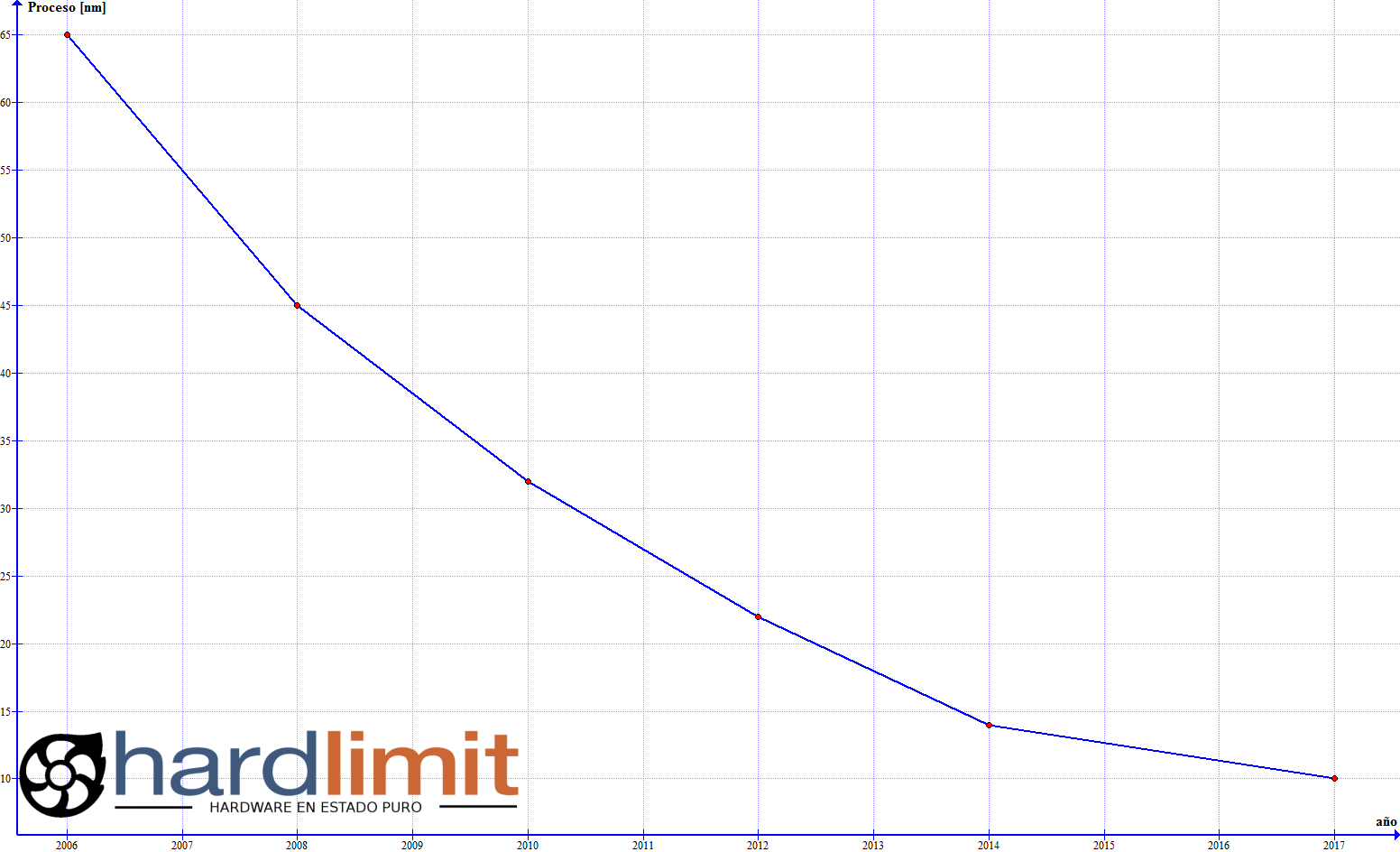
14nm is going to last a little more or less the same as the rest of the integration levels (if not more). What am I missing?
Toda la actualidad en la portada de Hardlimit
Mis cacharros -
@cobito don't focus on intel, think about everyone else. When did nVidia release its first graphics card in 14nm? This February, a tesla, with a ridiculous run. The first for mass consumption was the 1080-1070 in May, if I remember correctly. Amd still manufactures all its chips in 28nm, samsung started working with 14 nm at the end of 2015 with apple's A9...


Hello! It looks like you're interested in this conversation, but you don't have an account yet.
Getting fed up of having to scroll through the same posts each visit? When you register for an account, you'll always come back to exactly where you were before, and choose to be notified of new replies (either via email, or push notification). You'll also be able to save bookmarks and upvote posts to show your appreciation to other community members.
With your input, this post could be even better 💗
Registrarse Conectarse