AMD Zen, news and comments
-
AMD has announced that the mid-range Zen (Ryzen 5) will be released in less than a month. The confirmed models and prices are the four-core for $169 and the six-core for $219.
Toda la actualidad en la portada de Hardlimit
Mis cacharros -
Let's put another 50 € (price in store) and we are left with the RX 1500X for 220 € and the 1600X for 300 €.
The thing is that with the price drop of the Intels (the 7600K is at 250 €)... well, I don't know.
-
With all the hype, I almost threw the computer out the window to get one, but luckily I restrained myself. If I had to build a new computer, and it wasn't focused solely on gaming, I would go for one without thinking twice, but for those of us with Haswell-e / Broadwell-e, I think it's absurd.
The savings from making a change at the top of the range (1800X vs 6900X) are considerable, even more so if you pair that micro with a matching motherboard, in which, just like with the processor, you can save around 50% of the price of its counterpart for Intel (X370 vs X99).
A saving of 700€ well compensates for the differences that may be in performance, which, from what I've read, are not that many.
I leave you a new review about performance in games TOM'S HARDWARE REVIEW
-
Rumors have already come out and continue to circulate. There is talk of a 12-core and 24-thread micro and another of 16 cores at 3.6GHz. These seem more like the Xeons' counterparts, although it is not clear if they will be multiprocessor. Some compare them to the x950X, so no one is taking away the thousand or so euros.
Toda la actualidad en la portada de Hardlimit
Mis cacharros -
On top of that, they are releasing game patches that are improving, and a lot, the performance of these micros. In the end, before the year ends, we will have the real performance of these micros. Although I will continue to wait for the Raven Ridge, with the integrated APU. I am eager to see one in testing.
-
Following the same nomenclature as Intel, AMD has announced its low-end micros without much fanfare: the Ryzen 3.
Read more...
Toda la actualidad en la portada de Hardlimit
Mis cacharros -
They have been on the market for several months now and these AMD micros have proven to be a great alternative to Intel in many cases. I was thinking about stopping using the Xeon for my ITX "gamer" PC and upgrading to Ryzen, that even a Ryzen 3 1200 would be a huge leap, but for now there are very few ITX boards and none below 110€, double what some 1151 boards are worth. -
On Phoronix they have published some benchmarks of the Threadripper 1950X, the competitor of the i9 that brings 16 physical cores with SMT. It seems that in parallelizable operations, the Ryzen beats the i9 but in tasks with little use of many cores, the Threadripper lags a bit behind. Good beast after all.
Toda la actualidad en la portada de Hardlimit
Mis cacharros -
Now I have read that the latest BIOS version for the GigaByte X370 raises the default voltage to values between 1.5 and 1.7v.

The normal thing for a big grain OC on a Ryzen is something less than 1.4v, so that 1.7 is a call to disaster.
-
AMD is rumored to be releasing a Zen for servers with 64 cores SMT, 256 Mb of cache, and 128 PCIe lines. It is not known when or the price.
Toda la actualidad en la portada de Hardlimit
Mis cacharros -
In Videocardz they say that in April Zen+ (supposedly the second generation of the architecture) with 12nm lithography and higher frequency will be released.
Edited: It seems that AMD is going to make a discount on the Zen in some cases quite juicy.
Toda la actualidad en la portada de Hardlimit
Mis cacharros -
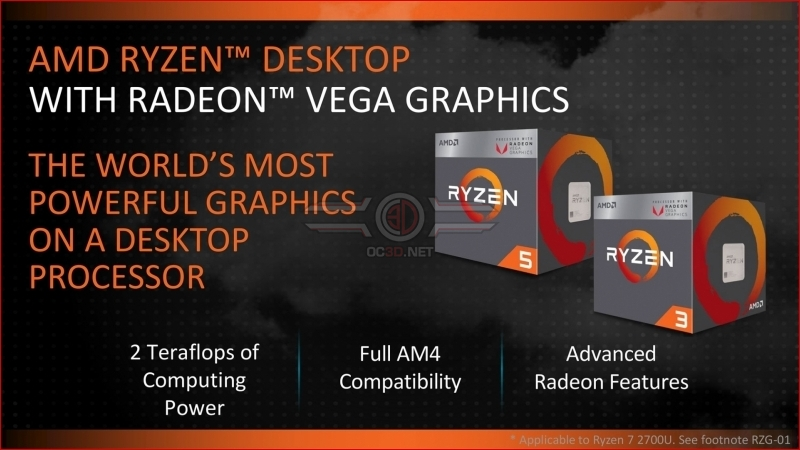
AMD has announced the G series of Ryzens which, like their Intel cousins, are a CPU+GPU tandem.
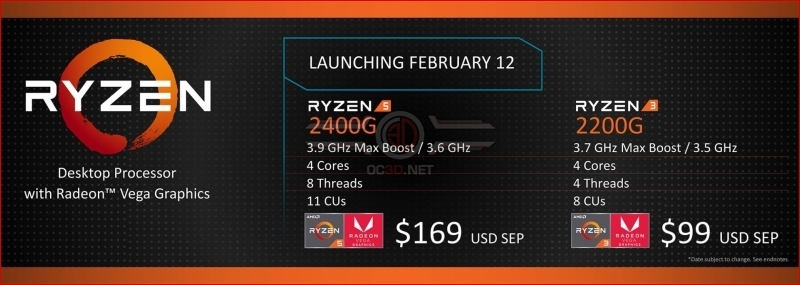
For now, there are only two models:
· Ryzen 2200G: 4 cores without SMT, 3.5GHz and GPU with 8 CUs Vega for $99
· Ryzen 2400G - 4 cores, 8 threads, 3.6GHz and GPU with 11 CUs Vega for $169It is clear that they want to compete against Intel's H series whose denomination, coincidentally or not, is quite similar to this one. The good thing for AMD is that this time they have no way of losing.
Toda la actualidad en la portada de Hardlimit
Mis cacharros -
Well!, the APUs are already showing their heads!. They look very good, although it's not for comparing the integrated graphics with an RX460.
Looking at the AMD graphics comparing with the i3-8100 (I take it as an example because I found more data about the HD630) it could be said that on average it doubles its performance, sometimes triples, sometimes only achieves about 50% more. If I take the Passmark page as a reference I could say that it approaches an Nvidia GT1030, which is not bad at all, but as I have commented halfway through what they promised. All this taking the data given by AMD with a grain of salt and waiting for independent reviews.
-
@cobito said in AMD Zen, news and comments:
The good thing for AMD is that this time they have no way of losing.
...I don't know.
Maybe it's because people now think that Intel micros explode and will go for anything AMD, but apparently, according to VideoCardz, the 2400G is an i7-6700 + GTX1030; but with the advantage that being an APU, the RAM must be as fast as possible anyway.
On paper, the H series seems to give these a good overhaul; we'll see how this crisis affects the new processors.
-
@whoololon said in AMD Zen, news and comments:
@cobito said in AMD Zen, news and comments:
The good thing for AMD is that this time they have no way of losing.
...I don't know.
I mean in the field of integrated GPUs from the entry level to the high end. Both Intel's H series and AMD's G series have AMD GPUs. And for desktops there are no Intel GPUs up to the mark or an alternative from Nvidia. Whether one triumphs over the other, AMD takes the cake.
To be honest, I'm more attracted to the i7-G although it's also true that with these two APUs that AMD has released, the H series is in a higher category.
Toda la actualidad en la portada de Hardlimit
Mis cacharros -
This post is being processed/translated. The original version will be shown:
Por aquí han publicado una lista de videos donde se ve el rendimiento del Ryzen 2200G (que por España se está vendiendo por 100€) y diría que los resultados son realmente buenos teniendo en cuenta el precio.
Esta es la lista de videos de Youtube:
:Toda la actualidad en la portada de Hardlimit
Mis cacharros -
For those 100€ the truth is that it's not bad at all. I've looked at a couple of games that I know (World of Warcraft a lot and War Thunder a little) and they put them at just over medium detail, 1080p, and they stay close to 60 fps. In the case of WoW it is true that they try out a starting area that hasn't changed much since the first expansion (Burning Crusade) and its graphic load is small. Surely in capitals with many people, raids or battlefields 40vs40 the detail would have to be lowered a lot. But as I said, for that price it is an excellent economic solution.
Another issue apart is that I still have very little in ITX AM4 motherboards and everything above 120€, so for me they are not much of an option, whether they are CPUs or APUs.
-
The second generation Ryzen processors are about to come out of the oven. The details of 4 models have been published:
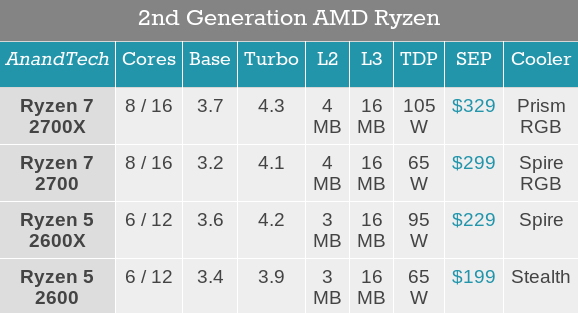
They come in 12nm and with that they have been able to turn them up a bit. Apart from that there are not many more details because AMD does not allow reviews to be published until the day of the launch (April 19). Curiously, it does allow pre-purchase.
As I took the table from Anandtech, I put a link to their entry although this is being talked about in many other places.
Toda la actualidad en la portada de Hardlimit
Mis cacharros -
This came out a few days ago and it only tangentially touches on the Zen, but here it goes. It seems that AMD is taking a very different policy with respect to Intel regarding sockets. In this entry from Overclock3d they tell us that with the Ryzen that came out in 2017, AMD committed to giving a long life to its AM4 socket. Remember that this socket came out in 2016 to house the Bristol Ridge APUs.
A few days ago they released the second generation of Ryzens that are still compatible with the boards for Zen that only need to have their BIOS updated. And it seems that they maintain that the socket will remain alive until 2020.
From that date, the arrival of PCIe 4-0 and DDR5 memory would force the company to release a new one. I think it is interesting this stance in contrast to the absurd changes that Intel has been making in recent years.
Toda la actualidad en la portada de Hardlimit
Mis cacharros -
@cobito said in AMD Zen, news and comments:
This came out a few days ago and only tangentially touches on Zen, but here it goes. It seems that AMD is taking a very different policy with respect to Intel regarding sockets. In this entry from Overclock3d they tell us that with the Ryzen that came out in 2017, AMD committed to giving a long life to its AM4 socket. Remember that this socket came out in 2016 to house the Bristol Ridge APUs.
A few days ago they released the second generation of Ryzens that are still compatible with the boards for Zen that only need to update the BIOS. And it seems that they maintain that the socket will remain alive until 2020.
From that date, the arrival of PCIe 4-0 and DDR5 memory would force the company to release a new one. I think it is interesting this stance in contrast to the absurd changes that Intel has been making in recent years.
I think Intel has had moments where it has had too many Socket changes, although in other cases it will have been forced by technical issues. But it is true that after the “famous” 775 it has been a restless butt and it has been noticed that they wanted to make people change their boards.
AMD does it very well with AM4, but it also had its moment of fame with the Socket FM1,2,2+…but I think it is good news that they decide to maintain this socket until 2020 (as long as it does not hinder performance, of course).I would love to get a Ryzen, but my current 4790K offers a lot of play and it cost me a significant amount of money to just throw myself into the pool for my current use.
Best regards!!






Hello! It looks like you're interested in this conversation, but you don't have an account yet.
Getting fed up of having to scroll through the same posts each visit? When you register for an account, you'll always come back to exactly where you were before, and choose to be notified of new replies (either via email, or push notification). You'll also be able to save bookmarks and upvote posts to show your appreciation to other community members.
With your input, this post could be even better 💗
Registrarse Conectarse