Hardlimit benchmark
-
@Xevipiu brings us a micro fresh out of the oven: a Ryzen 7 2700X.
It would have been interesting to compare it with the 1700X, but the results that exist are either from AMD or not passed under optimal conditions and have been discarded. But we have other Zens in the database that serve perfectly as a reference. For the 1800X, the 2700X is 8-10% faster, so although the difference is practically imperceptible, it is noticeable that Zen+ has improved a step compared to its predecessor. It should be noted that the change from the 0.014µm process to the 0.012µm process has allowed an increase in frequency and indeed, the 2700X runs 300MHz faster than the 1800X (although with an increase of 10W in its TDP). With this, we can conclude that in the comparison of Zen+ vs Zen, the architecture itself has not brought any improvement since the performance/frequency ratio is the same for both generations. In this aspect, it seems that Zen+ is more of a "tick" step (in Intel terminology) than an architecture change.
Continuing with the previous Zens, the 1600X is left far behind not only by generation but also by range (6 cores vs 8).
If we compare it with Intel micros, the closest one we have data for is the i7-8700, which can be said that with its 300Mhz extra over the Ryzen 7, it is barely able to outperform in single-thread in programs optimized in AVX2. With its 6 cores, it is unable to compete with Zen+ and its 8 cores in multi-thread. It is interesting to note that at this point, the performance per MHz of the Coffe-Lake (Intel's 8th generation) in AVX2 programs is considerably better than that of the second generation of Zens.
Toda la actualidad en la portada de Hardlimit
Mis cacharros -
The performance of the 2700x is terrible!
-
@xevipiu said in Hardlimit Test Bank:
The performance of the 2700x is terrible!
Do you mean it, or is it ironic?
-
@cobito said in Hardlimit Test Bench:
@namiga The problem detected is that the boost frequency is 2.6Ghz instead of the 2.8Ghz it should reach. Coincidentally (or not), those 2.6GHz is the medium load frequency, that is, when two cores are in use. I can think of two things: either there is still something consuming the core while the test bench is running, or for some reason, the CPU is unable to reach the boost frequency (high temperature, some issue with the BIOS, etc.).
To be honest, I can't think of anything you can do except take a look at the BIOS settings or check if the memory is running at the correct frequency. But I think it's too much work if it's just to send good results.
Regarding the results in these cases, they are usually reliable in multi-threaded tests. The problem is that the mon-threaded test bench was run at 2.6GHz and that is not representative of this model. That's why they are automatically discarded from the model's datasheet. In the same way, when the processor is overclocked, those results are not used to calculate the model's score but appear in a specific zero ranking for each datasheet.
Well, I haven't seen anything special in the BIOS. Just a section related to cooling, which was already set to "performance"...
I'm attaching screenshots of the computer at rest and after the test
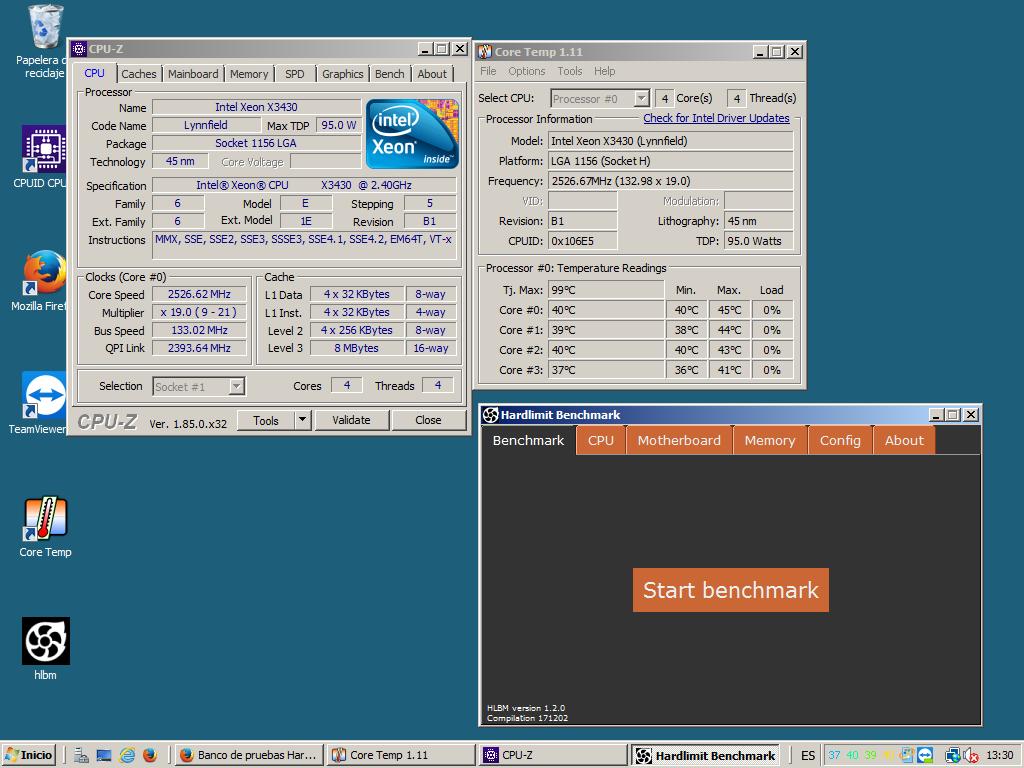
and here almost finished
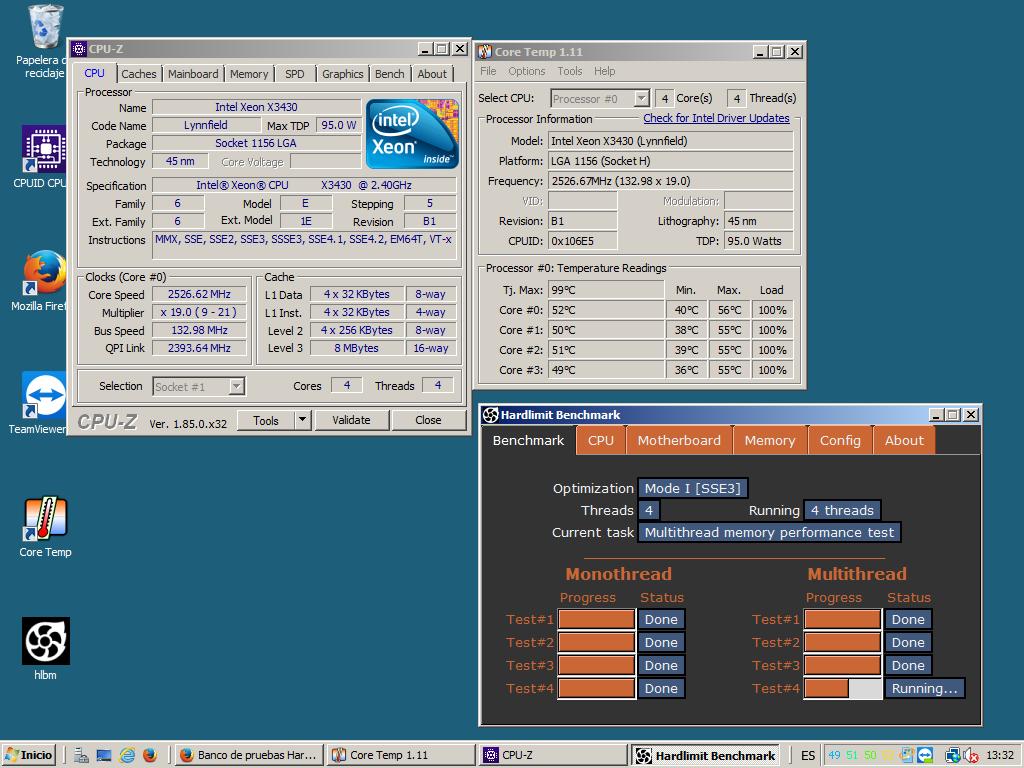
As you can see, the processor is always at 2.5Ghz... not 2.40, even when all 4 cores are at 100%...
strange... and there's no OC... it's a server ?Siempre Aprendiendo
www.namiga.es
-
@namiga Indeed, I had made a mistake. The frequency that has been measured is not 2.6Ghz but 2.56GHz (taking into account the measurement error, it is the 2.52GHz specified by Intel at full load) which is the frequency with the 4 cores occupied, not at half load as I had said.
But that is not the normal behavior of that processor. According to Intel, it should reach 2.8GHz with the use of a single core. The frequency table is as follows:
2800 MHz (1 core in use)
2667 MHz (2 cores)
2533 MHz (3 or 4 cores)I imagine it will be some limitation that HP has put in its configuration, or SpeedStep is disabled in the BIOS.
Toda la actualidad en la portada de Hardlimit
Mis cacharros -
@cobito well I assure you that the processor speed is always the same.
In single and multi...So it will be a matter of HP and the BIOS
Siempre Aprendiendo
www.namiga.es
-
A few hours ago @kynes has posted a fairly recent portable micro: an i7-8550U that ranks in the top10 overall for stock frequency single-threaded.Its nomenclature indicates that the nominal frequency is 1.8GHz but the boost frequency goes to a not insignificant 4GHz. In summary, it is a 4-core Kaby Lake with HT whose abysmal difference between boost and nominal frequency gives us a misleading first impression regarding performance. As mentioned, it is in the top10 single-threaded (ranked 7 to be more precise) and despite having a number of cores in line with its i7 nomenclature, it drops to 15th place in multithreaded.
If we look at the data, we see that its multithreaded performance in AVX2 mode is 2.6 times its single-threaded performance and if we go to FPU performance, the speed in multithreaded only doubles the single-threaded. That is, its 4 physical cores and 8 logical cores are closer to being a mirage than a reality.
With these peculiar results in hand, it is impossible to find similar micros since previous generations for which we have data are much more balanced in terms of their operating frequencies. If I am not mistaken, I would say that Intel has released a model with performance very different from what we are used to.
With this characteristic micro, I can't help but wonder if there is a real technical reason why Intel has decided to materialize these characteristics or if it is really a ploy. That is, what is the point of quadrupling the number of cores and adding HT to achieve 2-2.6 times the performance of one of them?
Intel has not disclosed all the technical information. We do not know its frequencies at half load (it would be very damaging and quite absurd that using only 2 cores, they would be reduced to only 1.8GHz).
Perhaps its owner can give us his point of view since from here everything seems a bit confusing.
As a positive note, I cannot overlook one of the most interesting things: it has a TDP of only 15W.
Toda la actualidad en la portada de Hardlimit
Mis cacharros -
It is a "complicated" micro in the sense that those 15W greatly limit its capacity. When you look at a program like throttlestop at the reasons that are limiting the frequency, it is continuously jumping the maximum power alert, or the amperage one. If you allow it to go up to 45W, it will certainly give a very high performance, but that is what it has to be able to use it in an ultrabook.Playing around with it a bit, after undervolting it, I managed to increase the performance in multithreading by about 15-20%. It is for office work, it is not essential that it is the most powerful equipment, but it is a shame how tamed this micro comes.
-
Let's see if I have some time later and I try frequencies with 1-2-4-8 threads, and with OCCT.
PS: It's not exact, but a quick approximation:
One thread: 3.9-4 GHz.
Two threads: 3.2-3.4 GHz.
Three threads: 3-3.1 GHz.
Four threads: 2.8-2.9 GHz.
Six threads: 2.4-2.6 GHz.
Eight threads: 2-2.3 GHz.Come on, what you gain with extra threads, you almost lose due to the drop in performance per thread, a lot of engine but little gasoline.
-
@kynes said in Hardlimit Test Bench:
Let's see if I have some time later and I test frequencies with 1-2-4-8 threads, and with OCCT.
PS: It's not exact, but a quick approximation:
One thread: 3.9-4 GHz.
Two threads: 3.2-3.4 GHz.
Three threads: 3-3.1 GHz.
Four threads: 2.8-2.9 GHz.
Six threads: 2.4-2.6 GHz.
Eight threads: 2-2.3 GHz.Come on, what you gain with extra threads, you almost lose it because of the performance drop per thread, a lot of engine but little gasoline.
I hadn't read the edition. To be honest, I find it a bit strange that there are frequency changes with more than 4 threads. The numbers more or less add up, although if it's true that when it uses HT it lowers the frequencies, it's possible that without HT the micro would perform better. Maybe if we pass the test bench with only 4 threads we'll find out.
On another note, @Namiga is back with another U model: an i7-6600U.
There are only valid validations in FPU mode since load was detected during the execution of the rest of the tests. This CPU has little to highlight and is being the typical processor of this series: 2 cores, HT, 4Mb of cache and a TDP of 15W.
As in recent months I've been getting by with an i7-5500U, I know what I'm talking about: These models don't deserve to be labeled as i7 (almost not even i5). Their performance is sufficient for office work, browsing and basic tasks, but with only 2 cores and such a tight TDP, it's very difficult to get much out of it.
In the case of Namiga's 6600U, with the data available, it can be said that it's similar to my 5500U with the difference that it runs at slightly higher frequency. Personally, I find the nomenclature misleading and seeing what they've done with the 8000 series that Kynes presented us (doubling the number of cores for nothing), it becomes increasingly clear to me that the U's are a bunch of nonsense. If at least the nomenclature were in line with what they offer, they would have a good pass.
Toda la actualidad en la portada de Hardlimit
Mis cacharros -
In all the years I've been doing this, I've never been able to understand Intel's u series.
Low voltage, low consumption... Okay... But I just don't see the point of having a low-power i7..... Having a high-performance CPU with low consumption is a dream... But the u series are not, not even close, high-performance CPUs.They are marketing leftovers.
That processor, according to cpuz, is 30% of my 4790k.... I don't see the logic
Sixth-generation CPU.... And low clock speed... What's the logic?... Absurd logic, perhaps...
Siempre Aprendiendo
www.namiga.es
-
@cobito said in Hardlimit test bench:
I hadn't read the edition. The truth is that I find it a bit strange that there are frequency changes with more than 4 threads. The accounts add up more or less although if it's true that when it pulls HT it lowers the frequencies, it's possible that without HT the micro performs better. Maybe if you pass the test bench with only 4 threads we'll find out.
The result of the test with 4 threads was approximately 5-7% lower than with 8 threads. I no longer have access to the laptop, so I can't validate a result, but the difference was ridiculous.
-
Hello @cobito.
I'm using an old laptop to run the benchmark, and this is what I get...
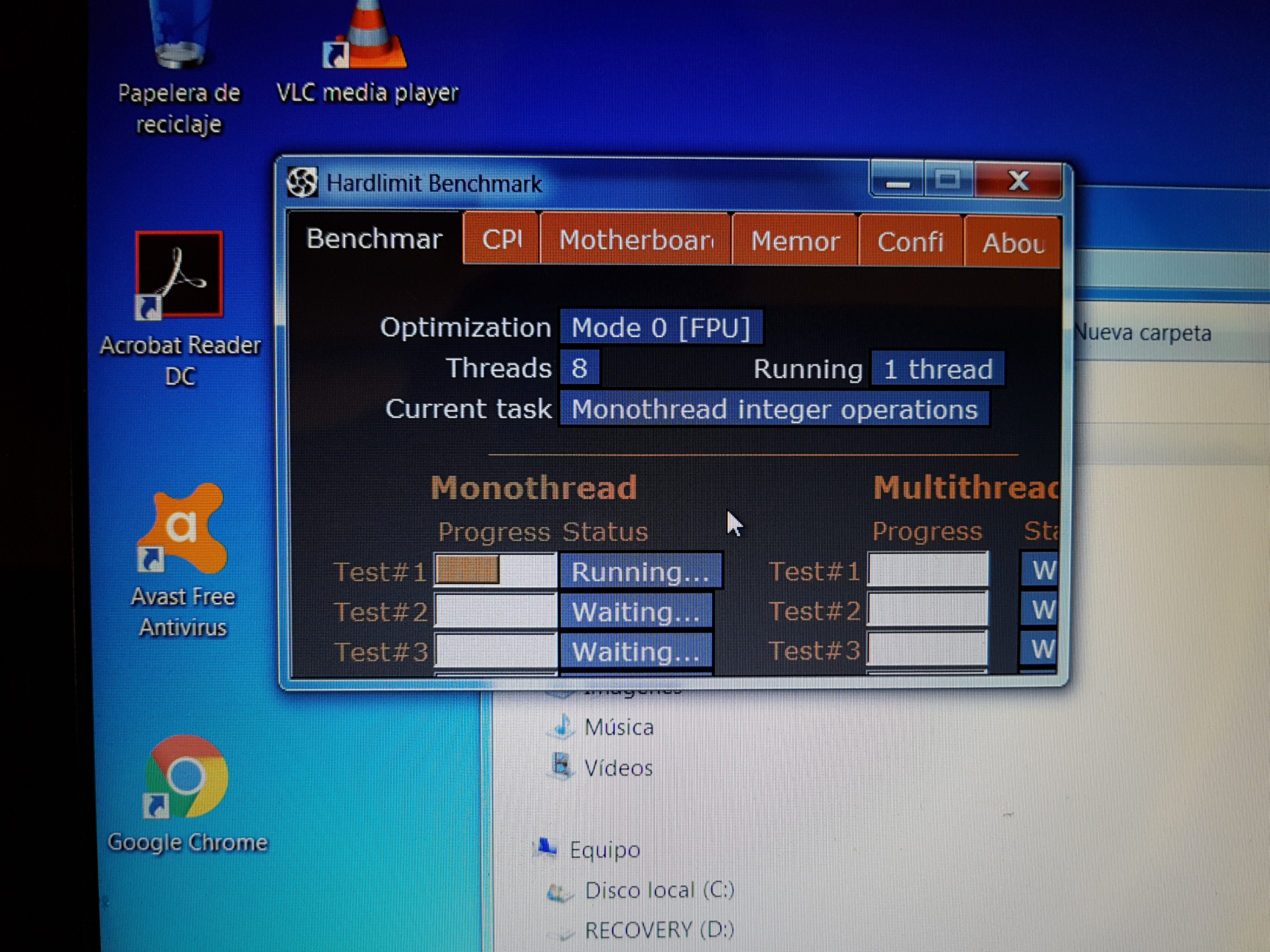
There's no way to see what's missing

Best regards
Siempre Aprendiendo
www.namiga.es
-
@namiga That's a Windows scaling issue. I'll note the problem, though it won't be a priority.
By the way, I've seen the results you sent and you should see the ups and downs of the scores. Looking at the desktop, I would say it's newly formatted, so it must be the antivirus.
Toda la actualidad en la portada de Hardlimit
Mis cacharros -
@krampak brought us a few days ago a pre-core era 775 socket micro: a Pentium D 925.
The truth is that there is not much to say: it is one of the last Netburst and came out almost 12 years ago. It runs at 3Ghz and with its 2 cores a TDP of 95W, it offers a performance similar to a Core 2 Duo E4400 when the latter runs at two-thirds of the frequency and has a proportional reduction in consumption.
What can I say about Netburst? An architecture to forget... Although thanks to it, a few years before AMD was able to catch up with Intel with its Athlon XP.
Toda la actualidad en la portada de Hardlimit
Mis cacharros -
@krampak brought us a CPU yesterday that will be one year old in a month: an i5-8250U.
The results are quite curious and it is inevitable to make the comparison with the i7-8550U from @kynes. Here you can see a comparison.
It can be said that the i5 is generally a similar micro to the i7 even though it is part of a lower range and costs about €100 less. The differences lie in the frequency (3.4GHz vs 4Ghz respectively) and the level 3 cache (6 vs 8 Mb). With the same TDP and the same Kaby Lake architecture, one would expect the i5 to be generally somewhat slower than the i7. But this is not the case.
In single-thread the i7 is 20% faster than the i5, which is attributable to its 17% higher frequency and its L3 cache that is 30% larger. But when we go to multi-thread comes the surprise: the i7 is between 5 and 25% slower than the i5 depending on the set chosen. Considering that the base frequency is somewhat higher in the i7 and that in the single-thread test there is not much difference between the FPU and AVX2 tests, I find it difficult to know why this could happen. Apparently, both the results sent by @kynes and by @krampak are correct. While it is true that some results of the 8550U have been passed with 16 threads when the micro is 8, the difference in scores is not too high compared to the results at 8 threads.
The only thing that comes to mind is that the HT of the i7-8550U is capped by some part, but it seems very strange given that the two micros are basically the same with the difference in frequency and cache: same architecture, same release date, same cpuid.
Toda la actualidad en la portada de Hardlimit
Mis cacharros -
@cobito @kynes It seems that in his case, when he increased the threads, the frequency decreased, but I noticed with the task manager that in single-thread mode, the frequency stayed around 2.6Ghz and in multi-thread mode, it curiously went up to 3.4Ghz, while he commented that in 4 threads it went down to 2.8Ghz.
-
The impression I get is that in the case of the laptop I worked with, HP limits the power to 15W in a "hard" way, Intel processors have a hard limit and a soft limit, if they are 15W they usually allow a consumption of I think 25W for about a few seconds, I think 28 seconds, and after that time, they lower the consumption to 15W, while in the case of the HP I checked that it never exceeded 15W, so it may be a matter of a limitation at the firmware level, due to lack of cooling or to lower consumption. In single-thread it would not reach exceeding those 15W, that's why the higher score for having more frequency and cache, and in multi-thread it would far exceed the i7 15W at maximum frequency, so from the beginning it would start with a handicap if my theory is correct. In a longer test it would probably end up surpassing the i5 in score, but in short tests, which allow the i5 to enter high consumption mode, it would have that advantage. -
@kynes In my case it is also an HP, a ProBook 450 G5.
-
@krampak said in Hardlimit test bench:
@kynes In my case it is also an HP, a ProBook 450 G5.
I understand that in your case it is a 15.6'' oriented to professionals, in my case it is a 14'' foldable, a Pavilion x360 14, I think the limitation may be due to having smaller dimensions and the possibility of folding it, which makes the heat go to the screen.





Hello! It looks like you're interested in this conversation, but you don't have an account yet.
Getting fed up of having to scroll through the same posts each visit? When you register for an account, you'll always come back to exactly where you were before, and choose to be notified of new replies (either via email, or push notification). You'll also be able to save bookmarks and upvote posts to show your appreciation to other community members.
With your input, this post could be even better 💗
Registrarse Conectarse