Hardlimit test bank
-
To me without problems.
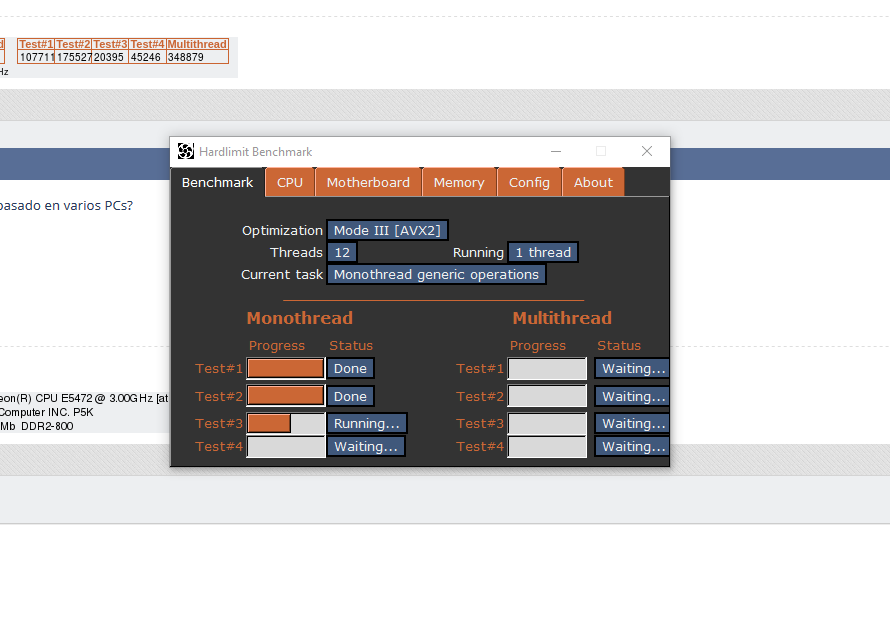
Best regards.
-
@cobito I've only tested it on my home PC. It was working fine now (running as Administrator), so I went to test running it without forcing administrator and when I closed the benchmark for the X, it continued running the tests in the background, so when I reopened the benchmark (correctly) and clicked Start, it closed abruptly without giving any message.
Edit: Now the current task and the bars look good, whether or not you force administrator mode.
-
@krampak This new version includes some extra security measures to prevent tampering with results. One of them is to prevent multiple instances of the test bank from running simultaneously, which is why you were closed without explanation when there were other 'core' processes running (in general, the policy is not to offer any information so as not to give clues, but perhaps I should make a warning message appear for these accidental cases, which I think are going to be quite common).
Regarding what happened to you the first time, it seems to have been an internal interface error, although I don't know what the cause could be. If it repeats, comment on it again and I'll send you a version with a debugging window to know exactly what is happening.
Regarding the fact that the processes continue to run after closing the window, this is the expected behavior until a mechanism is included to cancel the test. When this happens, all you have to do is wait a couple of minutes for the test bank to finish. After that, the processes will close automatically and you can run the program again. The cancel button was going to be included in this version, but with so many changes, I decided to release this version first, to get all the cases, and then add new functionalities.
Toda la actualidad en la portada de Hardlimit
Mis cacharros -
Hackers on the web? That's what I wondered when I received so many emails about test bank. The thing is, I thought it was spam, but I can see now that it's not.
Which CSM do you use for the web? -
@qvengador The mail service has been down for a few weeks. When we fixed it, it seems like it sent everything it had in the queue all at once.
Toda la actualidad en la portada de Hardlimit
Mis cacharros -
I just tested the new version on a PC with Windows 10 and defender and I got this warning @cobito

-
@krampak Thanks, it's already been reported. For now, McAfee has already fixed the false positive. I hope that in the coming days the rest will be resolved.
Toda la actualidad en la portada de Hardlimit
Mis cacharros -
Microsoft has given the green light to the file. If anyone has Windows Defender with definition 1.259.206.0 or higher and can confirm it to me, I will be more at ease.
It can happen that some antivirus gives a positive result, but for Windows Defender to wipe it out at the first opportunity gives a sorry image.
Toda la actualidad en la portada de Hardlimit
Mis cacharros -
Now only results obtained from stock frequency validations are calculated. In return, a overclocking ranking appears on the tab of each model. Example.
The system now calibrates the frequencies sent by the test bench but for this it has to learn based on the results sent. The more results are sent at stock frequency, the better the measured frequency will be. For the moment this only applies to the tab of each model and not to the individual results.
As always, any report of failure or strange thing will be welcome.
Toda la actualidad en la portada de Hardlimit
Mis cacharros -
@cobito said in Hardlimit test bank:
Microsoft has given the green light to the file. If someone has Windows Defender with definition 1.259.206.0 or higher and can confirm it to me, I'll be more at ease.
It can happen that some antivirus gives a positive, but that Windows Defender wipes it out at the first opportunity gives a pitiful image.
Confirmed, I didn't get the warning this time.
-
Some important changes in the Central.
Now the overclocked validations have a different treatment than the stock frequency validations. That makes the models for which there are no stock frequency results or whose measured frequencies show inadequate test bench conditions* not appear in the statistics. For example, there is the i7-6959X from @Xevipiu that no longer appears in the cover ranking or in the comparisons because there are no stock frequency results. In addition, the datasheet does not show all the information
or this is inconsistent.On the other hand, now the frequency shown in the results (page that appears when validating) is corrected based on the previously sent results. As I said above, the more results there are at stock frequency, the more precise and accurate the frequencies shown will be. In principle, with 3 or 4 validations in any mode, it should be enough to show an adequate frequency.
Regarding the results of overclocked micros, as I also mentioned above, in each datasheet there is a ranking of individual results showing the user, the frequency, the scores and the motherboard model. Example.
*The frequency measurement is done on a single core, so if there are background programs hogging part of the processor and consuming several cores, the measured frequency will not be the "boost" frequency but the one provided at medium load or at full load. If there is a model in which in all results this interference has occurred, this model will not appear in the statistics.
Regarding the problems of these changes: the back-end has become very slow (again). In the next code sweep, optimization will be the priority.
EDITED: The performance problems and some minor bugs on certain pages have been fixed.
Toda la actualidad en la portada de Hardlimit
Mis cacharros -
@cobito Buenas.
I'm testing an i7 for my niece. it's set up in English, and I get an error when starting the Bench..
error 0xc0000142. the application cannot start correctlyCould it be a problem because the operating system is in English?
Siempre Aprendiendo
www.namiga.es
-
@namiga Vale... I should have been updating something. A restart and everything is ok
Siempre Aprendiendo
www.namiga.es
-
@cobito I'm on a freshly installed Windows 10 (still without the aniversary or creators update), with administrator permissions on a laptop i5-7200U and I get the following error:

-
Siempre Aprendiendo
www.namiga.es
-
@krampak seems to be the same error as @Namiga. I think it was an update issue and after a few reboots it got fixed.
Toda la actualidad en la portada de Hardlimit
Mis cacharros -
In the coming days I will prepare new rankings (which will not appear on the front page but on a specific rankings page). I would appreciate it if you could tell me which statistics you would find interesting. Initially I thought that a ranking of the best micros for games would be good.
Regarding CPUs for games I am not very sure about the characteristics. My idea is as follows (correct me if I am wrong):
- I think that today, having more than 2 or 3 cores does not make any difference but if video broadcasting or recording services are used, having 4 cores is recommended.
- In games, it is important to have power in arithmetic operations. I thought of giving the following weight: 75% for integer and floating point tests and 25% for the test of generic tasks (is the memory test omitted?).
In this case, results with 4 execution threads would start to be well received (they always are, but now they would be more) even from micros that have more than 4 cores since the frequency is not the same in many cases.
What do you think?
Toda la actualidad en la portada de Hardlimit
Mis cacharros -
@krampak about the results of the 8700k that you sent a while ago, do you have the micro underclocked?
Toda la actualidad en la portada de Hardlimit
Mis cacharros -
No, it was stock @cobito -
Hello @cobito!!!
First of all, congratulations on this initiative, I just found out now, as soon as I can I'll pass it on to all my PCs.
For now, I wanted to pass it on to the Ryzen 3 1200 and I see that it detects 1 CPU, 1 CORE, 4 Threads, check that out because it seems like there's a bug with core detection on the Ryzen.Best regards!
MAIN: Ryzen7 3800X + RTX2070Super + Asus x470 StrixF + KFA2 HOF 16GB DDR4 4000 + NVMe Samsung 970 EvoPlus 500GB + Samsung 850Pro 512GB + Samsung 860QVO 2TB + Asus Xonar STX + Phanteks Enthoo Pro M Se + Seasonic Focus+ 650W
LAPTOP: Asus Strix G531GT Intel i5 9300H + GTX1650 4GB + 16GB DDR4 2666 (8x2) + NVMe 256GB + 1TB HDD