Hardlimit test bank
-
@qvengador said in Hardlimit test bench:
I just did the test and I get a strange code in the signature.
I think you mean that your nick has been superimposed on the results table. I have it noted for the next revision.
Another curiosity is to know who does these things and what it is programmed in. Thanks,
I do this myself. The front-end of the central (the web with results) is made with PHP-HTML and the back-end is written in C. The front-end of the program is written in TkInter and the back-end is in C and assembler.
I use C only when brute force processing is needed (like the calculation of results, similar processors, etc. of the central) and for the test bench where the compilation has to be predictable. Also, I need assembler to calculate frequency, read micro identification records and other low-level operations.
Toda la actualidad en la portada de Hardlimit
Mis cacharros -
@cobito Eres un maestro
-
@Namiga brings us this time a micro from AMD from the pre-Zen era. It's an Excavator from a year ago whose strong point is surely the integrated graphics. It's the A9 9420.
Its performance is not for throwing rockets but for being a portable micro and with a TDP 15W it is not so bad. Coincidentally, the most similar model found has been the i3-6006U that the same companion brought us a few days ago. The A9 has snatched the tail leadership in the AVX2 multithread test by quite a bit. In the single thread it surpasses the 6006U by very little. In general both seem to be very similar processors, but the lack of SMT in the AMD makes it succumb to the Intel with HT in multithread.
Toda la actualidad en la portada de Hardlimit
Mis cacharros -
Why does Kynes have a better rank than me? Is it because of memory? It's not because I'm envious, which I am, but because I know what this rank thing is about.
-
@qvengador Because I am more handsome, taller, smarter and I don't have grandmothers

Now seriously, you passed the test in mode 2, my team in mode 2 gets more or less the same as yours, 42095 in monothread and 138049 in multithread.
-
@kynes I will repeat it. It is a simply philosophical question. I mean what makes a pc more competent. Memory, without a doubt, that is the reason for my question. Well then in the ranks it always depends on the ordering criterion but ultimately it is to know what combination of elements makes a pc more efficient.
-
@qvengador When you run it, and we can compare on equal tests, you'll see that your team scores better than mine in this benchmark. Cobito can confirm, but I think his tool is about 90% processor and 10% memory.
-
Missing a link to statistics at the end of passing the test
-
@kynes said in Hardlimit Test Bench:
Cobito can confirm, but I think his tool is about 90% CPU and 10% memory.
Tests 1, 2, and 3 are pure CPU. Test 4 makes heavy use of memory but depends heavily on the number of threads to run. The higher the number of threads, the more the result is penalized because more memory accesses are being done concurrently. That 90/10 percentage is more or less correct since the memory test aims to use as much CPU as possible where the bottleneck is memory.
@QVENGADOR next week I'll be able to find some time to fix the username issue in the signatures.
@xevipiu said in Hardlimit Test Bench:
A link to statistics would be missing at the end of passing the test
What do you mean by that link? If you go to the CPU information tab, there's a button to check the CPU datasheet with results, statistics, and extra information. And when the test bench finishes, a button appears to validate that leads directly to the result with detailed information about the test.
========================
And on another note, @Namiga keeps sending new CPUs. We should show a ranking of users who have validated the most different CPU models, let's see what comes out...Anyway, this time she brings one from 2012: a portable processor i3-3217U.
It's not easy to find similar models for this one. I've noticed that with Ivy Bridge the system struggles and it's probably due to it being an architecture without support for AVX2 and that there are quite a few models with incomplete results (without tests in Mode II - AVX). So this time I'm not able to make a half-decent comparison (well, I'll say that the one that looks most like it is the i5-2467M, but that's not the same). The CPU itself has 2 cores with HT and a TDP of 17W.
In addition, she has sent results of a Xeon X3430, but it seems that the results were not sent under optimal conditions and have been discarded by the system. This happens when there are background processes consuming CPU while the test bench is being passed. Still, if you're curious, the validations are always available and you can find them through the search engine.
Toda la actualidad en la portada de Hardlimit
Mis cacharros -
You should put a direct tab to https://bm.hardlimit.com/
Intel 8088 7.15Mhz, 512Kb RAM, CGA 4coleretes, HD 10Mb
-
@cobito said
In addition, he has sent results of a Xeon X3430, but it seems that the results were not sent under optimal conditions and have been discarded by the system. This happens when there are background processes consuming CPU while the benchmark is being run. Nevertheless, if you are curious, the validations are always available and you can find them through the search engine.
Well, you are right. It is a server, and in a hurry I put w10 on it. There are no video drivers for w10... so the one from Microsoft was installed, which we know is not worth much... so it could have been that.
I will put a 2008 server on it and repeat
Siempre Aprendiendo
www.namiga.es
-
@cobito
I've already installed the W2008 server and its drivers OK... but I can't run the HLM.
It says that a library is missing...
I've tried downloading the one you put in the link but it says it's not the right one, and in w2008 x86 I've already installed everything that's in Windows update
Error... I've already seen the problem.... it's only available for W2008 x86 without SP.
I've installed SP1 and it's installing SP2...
After that it should work... I'll let you knowSiempre Aprendiendo
www.namiga.es
-
Ya. Por fin he podido pasar el hlbm al xeon.
Dime si son resultados coherentesSiempre Aprendiendo
www.namiga.es
-
@namiga The problem detected is that the boost frequency is 2.6Ghz instead of the 2.8Ghz it should reach. Coincidentally (or not), those 2.6GHz is the medium load frequency, that is, when two cores are in use. I can think of two things: either there is still something consuming the core while running the benchmark or for some reason, the CPU is unable to reach the boost frequency (high temperature, some issue with the BIOS, etc.).
The truth is that I can't think of anything you can do except take a look at the BIOS settings or check if the memory is running at the correct frequency. But I think it's too much work if it's just to send good results.
Regarding the results in these cases, they are usually reliable in multi-threaded. The problem is that the benchmark in single-threaded mode was run at 2.6GHz and that is not representative of this model. That's why they are automatically discarded from the model's datasheet. In the same way, when overclocking the processor, those results are not used to get the model's score but appear in a specific zero ranking for each datasheet.
Toda la actualidad en la portada de Hardlimit
Mis cacharros -
@cobito OK. I will check the Bios, see if I see anything strange and repeat the test
Siempre Aprendiendo
www.namiga.es
-
@xevipiu said in Hardlimit Test Bank:
You should put a direct tab to https://bm.hardlimit.com/
Note taken. The program's development cycle is slower than the central's because the process of releasing each new version between compilations, quality control, and sending the executable to antivirus developers to add it to their whitelists is too slow to incorporate just a couple of changes.
@QVENGADOR I've expanded the space for the username in the signature, so it no longer overlaps with the results table.
@namiga said in Hardlimit Test Bank:
@cobito OK. I'll check the Bios, see if I see anything strange and repeat the test
 thanks
Toda la actualidad en la portada de Hardlimit
Mis cacharros -
@Xevipiu brings us a micro fresh out of the oven: a Ryzen 7 2700X.
It would have been interesting to compare it with the 1700X, but the results that exist are either from AMD or not passed under optimal conditions and have been discarded. But we have other Zens in the database that serve perfectly as a reference. For the 1800X, the 2700X is 8-10% faster, so although the difference is practically imperceptible, it is noticeable that Zen+ has improved a step compared to its predecessor. It should be noted that the change from the 0.014µm process to the 0.012µm process has allowed an increase in frequency and indeed, the 2700X runs 300MHz faster than the 1800X (although with an increase of 10W in its TDP). With this, we can conclude that in the comparison of Zen+ vs Zen, the architecture itself has not brought any improvement since the performance/frequency ratio is the same for both generations. In this aspect, it seems that Zen+ is more of a "tick" step (in Intel terminology) than an architecture change.
Continuing with the previous Zens, the 1600X is left far behind not only by generation but also by range (6 cores vs 8).
If we compare it with Intel micros, the closest one we have data for is the i7-8700, which can be said that with its 300Mhz extra over the Ryzen 7, it is barely able to outperform in single-thread in programs optimized in AVX2. With its 6 cores, it is unable to compete with Zen+ and its 8 cores in multi-thread. It is interesting to note that at this point, the performance per MHz of the Coffe-Lake (Intel's 8th generation) in AVX2 programs is considerably better than that of the second generation of Zens.
Toda la actualidad en la portada de Hardlimit
Mis cacharros -
The performance of the 2700x is terrible!
-
@xevipiu said in Hardlimit Test Bank:
The performance of the 2700x is terrible!
Do you mean it, or is it ironic?
-
@cobito said in Hardlimit Test Bench:
@namiga The problem detected is that the boost frequency is 2.6Ghz instead of the 2.8Ghz it should reach. Coincidentally (or not), those 2.6GHz is the medium load frequency, that is, when two cores are in use. I can think of two things: either there is still something consuming the core while the test bench is running, or for some reason, the CPU is unable to reach the boost frequency (high temperature, some issue with the BIOS, etc.).
To be honest, I can't think of anything you can do except take a look at the BIOS settings or check if the memory is running at the correct frequency. But I think it's too much work if it's just to send good results.
Regarding the results in these cases, they are usually reliable in multi-threaded tests. The problem is that the mon-threaded test bench was run at 2.6GHz and that is not representative of this model. That's why they are automatically discarded from the model's datasheet. In the same way, when the processor is overclocked, those results are not used to calculate the model's score but appear in a specific zero ranking for each datasheet.
Well, I haven't seen anything special in the BIOS. Just a section related to cooling, which was already set to "performance"...
I'm attaching screenshots of the computer at rest and after the test
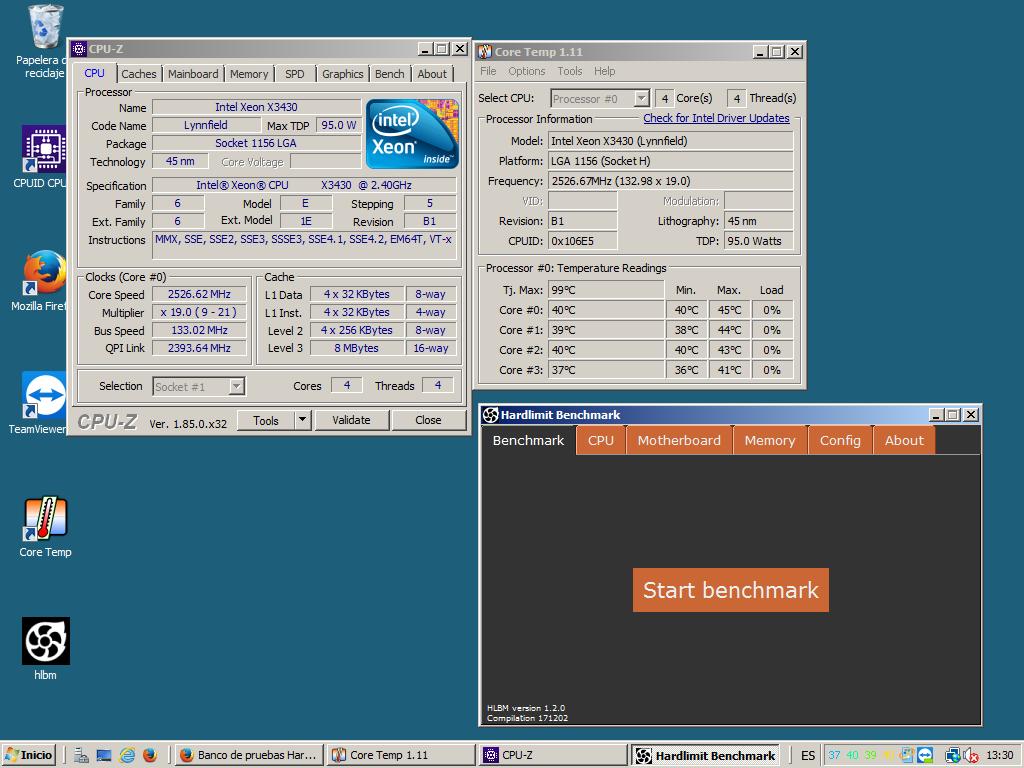
and here almost finished
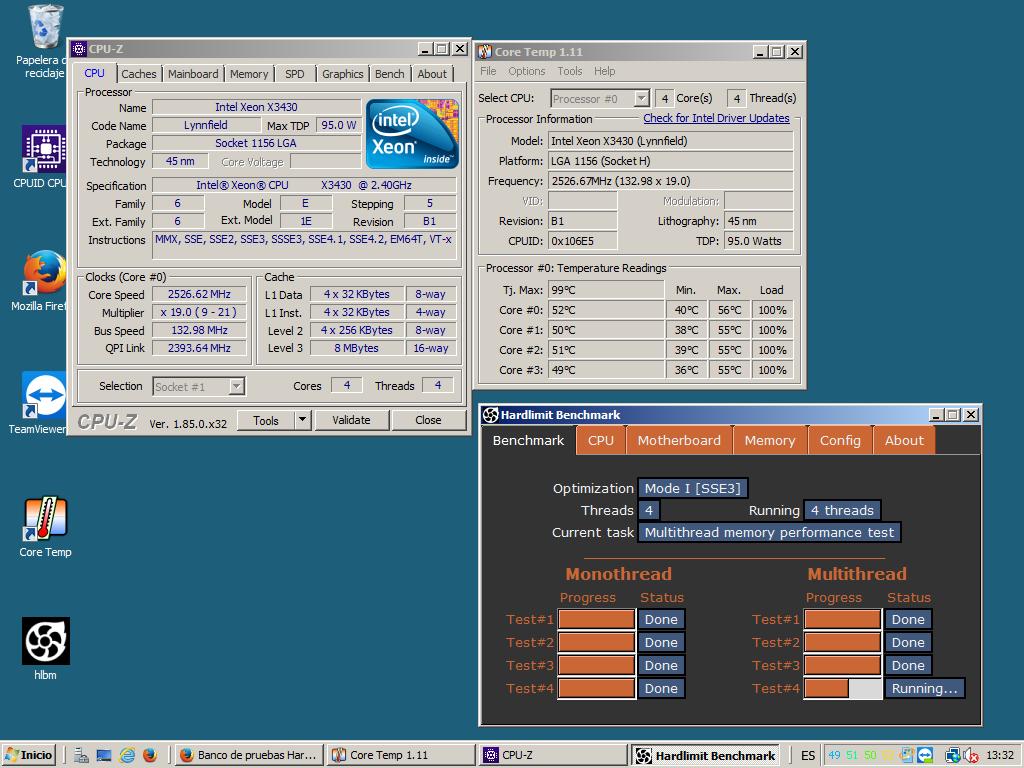
As you can see, the processor is always at 2.5Ghz... not 2.40, even when all 4 cores are at 100%...
strange... and there's no OC... it's a server ?Siempre Aprendiendo
www.namiga.es