Hardlimit test bank
-
@krampak brought us a few days ago a pre-core era 775 socket micro: a Pentium D 925.
The truth is that there is not much to say: it is one of the last Netburst and came out almost 12 years ago. It runs at 3Ghz and with its 2 cores a TDP of 95W, it offers a performance similar to a Core 2 Duo E4400 when the latter runs at two-thirds of the frequency and has a proportional reduction in consumption.
What can I say about Netburst? An architecture to forget... Although thanks to it, a few years before AMD was able to catch up with Intel with its Athlon XP.
Toda la actualidad en la portada de Hardlimit
Mis cacharros -
@krampak brought us a CPU yesterday that will be one year old in a month: an i5-8250U.
The results are quite curious and it is inevitable to make the comparison with the i7-8550U from @kynes. Here you can see a comparison.
It can be said that the i5 is generally a similar micro to the i7 even though it is part of a lower range and costs about €100 less. The differences lie in the frequency (3.4GHz vs 4Ghz respectively) and the level 3 cache (6 vs 8 Mb). With the same TDP and the same Kaby Lake architecture, one would expect the i5 to be generally somewhat slower than the i7. But this is not the case.
In single-thread the i7 is 20% faster than the i5, which is attributable to its 17% higher frequency and its L3 cache that is 30% larger. But when we go to multi-thread comes the surprise: the i7 is between 5 and 25% slower than the i5 depending on the set chosen. Considering that the base frequency is somewhat higher in the i7 and that in the single-thread test there is not much difference between the FPU and AVX2 tests, I find it difficult to know why this could happen. Apparently, both the results sent by @kynes and by @krampak are correct. While it is true that some results of the 8550U have been passed with 16 threads when the micro is 8, the difference in scores is not too high compared to the results at 8 threads.
The only thing that comes to mind is that the HT of the i7-8550U is capped by some part, but it seems very strange given that the two micros are basically the same with the difference in frequency and cache: same architecture, same release date, same cpuid.
Toda la actualidad en la portada de Hardlimit
Mis cacharros -
@cobito @kynes It seems that in his case, when he increased the threads, the frequency decreased, but I noticed with the task manager that in single-thread mode, the frequency stayed around 2.6Ghz and in multi-thread mode, it curiously went up to 3.4Ghz, while he commented that in 4 threads it went down to 2.8Ghz.
-
The impression I get is that in the case of the laptop I worked with, HP limits the power to 15W in a "hard" way, Intel processors have a hard limit and a soft limit, if they are 15W they usually allow a consumption of I think 25W for about a few seconds, I think 28 seconds, and after that time, they lower the consumption to 15W, while in the case of the HP I checked that it never exceeded 15W, so it may be a matter of a limitation at the firmware level, due to lack of cooling or to lower consumption. In single-thread it would not reach exceeding those 15W, that's why the higher score for having more frequency and cache, and in multi-thread it would far exceed the i7 15W at maximum frequency, so from the beginning it would start with a handicap if my theory is correct. In a longer test it would probably end up surpassing the i5 in score, but in short tests, which allow the i5 to enter high consumption mode, it would have that advantage. -
@kynes In my case it is also an HP, a ProBook 450 G5.
-
@krampak said in Hardlimit test bench:
@kynes In my case it is also an HP, a ProBook 450 G5.
I understand that in your case it is a 15.6'' oriented to professionals, in my case it is a 14'' foldable, a Pavilion x360 14, I think the limitation may be due to having smaller dimensions and the possibility of folding it, which makes the heat go to the screen.
-
In the last few hours, no less than 3 new models have been received, namely:
@krampak brings us two CPUs: an i5 from 7 years ago and the most recent Xeon that we have in the database.
For his part, @Namiga returns to the charge with a Coffee Lake i3.
The grandfather is an i5-2400 with 4 cores and without HT. The comparison algorithm gets a bit confused because there aren't many models from his fifth, but it gives us some interesting results. In multithread, the performance is similar to the i7-7500U released to the market a decade later. And watch out for the patch because the Sandy Bridge has a TDP of 95W while that of the Kaby Lake is only 15W.
The Xeon is a Xeon Silver 4110. In our database we have a generous amount of Xeons (largely thanks to the contributions also of @krampak), but almost all are quite old models. In contrast, this Xeon is a Skylake that has been on the market for just a year. It has 8 cores with HT, 11Mb of L3 cache and a TDP quite moderate considering all the factors: 85W. In this case, the comparison becomes quite complicated due to the lack of models of this category and era. Coincidentally, a 7xxxU series comes out again as the most similar model and it is that the i5-7200U (a year earlier but a generation later), has a very similar single-thread performance. Considering that the turbo frequencies have a difference of only 100Mhz, we can confirm what we already knew: Kaby Lake is a rehash of Skylake.
Regarding the multithread performance of the Xeon, it is similar to an i7-7700K. In reality, the FPU multithread performance is identical although in AVX2 the Xeon seems to get a slight advantage (13%). Now, the i7 has half the cores at double the base frequency so the result is not surprising. Probably here the interesting thing would be to see the results of each test individually and there are important differences between both micros in each of the tests. In case someone wants to investigate more, I leave you the validation of an i7-7700K and here the one of a Xeon Silver 4110.
And to finish this batch that comes more loaded than usual (that's good), we move on to the i3-8100 that @Namiga has brought us. It's a Coffee Lake that doesn't even have a year. It runs at 3.6GHz (there is no information about the Speed Stepping of this model) and comes with 4 cores without HT. Not having validations in FPU, the comparison is somewhat more imprecise, although there is a model that fits perfectly with the data we have: a Ryzen 1600X that matches the performance both single and multithread. It can be said that for its just over 100€, it is a really interesting option for all types of applications. In fact, it is in the top 15 of micros at stock frequency, which is quite impressive considering that it is the most basic model of the i3 Coffee Lake.
Toda la actualidad en la portada de Hardlimit
Mis cacharros -
My i9 7980XE does not start the test
-
@Xevipiu I see that it is a micro with 36 execution threads. The test bench is capped at 32. Try manually entering 32 threads or 18 (physical cores of your micro) to see if it runs.
I am noting this bug as a priority, although I am short on time this summer. As soon as I have a moment, I will look into it.
Toda la actualidad en la portada de Hardlimit
Mis cacharros -
@krampak has brought us a 7-year-old Xeon Westmere. But it seems to have a bit of OC (@krampak, can you confirm that you've overclocked it by 200MHz?). So, comparisons are not possible.
Toda la actualidad en la portada de Hardlimit
Mis cacharros -
@cobito No, it doesn't have any OC. It's a server and it comes standard

-
I've run it again and took a screenshot while it was running, I really haven't seen it go over 2105Mhz.
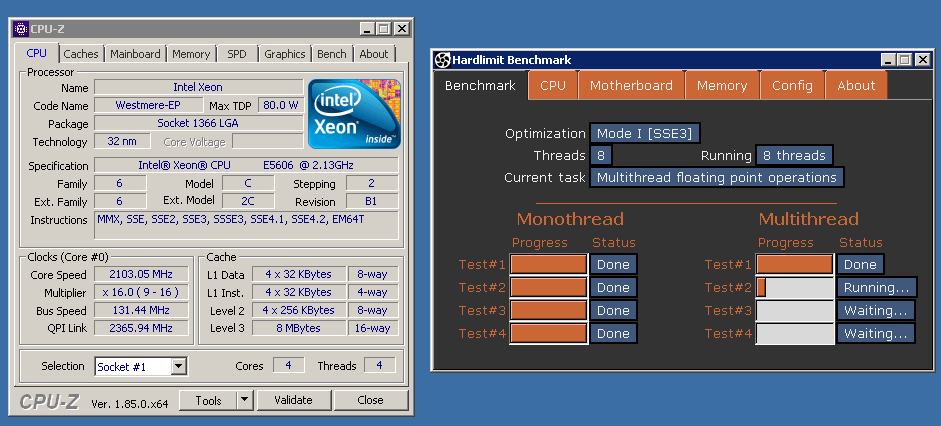
-
@krampak Thanks for the info. I'll have to add a fix for that particular model.
Toda la actualidad en la portada de Hardlimit
Mis cacharros -
@krampak brought us a few models a few days ago and once again, a bug has been exploited although this time from the central that is noted for when the new season of changes returns.
The first one is an i5-2300. It is a 2011 micro with 4 cores and no HT. Removing the 2xxx series from the comparison, its multi-thread performance is similar to the 7200-U which only has 2 cores although it is a year and a half newer. As for single-thread performance, it looks like the i3-6006U also from a couple of years ago.
Another model is the i3-3220 of which there is only one result in AVX. There is no particularly interesting comparison because there are quite a few models from its fifth. It is an Ivy Bridge of 2 cores with HT.
The latest novelty is a Pentium G3220, a Haswell of which there are no comparisons because the two results apparently were sent with the micro clocked at 3.2GHz when the stock frequency is, according to Intel, 3GHz without turbo.
Toda la actualidad en la portada de Hardlimit
Mis cacharros -
For the first time in just over a month, we have received a new CPU once again, from the hand of @krampak. When I saw the model, I thought "umm, how strange". Then I went to create the entry and lo and behold, I couldn't complete it with the current structure of the database. And all because it has a level 4 cache! Well, it is an i5-5675R, a Broadwell from 2015 of which we have received tests in all modes. As I have no idea what this series is about, I had to search San Google. The first thing is that it seems to be a desktop CPU. It comes in a BGA package so it should come soldered on a board although I have seen that they sell (sold) it separately. To finish this paragraph, it has an Intel Iris Pro Graphics 6200 integrated GPU that allows resolutions of up to 4k. Well, looking at one of the validations, it seems that it comes from a Mac, specifically a 21.5-inch Retina 4K iMac from late 2015. I suppose that explains some of the strangeness. But in order not to lose the reader's interest, I will return to mention that which has made the database obsolete: its 128Mb level 4 cache. It is something that I had never seen before and that I imagine will be an external memory to the chip. Looking a little more, it seems that this cache has received the commercial name of "Crystal Well" and indeed it is in an independent die from the CPU although it goes in the same package. The thing is that it is a memory used by both the integrated GPU framebuffer and the CPU. Regarding performance, it is similar to the i5-8250U and the i7-4790K. Basically they are three micros from different eras and intended for very different purposes but in summary it can be said that with its 65W it has reached the 88 of the 4790K and that without HT, it has almost reached the 8250U being the latter two years younger (although with a TDP of only 15W). In summary, it is one of the most interesting validations received in quite some time, difficult to compare and with some rather exotic characteristics.Toda la actualidad en la portada de Hardlimit
Mis cacharros -
@cobito Correct! it's an iMac retina that arrived at work with BootCamp and which I didn't hesitate to use to run the test
 By the way, are you messing around with the comparator? I was about to enter a hard drive but I get screen options instead of drives.
 -
@krampak said in Hardlimit test bench:
By the way, are you messing with the comparator? I was about to enter a hard drive but I get screen options instead of drives.
Yes but you should be able to choose whether to add a screen (I still don't recommend it, that's why I haven't said anything) or a hard drive. That is, there are two tables: one above for hard drives and another below with the screens.
Toda la actualidad en la portada de Hardlimit
Mis cacharros -
We have two new micros: a Xeon from @krampak and a Celeron from @Namiga. The latter has actually been in the back room for 10 days, but I had forgotten about it.
The Celeron is a 3855U, which is a Skylake from late 2015. Being a Celeron and part of the U series, you can't expect great achievements and indeed, you have to go to Core 2 Duo to see similar micros in FPU. But this one has something special and it is that although it doesn't have recent sets like AVX1/2, its SSE3 performance exceeds expectations after seeing the performance in the most basic mode. And here, it is comparable to an i7-860 in single-thread, a somewhat old CPU but mid/high range.
About the Xeon, it is a E3-1220 v3. It is a somewhat older micro; from 2013. It is a Haswell with 4 cores that practically matches the performance of an i7-4720HQ. Considering that the latter is a portable CPU with half the TDP and only 2 years newer, the Xeon doesn't seem too spectacular. It is also true that we are comparing a basic Xeon with the top of the range of Intel's portable CPUs.
Toda la actualidad en la portada de Hardlimit
Mis cacharros -
@krampak brings us back a couple of fairly recent processors and both are very similar.
The first one is an i5-8500; a Coffe Lake from 6 months ago. It has 6 cores without HT and runs at 4.1Ghz. The most similar is another recent CPU (although not as much): the i7-7700. Basically they have the same TDP and go to almost the same frequency. But the Coffee Lake has 6 bare cores and the Kaby Lake has 4 with HT. In essence, the evolutionary improvement seems to be in AVX2 where the i7-7700 seems to puncture in front of the i5-8500 only in multithread. Probably because that performance per extra MHz is getting it thanks to HT and this one doesn't go so well with more complex repertoire.
The other is an i5-8500T, the low-power twin brother of the previous one. Comparatively speaking, with a TDP of 30W less and a frequency reduced 600Mhz, the performance per MHz almost matches in both (same architecture and same cache) while the efficiency of the T series surpasses the i5-8500 by quite a bit.
Toda la actualidad en la portada de Hardlimit
Mis cacharros -
@cobito said in Banco de pruebas Hardlimit:
@krampak brings us back a couple of fairly recent processors, and both are very similar.
The first one is an i5-8500; a Coffe Lake from 6 months ago. It has 6 cores without HT and runs at 4.1Ghz. The most similar is another recent CPU (though not as recent): the i7-7700. Basically, they have the same TDP and go to almost the same frequency. But the Coffee Lake has 6 bare cores and the Kaby Lake has 4 with HT. In essence, the evolutionary improvement seems to be in AVX2 where the i7-7700 seems to puncture against the i5-8500 only in multithreading. Probably because that performance per extra MHz is getting it thanks to HT and this one doesn't do as well with more complex repertoires.
The other is an i5-8500T, the low-power twin brother of the previous one. Comparatively speaking, with a TDP of 30W less and a frequency reduced by 600Mhz, the performance per MHz is almost the same in both (same architecture and same cache) while the efficiency of the T series surpasses the i5-8500 by quite a bit.
I think I remember that in the 8500T it gave me a better result in SSE3 than in AVX, can that be? I repeated it several times and it came out the same.