Hardlimit benchmark
-
@krampak said in Hardlimit Test Bench:
Very cool the latest version!! It looks more professional and the reduced load time is noticeable.
Thanks. I'm glad you can see the difference in the boot time.
@whoololon said in Hardlimit Test Bench:
And to celebrate, we inaugurate it with a radiant i3-3120M.

Edit: By the way, Smart Screen is still popping up, at least on W8.1.
Perfect, it's been a while since anything new came in.
Smart Screen is still happening on Windows 10 as well. To be honest, it's taking longer than I've read around. Maybe it hasn't been downloaded enough times yet, or maybe it really is important to download it from Internet Explorer or Edge. I hope it disappears in the next few days.
Toda la actualidad en la portada de Hardlimit
Mis cacharros -
-
@Xevipiu Is it a sample of engineering? Perhaps of a Core i9-9900K/S?
Toda la actualidad en la portada de Hardlimit
Mis cacharros -
@cobito said in Hardlimit test bench:
@Xevipiu Is it a sample of engineering? Maybe of a Core i9-9900K/S?
No, it's from a 10th Gen series, an i9 10980HK, throttled, but it holds its own
-
@Xevipiu said in Hardlimit test bench:
@cobito said in Hardlimit test bench:
@Xevipiu Is this a sample of engineering? Maybe from a Core i9-9900K/S?
No, it's from a 10th Gen series, an i9 10980HK, capped, but it holds its own
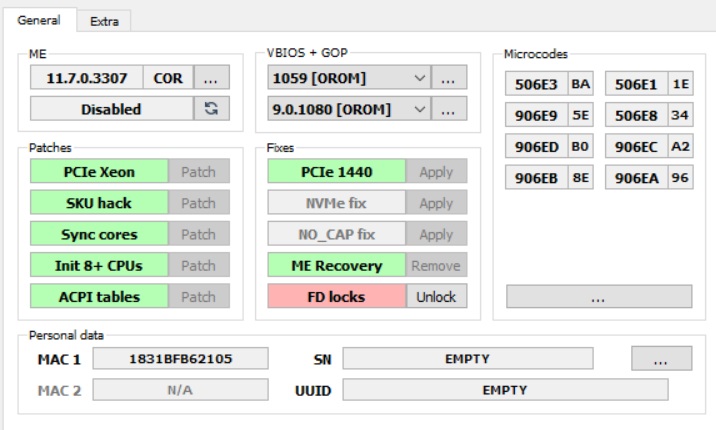
Ok, I was confused by the signature because yours returns 906ED of which all are Coffee Lakes.
Actually it makes sense according to the results because it pulls 15-20% ahead of the Core i9-9900K in multi-thread.
It remains in a very good position in single-thread. If you remove the memory test (where Zen 2 usually does well) it would be first in the single-thread ranking.
Toda la actualidad en la portada de Hardlimit
Mis cacharros -
@cobito said in Hardlimit Test Bench:
@Xevipiu said in Hardlimit Test Bench:
@cobito said in Hardlimit Test Bench:
@Xevipiu Is this a sample of engineering? Maybe from a Core i9-9900K/S?
No, it's from a 10th Gen series, an i9 10980HK, capped, but it holds its own
Ok, I was distracted by the signature because yours returns 906ED of which all are Coffee Lakes.
Actually it makes sense according to the results because it beats the Core i9-9900K by 15-20% in multi-thread.
It remains in a very good position in single-thread. If you remove the memory test (where Zen 2 usually does well) it would be first in the single-thread ranking.
Think that the memory issue is capped at 2140 or 2400mhz, it's a big handicap, the ZEN or the same 9900k beat me
Here you have the family of micro-code's of processors "ES", for your database
-
The version 1.5.0 of the program has just been released the program version that mainly comes with changes on the information related to the memory:· Now it detects "form factor" of integrated memory in processor encapsulation (SoC).
· Now it detects memory types HBM, HBM2, DDR5 and LPDDR5.
· A bug has been fixed that made that under certain memory configurations, the information of the memory type, form factor or frequency was not shown in the program.
· Now the brand and part number of the memory is shown in the program.
· *Also the brand and part number of the RAM memory is sent in the validation process.
· *In addition, the available instruction repertoire is also sent in the validation along with the detection of hypervisor (execution on virtual machine).*The information related to the memory and the available instruction repertoire will be shown in the central soon. This will also give rise to the creation of a database of memories along with the results of the memory test. Regarding the detection of hypervisor use, soon the results sent from a virtual machine will be discarded for the calculation of statistics.
For the moment the executable is available and in the next few hours it will be possible to download/update it from the Microsoft Store.
As usual, if you see something strange, do not hesitate to comment on it.
Toda la actualidad en la portada de Hardlimit
Mis cacharros -
It seems that we have been for over a month with the test bank database blocked and, therefore, without receiving validations during this period. Since yesterday, the validation system is operational again.
Toda la actualidad en la portada de Hardlimit
Mis cacharros -
Histograms have been added to the validated results page. Now, when you validate your result, if there are more than 5 validations in the mode in question, a histogram per test will appear where you can see the frequency in which the scores are repeated in a series of ranges. It also indicates in which range your result is located. Example. They take a little while to load and there are still a couple of things to fix, but for most cases, they work correctly.
In addition, Zen 3, Tiger Lake and Rocket Lake are added to the list of architectures, so it is now possible to see the rankings of the CPUs that we have received from said architectures.
Toda la actualidad en la portada de Hardlimit
Mis cacharros -
The central extends its tentacles to the world of motherboards. The menu now includes a list of motherboards sorted by socket. Within the list, they are classified by chipset. In addition, in the tab of each processor, a list of motherboards where the micro has been tested is shown.
Toda la actualidad en la portada de Hardlimit
Mis cacharros -
The motherboard database has been completed (a few of the validations made in recent days are still pending). Example: LGA 1700 motherboard list.
A database of PCs and laptops has also been created, which can be accessed from the "Computers" menu. They are classified by architecture and brand. Many are still missing from this (I am at 15% of all those we have). It will be completed little by little. Example: list of Skylake PCs and laptops.
Finally, extra information about the processor has been added to the validation result, paving the way for adding extra information about the motherboard and memory. Example: this validation.
The motherboard and computer databases are still very basic. Extra information such as type of memory, type and number of connectors and other typical characteristics of these gadgets still need to be added.
Toda la actualidad en la portada de Hardlimit
Mis cacharros -
Finally, the database of motherboards and computers has been completed. In total, we have 540 different models.
In addition, the datasheet for each processor now shows the list of computers where the CPU has been tested alongside the list of motherboards. Example.
The type of memory and form factor are also shown in the datasheet for each motherboard and each computer. Example.
Finally, the validation results now show more precise and detailed information about the motherboard or computer. Example with computer.
Example with motherboard.Next stop: memories.
P.S.: I wanted to thank everyone who has sent validations and those who continue to do so, because the central would be nothing without your contributions.
Toda la actualidad en la portada de Hardlimit
Mis cacharros -
To compensate for the lack of news on the front page last week, we present version 3.11 for Group Work of the central that is more tocha than usual.
We have added the database of RAM memories that are sorted by type of memory. This now allows us to show the relationships between motherboards, memories and processors in each tab (what has been tested with what). We have a total of 300 memory models.
The new memory database along with the motherboard database that debuted in the previous version, has served to show all the available information at the time of validation. With this, the user obtains a detailed report of their hardware every time they validate a result (as long as their hardware is in our database). Example.
Similar computers are also shown in the tab of each computer. Similar computers are considered those that mount the same motherboard.
Another pending change was the list of architectures, which has been updated. The last one added has been Alder Lake that debuted in 2021. At the moment we have 9 cpus of this hybrid architecture of Intel.
A small change: the "Architectures" menu is now the "Processors" menu, since the computers are also ordered by architecture.
To finish, the front page of the central now shows the latest validations of processors, motherboards, computers and RAM memories. This change has also been applied to the general front page, where the latest videos have also been moved to second position and validations have been left for the end.
The details are in the first post of this thread and in the first post of the front page thread.
As usual, any report of any failure will be welcome.
Toda la actualidad en la portada de Hardlimit
Mis cacharros -
In the next version, there might be the possibility of having the MPi cluster option for windows, MPHI for linux. Just out of curiosity, I think we could do a test by connecting nodes between a few.
Cluster MPI de tres nodos formado por tres SERVIDORRES HP PROLIANT DL360P 1U 2X E5-2680V2 CPU'S, 20 cores, 40 hilos a una frecuencia base de 2,8GHz. 192 GB de memoria RAM DDR3 ECC (8 x módulos de16 GB 800Mhz)´+ 1U 2X E5.-2697 V2 a una frecuencia base de 2,8 Ghz 192 GB de Ram ECC (8 módulos de 16 Gb 800 mhz) 24 Cores 48 hilos ( 44c/88T)+ 1u 2xE5 2603v2 con una frecuencia base de 1,9ghz 64 Gb DDR3 ecc (4x módulos de 16)
-
@jordiqui I'll keep it in mind. Keep in mind that the program's development cycle is much slower than that of the central, mainly because I have to buy a code certificate every time I modify the program and it lasts for a year, so I accumulate change notes to apply them all at once when the time comes.
In the short term, only changes in the central are planned.
I say this so that you don't think I ignore it.
Toda la actualidad en la portada de Hardlimit
Mis cacharros -
@cobito Tranquilo, creo que con estos bichos estaré unos años. Los programadores de verdad que tenéis mérito. No sabía por otra parte, esto que has comentado de las modificaciones del código. Por otra parte, no sé lo que tardarán en llegarme los e5 2697 v2, creo que de la serie e5 XXXX v2 son los más potentes. Añadiremos más variedad al banco de pruebas. Un abrazo.
Cluster MPI de tres nodos formado por tres SERVIDORRES HP PROLIANT DL360P 1U 2X E5-2680V2 CPU'S, 20 cores, 40 hilos a una frecuencia base de 2,8GHz. 192 GB de memoria RAM DDR3 ECC (8 x módulos de16 GB 800Mhz)´+ 1U 2X E5.-2697 V2 a una frecuencia base de 2,8 Ghz 192 GB de Ram ECC (8 módulos de 16 Gb 800 mhz) 24 Cores 48 hilos ( 44c/88T)+ 1u 2xE5 2603v2 con una frecuencia base de 1,9ghz 64 Gb DDR3 ecc (4x módulos de 16)
-
Having passed the three tests with the e5 2697 v2 and easily surpassing the 2680, 2660, and 2651, I would say that this generation offers the best performance.
Cluster MPI de tres nodos formado por tres SERVIDORRES HP PROLIANT DL360P 1U 2X E5-2680V2 CPU'S, 20 cores, 40 hilos a una frecuencia base de 2,8GHz. 192 GB de memoria RAM DDR3 ECC (8 x módulos de16 GB 800Mhz)´+ 1U 2X E5.-2697 V2 a una frecuencia base de 2,8 Ghz 192 GB de Ram ECC (8 módulos de 16 Gb 800 mhz) 24 Cores 48 hilos ( 44c/88T)+ 1u 2xE5 2603v2 con una frecuencia base de 1,9ghz 64 Gb DDR3 ecc (4x módulos de 16)
-
@jordiqui The closest ones are the 2697 and the 2680. Here it is curious that although the E5-2680 has a higher frequency than the 2697, the latter beats it in the single-thread test. It seems that the 5MB difference in the L3 cache compensates for all that. In any case, the single-thread performance is practically identical for both.
The appreciable difference is in multi-threading, where the 2x12 cores of the 2697 outperform the 2x10 cores of the 2680 by 14%. In this case, it seems that something is affecting the memory performance of the 2697 despite its superior cache: it may be a penalty for the 4 extra threads or that the memory configuration is different in each option.
Toda la actualidad en la portada de Hardlimit
Mis cacharros -
@cobito said in Hardlimit test bench:
@jordiqui The closest ones are the 2697 and the 2680. Here it is curious that although the E5-2680 has a higher frequency than the 2697, the latter beats it in the single-thread test. It seems that the 5MB difference in the L3 cache compensates for all that. In any case, the single-thread performance is practically identical for both.
The appreciable difference is in multi-threading, where the 2x12 cores of the 2697 outperform the 2x10 cores of the 2680 by 14%. In this case, it seems that something is affecting the memory performance of the 2697 despite its superior cache: it may be a penalty for the 4 extra threads or that the memory configuration is different in each option.
The ram is identical pc8500 333 mhz, 533, no more. The only thing that has changed and I haven't commented on is the power supplies. Before they went with 250w, now 750w. I repeated the test with the new power supplies and it improved a bit compared to the previous test. Since we are here and not going to another thread, a rack cabinet arrived that must be for midgets and I gave them the exact model name, dimensions, etc., so nothing, that as long as they don't remove the front walls (glass door and the back there's no way to put anything in). And the store is known to all of us who are here. The truth is that with age I've told them that there's no problem, they'll change it for one that I can put them in and that's it, but this has been happening to me for 20 years and I was already nervous.
Cluster MPI de tres nodos formado por tres SERVIDORRES HP PROLIANT DL360P 1U 2X E5-2680V2 CPU'S, 20 cores, 40 hilos a una frecuencia base de 2,8GHz. 192 GB de memoria RAM DDR3 ECC (8 x módulos de16 GB 800Mhz)´+ 1U 2X E5.-2697 V2 a una frecuencia base de 2,8 Ghz 192 GB de Ram ECC (8 módulos de 16 Gb 800 mhz) 24 Cores 48 hilos ( 44c/88T)+ 1u 2xE5 2603v2 con una frecuencia base de 1,9ghz 64 Gb DDR3 ecc (4x módulos de 16)
-
@jordiqui I was talking about the RAM because I saw that in the results with the E5-2697 v2, the memory indeed goes to 1067MHz (the PC3-8500 you mentioned), but there are several validations with the E5-2680 v2 where the memory was measured at 1600MHz, so probably that's why the memory average is better on the 2680. It seems that those at 1600MHz were all done in February.
Toda la actualidad en la portada de Hardlimit
Mis cacharros



Hello! It looks like you're interested in this conversation, but you don't have an account yet.
Getting fed up of having to scroll through the same posts each visit? When you register for an account, you'll always come back to exactly where you were before, and choose to be notified of new replies (either via email, or push notification). You'll also be able to save bookmarks and upvote posts to show your appreciation to other community members.
With your input, this post could be even better 💗
Registrarse Conectarse