First tests of Nvidia's 980 and 970
-
Before I used to synchronize them the same way but at the Master frequencies, before Kepler and the boost, now they go backwards and it puts them all at the frequency of the worst one and with 4 cards it's noticeable.
I like them synchronized better, but of course if you get a bad one it makes dust, it takes performance from all of them, if you get good ones then synchronizing the frequencies is good, depending on what drivers they release they will get it to pull something more stable.
The V-sync is a problem, although I suppose they will fix it with drivers, they should have released exclusive drivers for these and try to fix those things quickly and then unify them.
People are going crazy, wanting to change 780Ti or SLI of 780, they can perfectly wait a while and be able to upgrade to a better Maxwell, it's just that they should only look at the TDP and see that the 970 has 145W even less than a 660gtx which has 150W, it yields double, with OC possibly more than double because the 660 doesn't go up, but it seems that as soon as they release something of 200 or 220W it must be a cucumber and that's when it's interesting to change GK110, because it should give a significant margin, that in 28nm in 20nm perhaps the difference is greater.
Regards
People do what they want. But it's silly to change a GTX 780, TITAN, TI for these.
Undoubtedly these pull more and consume much less, but there's no logical change. I've done it simply because one of my TITANs has died and it's not even worth it or you can't get a replacement.
The 20nm has to be a huge leap. And there will be a substantial leap in %.
Now of course for it to start from 0, a 970 is undoubtedly the best option price performance.Not to say the only one.
Salud.2
-
People do what they want. But it's silly to change a GTX 780, TITAN, TI for these.
Undoubtedly these throw more and consume much less, but there is no logical change. I have done it simply because one of my TITANs has died and it's no longer worth it or even possible to get a replacement.
The 20nm thing has to be a huge leap. And there will be a substantial leap in %.
Now of course for it to start from 0, a 970 is undoubtedly the best option in terms of price-performance. Not to mention the only one.
Salud.2
Of course for people with 480, 570, 580, even 660, for those people it's a very big step and they will improve a lot in temperature, noise and consumption, even some 600 series.
In 20nm it should be a better step, which I fear they will make it quite expensive, they will say that the process is expensive and perhaps they will release it drop by drop, which is why they might release some in 28nm with 200 or 220W TDP, because it seems that they can stretch this well and it will be more profitable than Kepler.
The bad thing is that it should also be profitable for buyers, but they will probably do that of releasing something bigger in 28nm and they would release these renamed for example to 170gtx and 160gtx or 1600gtx depending on how they want to call it.
saludos
-
Sure for people with 480, 570,580, even 660, for those people if it is a very big step and they will improve a lot in temperature, noise and consumption, even some series 600.
In 20nm it should be a better step, which I fear they will make it quite expensive, they will say that the process is expensive and perhaps they will release it drop by drop, that's why it's possible that they will release some in 28nm with 200 or 220W TDP, because it seems that they can stretch this well and it will be more profitable than Kepler.
The bad thing is that it should also be profitable for buyers, but possibly they will do that of releasing something bigger in 28nm and they would release these renowned for example to 170gtx and 160gtx or 1600gtx depending on how they want to call it.
regards
And with a 680 too. We are talking about a graphics card that with oc takes it without considering the dual 690.
-
And with a 680 as well. We're talking about a graphic that with oc is taken without hesitation to the dual 690.
Of course I said 600 series, Nvidia has compared them against the 680, what I was referring to a bit about the price ranges and potential buyers, some people do not spend 500€ or more on a card so I think the ones that will sell a lot are the 970 and 960 when it comes out.
The 980 will have its market but where they will sell a lot is with the 970 and if it comes out well priced the 960 will sweep in sales.
But in Nvidia's comparative tables they have put the 680 which is the graphic that they think can be upgraded to these, 600 series and below, although in the end many will also upgrade 700 series like the 760 and 770.
P.d. it is noticeable that these had entered very few, that's why prices went up, as soon as they come in from all brands they will stabilize in price and go down a bit.
http://www.wipoid.com/tarjetas-graficas-nvidia/4139-msi-geforce-gtx-970-gaming-4gb-gddr5-4719072365752.html
http://www.wipoid.com/tarjetas-graficas-nvidia/4149-zotac-geforce-gtx-970-4895173605369.html
http://www.wipoid.com/tarjetas-graficas-nvidia/4153-evga-geforce-gtx-970-acx-20-4gb-gddr5-4250812406569.htmlthat until the 25th or 26th can be considered a paperlaunch, very few have arrived.
Regards
-
Claro dije serie 600, Nvidia estas las ha comparado contra la 680, lo que me referia un poco a los rangos de precios y posibles compradores, alguna gente no se gastan 500€ o mas en una tarjeta por eso creo que las que venderan mucho son las 970 y 960 cuando salga.
Las 980 tendrá su mercado pero donde se hincharan a vender es con la 970 y si sale bien de precio la 960 esa arrasara en ventas.
Pero en las tablas comparativas de Nvidia a metido la 680 que es la grafica que ellos piensan que se puede actualizar a estas, serie 600 para abajo, aunque al final muchos actualizaran también series 700 como la 760 y 770.
P.d. se nota que estas habían entrado muy pocas, por eso subieron los precios, en cuanto entren de todas las marcas se iran estabilizando en precio y bajando algo.
MSI GeForce GTX 970 Gaming 4GB GDDR5 - Wipoid.com
Zotac GeForce GTX 970 4GB GDDR5 - Wipoid.com
EVGA GeForce GTX 970 ACX 2.0 4GB GDDR5 - Wipoid.comque hasta el 25 o 26 se puede considerar un paperlaunch, han llegado poquísimas.
Saludos
la zotac con PCB corto rindiendo como una 290X y consumiendo menos de la mitad es de risa..
Paperlaunch total,no es..pues había unidades disponibles en su lanzamiento,tanto de 980 como 970.Eso sí,unidades contadas con los dedos de ambas manos.Eso lo hacen porque el cupo para España es limitadísimo.Solo Gigbayte y MSI,pero sobre todo la primera,són las que se esmeran lo mas posible para el mercado español debido a sus delegados que hacen lo imposible para que unidades que corresponden a otros países les sean cedidas para poder mandar aunque sea 10 unidades a España.Pero eso pasa siempre en todos los lanzamientos.No somos país prioritario de lanzamiento ni para Nvidia,Intel ni AMD.Todo lo que se consiga de esas marcas en los días de lanzamiento es debido como digo a los delegados regionales de esos países que hacen lo imposible para al menos,tener presencia.Porque cupo no tenemos destinado.
Salu2.
-
Congratulations on those 4 new ELP3 graphics! I see that they perform well and consume little.
Personally, with a sli of titan, I'm waiting for the new series and let's hope it's 20nm.
That is, if you play at 4K resolution, you have to remove the filters because they can't.
Too bad one of your Titans died, have you tried processing the RMA?
My Zotac died recently and I processed it and they gave me a new one from the manufacturer, I was lucky.regards
-
Congratulations on those 4 new ELP3 graphics! I see that they perform well and consume little.
Personally, with a sli of titan I'm waiting for the new series and let's hope it's 20nm.
That is, when playing at 4K resolution you have to remove the filters because they can't.
Too bad one of your Titans died. Have you tried processing the RMA?
My Zotac died recently and I processed it and they gave me a new one from the manufacturer, I was lucky.regards
If they process it, they will return the money, which is more advantageous. But there is no stock of TITAN anymore and the little that is there, as you will understand, it is not acceptable to pay more than 1000€ per unit. Zotac is different, because at the same time as EVGA, having more time the warranty they have refurbished or new units to replace. The other manufacturers do not.
regards.
-
The Zotac with short PCB yielding like a 290X and consuming less than half is laughable..
Paperlaunch total, it's not..well there were units available at launch, both 980 and 970. Yes, units counted on the fingers of both hands. They do this because the quota for Spain is extremely limited. Only Gigabyte and MSI, but especially the former, are the ones that strive as much as possible for the Spanish market due to their delegates who do everything possible so that units corresponding to other countries are ceded to them so they can send at least 10 units to Spain. But this always happens in all launchings.No we are not a priority launch country for Nvidia, Intel or AMD. Everything that is obtained from these brands on launch days is due, as I say, to the regional delegates of those countries who do everything possible to at least have a presence. Because we do not have a designated quota.
Salu2.
If it's not paperlaunch but very limited units, as soon as stock from all manufacturers comes in, prices should stabilize, it seems that Zotac plans to release its extreme here in Europe although the price is exaggerated, although it seems like a good beast, the bad thing is that it won't be so easy to use it in SLI.
The frequencies are high.
Zotac GeForce GTX 980 AMP! Extreme Edition 4GB GDDR5 - Wipoid.com
Anyway, maybe in the end a Gigabyte and maybe an Ocea, this is luck although with Gigabyte I saw many good ones for OC.
Saludos
-
Hola.
P:D:Ah! una cosa se me olvidó comentar,ahora en SLI (o al menos en 4) ya cada gráfica no tiene su propio boost.Sino que todas se sincronizan,pero a la que peor boost tiene.Esto en mi caso en poco putadita,ya que las buenas tienen como 20 o 30MHZ de boost adicional que se pierden por el camino.En el caso de que una de ellas baje de boost,bien por temp o TPD,las otras hacen lo mismo..etc.
Buen dato.
La gente se esta volviendo loca, querer cambiar 780Ti o SLI de 780, pueden esperar perfectamente un tiempo y poder actualizar a una Maxwell mejor, es que solo deberían mirar el TDP y ver que la 970 tiene 145W incluso menos que una 660gtx que tiene 150W, rinde el doble, con OC posiblemente mas del doble pues la 660 no sube, pero se ve que en cuanto saquen algo de 200 o 220W debe ser un pepino y es entonces cuando interesa cambiar GK110, por que le debe sacar un margen importante, eso en 28nm en 20nm quizá sea mayor la diferencia.
Saludos
La verdad que si se cuenta con una resolución 1080p o 1440p no tiene sentido ya deberían esperar los 20nm.
Salu2.
La gente que haga lo que quiera.Pero es una tontería cambiar un GTX 780,TITAN,TI por estas.
Lo de 20nm si tiene que ser un salto imponente.Y ahí si que habrá un salto sustancial en %.
Ahora por supuesto para que el parta de 0,un 970 es sin duda la mejor opción precio rendimiento.Por no decir la única.
Salud.2
Es indudable que la 20nm pegara un salto bastante grande pero seguramente en el precio también seria bueno verla con 6GB, igualmente un SLI 970 por $660 es un poco difícil de igualar por muy buena que salga la de 20nm.
Salu2.
-
It is undeniable that the 20nm will make a pretty big leap, but it would surely be good to see it with 6GB as well, and an SLI 970 for $660 is a bit hard to match, no matter how good the 20nm one turns out to be.
Regards.
The price with Nvidia Patagonian is a mystery... you might be surprised, as with the GTX970, which costs more than 1000€ for a TITAN.
What is pretty clear is that a GM110 in 20nm with the power it is supposed to have, plus the die size, etc., we will be talking again about absolutely outrageous prices. The thing is, it could easily take a year for that to happen. Since the 20nm process is still far from mature, Nvidia already has its new architecture in 28nm and now, in about 6 months, AMD will have to make a move with the 20nm, which is its only lifeline, since they have pushed this node to the limit and can't make a move anymore, except to lower prices.
So, there is still a lot of time to see those supposed GM110s. Or 210s or whatever they want to call them...
Regards.
-
The price with Nvidia patagónico is a mystery…it can surprise you,like with the GTX970,that stabs you with more than 1000€ for a TITAN.
What is quite clear,is that a GM110 in 20nm with the power that it is supposed to have,plus the size of the die etc..we will be talking again,of absolutely outrageous prices.The thing is,it can perfectly pass a year for that.Since the 20nm process is far from mature,nvidia already has its new architecture in 28nm and now from here to about 6 months,it will be AMD's turn to make a move with the 20nm which is its only lifeline,since they pushed this node to the limit and they can't make a move anymore,except to lower prices.
So,there is still a lot to see,of those supposed GM110.Or 210 or whatever they want to call them..
Regards.
AMD will soon make a move with an R9 390X to face the GTX 980 and as always it will surely be $ 50-100 cheaper
I didn't think it would take so long for a 20nm, they are already talking about the GTX 990 for Q4/2014
MSI Lightning GTX 980Ti and 990 ¿Double core and GM210? - Benchmarkhardware
[PC Tuning]GeForce GTX 990 and probably Titan X on the way!
Salu2
-
AMD will soon move its pieces with an R9 390X to face the GTX 980 and as always it will surely be $50-100 cheaper
I didn't think it would take so long for a 20nm, but now they're already talking about the GTX 990 for Q4/2014
MSI Lightning GTX 980Ti and 990 ¿Double core and GM210? - Benchmarkhardware
[PC Tuning]GeForce GTX 990 and probably Titan X on the way!
Salu2
I don't know what card AMD will move except for the one with liquid cooling + exaggerated consumption. They already have 2 architectures in 28Nm.La the last one clearly thought for 20nm.La the only way they would have to be able to compete with Nvidia would be to release a new architecture again that is much more efficient in performance/W. And not doing it in 20nm would be a waste.
But well, if they want to release monsters that eat watts, with liquid hybrids to be able to compete with graphics cards of 256BIT and 160W of TPD, it's up to them and those who buy them.
Un saludo.
-
I don't know what card AMD is going to move unless it's the one with liquid cooling + excessive consumption. They already have 2 architectures in 28Nm.La the last one clearly thought for 20nm.La the only way they would have to be able to compete with Nvidia would be to release a new architecture again that is much more efficient in performance/W. And not doing it in 20nm would be a waste.
But well, if they want to release monsters that eat watts, with liquid hybrids to be able to compete with graphics cards of 256BIT and 160W of TPD, it's their business and those who buy them.
Best regards.
Maybe they could take away computing power, to gain some performance and above all lower consumption, but I don't see it interesting to sell 512-bit graphics cards for less than 300€, I don't think it will be profitable for them.
They would have to improve performance/watt quite a bit, for my part I hope they can release something good, because if not Nvidia won't have any rush to release something better and above all won't lower prices.
But the thing is that the 290 and 290x need good coolers, a better PCB than these Maxwells and better and more expensive electrical components, that's why it's difficult to try to make something bigger if they don't make an adjustment to the architecture to lower the TDP, and more so to then have to lower prices, although Nvidia doesn't seem to want to put them in too much trouble, as they give performance drop by drop.
Best regards
-
I don't know what card AMD is going to move unless it's the one with liquid cooling + excessive consumption. They already have 2 architectures in 28Nm.La the last one clearly designed for 20nm.La The only way they would have to be able to compete with Nvidia would be to release a new architecture again that is much more efficient in performance/W. And not doing it in 20nm would be a waste.
But well, if they want to release monsters that eat watts, with liquid hybrids to be able to compete with graphics cards with 256BIT and 160W TDP, it's up to them and those who buy them.
Best regards.
To be honest, I don't really think these graphics cards are a bomb with their low consumption and being fresh but AMD has something coming and they're not saying anything but everything points to the R9 390X

And from there comes that the GTX 990 arrives before the end of the year to compete with the new AMD we'll see what they have prepared for us.
Salu2.-
-
The truth is, I also don't really think these graphics cards are a bomb with their low consumption and freshness, but AMD has something coming and they're not saying anything, but everything points to the R9 390X
And from there it comes that the GTX 990 arrives before the end of the year to compete with the new AMD, we'll see what they have prepared for us.
Salu2.-
I don't think that's the reason for the 990's release, if it comes out it's because it will be easy for them to put two GM204s in a dual, but well, if AMD brings competition, welcome it, it's always good for the buyer that there is competition, no matter what brand they buy.
saludos
-
I don't know what move AMD is going to make, other than liquid cooling and excessive power consumption. They already have 2 architectures at 28Nm.La, the last one clearly designed for 20nm.La. The only way they would be able to compete with Nvidia would be to release a new architecture that is much more efficient in terms of performance per watt. Not doing it at 20nm would be a waste.
But hey, if they want to release power-hungry monsters with liquid cooling hybrids to compete with graphics cards with 256-bit buses and 160W TDPs, it's up to them and those who buy them.
Best regards.
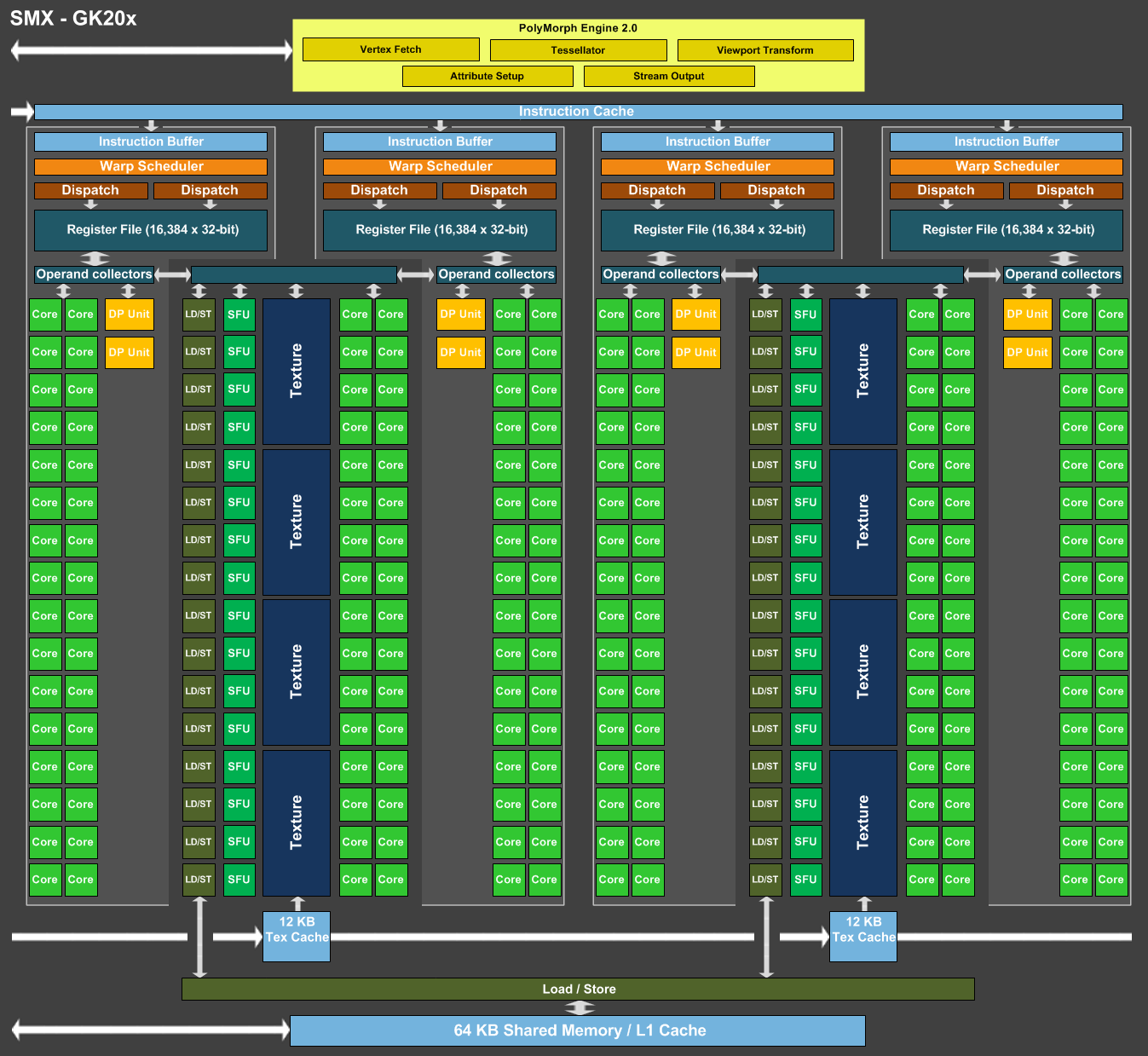
Nvidia also has 2 architectures at 28 nm, in fact, they have 2 architectures plus 3 revisions of these (original Kepler, bigkepler-gpgpu or GK110, "refined-betamaxwell" Kepler with the GK208, and in Maxwell, 1.0 and 2.0):
(to see SMX/SMM schematics and changes, go to the spoiler)
!

! The first Kepler is the "mainstream" or "performance" chip, designed for GeForce cards and with less consideration for GPGPU, especially in scientific contexts, which is why its DP power is reduced, not capped as happens with GeForcees based on GK110 (except the Titan, that hybrid product).
!
! The SMX of the GK110 is not actually identical, not only because of its much more powerful DP, but also because of how the cache works, since for example the texture cache also functions as an ordinary data cache, there's no need to associate data with textures as happens with the GK104 (purely GPGPU functionality).
! Between both chips, the most radical change is on a larger scale, in the GK110, they bet on computational density rather than purely rendering characteristics, which is why in each GPC there are 3 SMX (basic processing unit for 3D, since it basically does all the steps of the graphics pipeline except the final pixel writing to VRAM or handling AA), and not the 2 SMX of the GK104. The bet is clear towards computing (also in a larger L2, proportionally, it's triple when it shouldn't be more than 50% of the GK104 if its design were strictly scaled up for more power).
!
! The GK208 is a curious experiment, where Nvidia made some steps prior to simplifying the SMX that would end up in Maxwell's SMMs, they begin to rebalance units that are not as used as hard shared between two schedulers (it's, to compare with something, like "cores" in a multicore system, they handle the "threads/processes" that are the shader streams to be executed, and can send more than one instruction to execute simultaneously, hence why Kepler has some difficulty reaching maximum use of its hard in certain environments and that's why this redesign, which is based on the principle of less is more, sharing what is far from a 100% workload).
!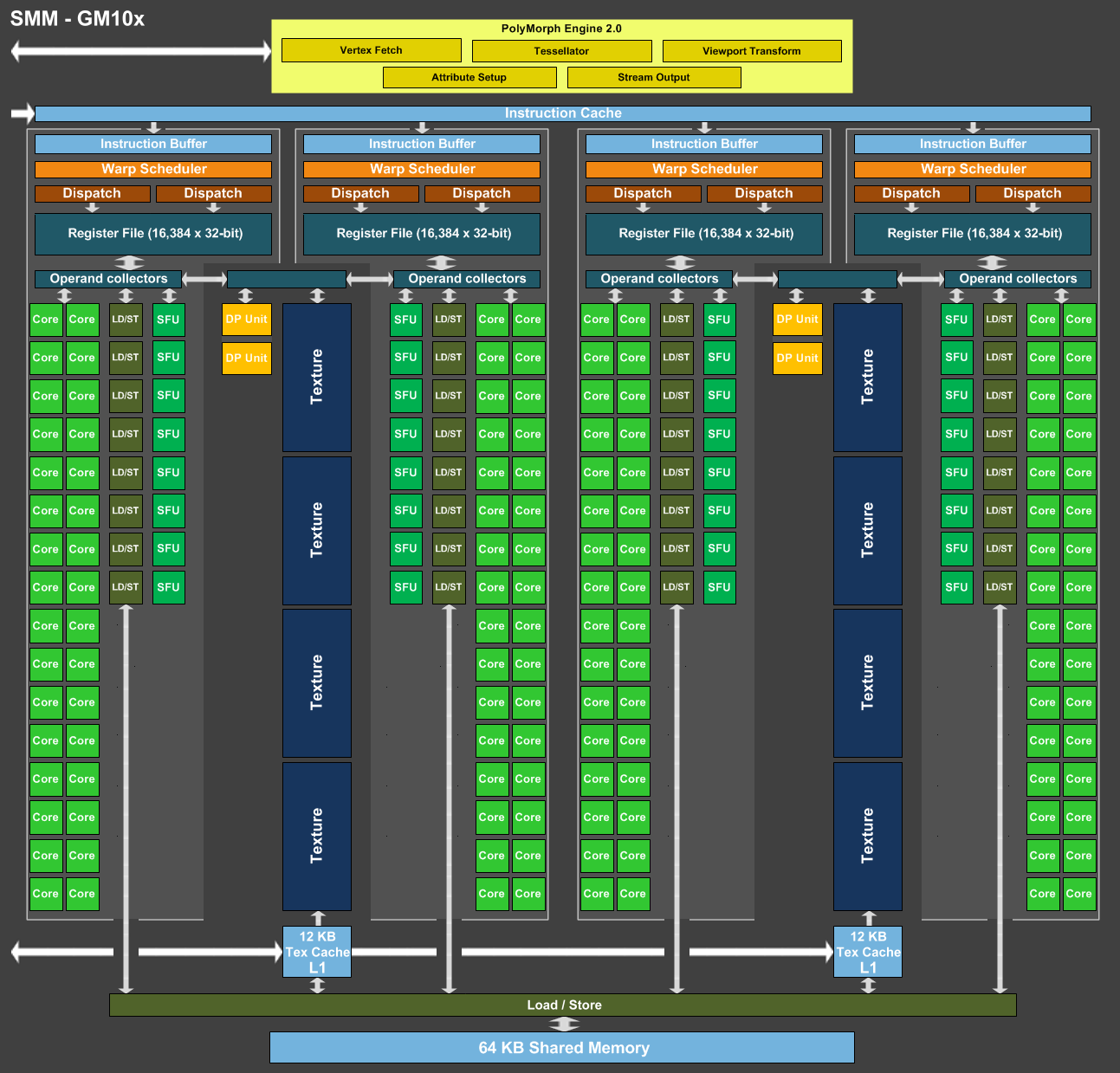
! Maxwell 1.0 of the GTX 750, here we already see the final facelift of the SMMs vs SMX, each SMM can in optimal circumstances render as an SMM, but with much less execution hard. Drastic changes like the massive L2 and putting 5 SMMs per GPC instead of the 2-3 SMX per GPC of the Keplers are part of its hallmark.
!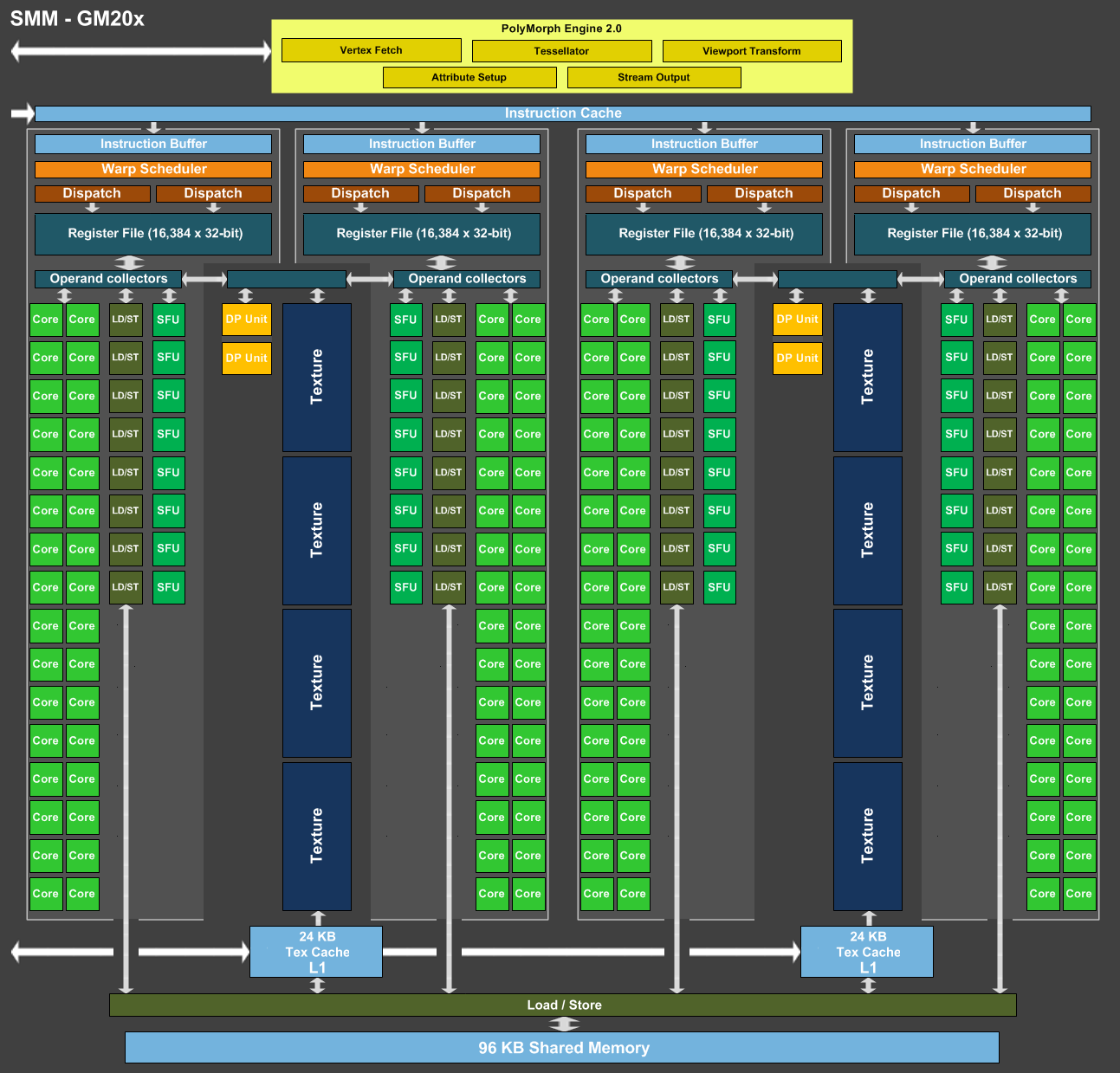
! Maxwell 2.0, not only changes the balance of SMMs per GPC again to reduce it to 4 SMM per GPC, which is a sign of a greater orientation towards 3D (I repeat, each GPC acts as a mini GPU capable of processing from the first geometric stages to "spit out" pixels already processed and to send to memory via ROPs, lowering the number of SMMs in Maxwell 2.0 allows making them somewhat more compact). But it also makes "unnoticed" changes like increasing the L1 caches and the shared memory of each SMM, in one case doubling it and in another increasing the size by 50%, possibly to compensate for small caches.
!In short, AMD is not so limited by the 28 nm process because they have "played all their cards", their redesigns around GCN 1.0, 1.1 and 1.2 are not even as many as the redesigns Nvidia has made in their chips, which says less but does them and sometimes without warning (GK208 is the best example).
Nvidia could perfectly release a chip of greater power at 28 nm that would rival the size of the GK110, it's even relatively easy for them having as a template a GM204 of just under 400mm2:
Increase the hard of the GM204 by 50%, you would get a chip of just under 600mm2, only marginally larger than the GK110, and with a power possibly much superior (6 GPCs, 3072 CC, 24 SMMs, 3 MB L2 and 384-bit bus, all this they can do right now, if they want, and even probably could recycle the PCB of the GK110 for this, as they have done between GK104 and GM204).
AMD hasn't burned their cards, because despite being "hot/hungry" as the relatively large Hawaii (460mm2, not much larger than the GM204, but with equal or superior power consumption to the GK110), they can very possibly revise their architecture as they did with Tonga, as they did with Hawaii itself and others, and achieve the balance they don't have today in terms of consumption.
It is supposed that the collaboration with Synopsis, a company with which they have reached a long-term agreement, resulted in 2 graphics chips with "revised consumption", one is Tonga (greater than 350mm2 said the Synopsis note, it must be this one), which may not be very successful but has fixed something regarding Hawaii in terms of tessellation, to begin with, and another is an unknown chip larger than Hawaii (greater than 500mm2).
I hope they refine this more, but at the very least they will have fixed the problems of Hawaii with tessellation that were not up to expectations (Hawaii should be at least twice as competent as Tahiti in this, and normally its advantage was much smaller, Tonga already demonstrates that it could be done better surpassing Hawaii in this).
500mm2 allows for a lot of redesign, being the larger chip, although it's not a technical marvel that advances the situation much, it will probably offer more performance, at least that. And if there's luck and they have worked and aimed better than with Tonga vs Tahiti at the problems of Hawaii with this replacement, enough to not only match the GM204s, but perhaps even match a possible "big Maxwell" at 28 nm. Or at least compete against its entry-level flavors.
-
Nvidia también lleva 2 arquitecturas a 28 nm, de hecho son 2 arquitecturas más 3 revisiones de éstas (kepler original, bigkepler-gpgpu o GK110, kepler "refinado-betamaxwell" con el GK208, y en maxwell, 1.0 y 2.0):
(para ver esquemas de SMX/SMM y cambios ir a spoiler)
!
! El primer kepler es el "mainstream" o "performance, el chip pensado para tarjetas geforce y con menor consideración a GPGPU de ámbito sobre todo científico, por eso su potencia DP es reducida, no capada como pasa con las Geforce basadsa en GK110 (excepeto las Titan, ese producto híbrido).
!
! El SMX de los GK110 en realidad no es idéntico, no sólo por el tema de su coma en DP mucho más potente, sino también por el funcionamiento de la caché, ya que por ejemplo la caché de texturas funciona también como una caché de datos ordinaria, no hace falta asociar los datos a texturas como pasa con el GK104 (funcionalidad puramente gpgpu).
! Entre ambos chips el cambio más radical está sin embargo a mayor escala, en los GK110 se apuesta por la densidad de cómputo que por las características más puramente de render, por eso en cada GPC hay 3 SMX (unidad de proceso "básica" para 3D, ya que básicamente hace todos los pasos de la pipe gráfica excepto la escritura final del pixel a VRAM o manejo de AA), y no los 2 SMX del GK104. La apuesta es clara hacia el cómputo (también en L2 más grande, en proporción, es el triple cuando no debería ser más que el 50% del GK104 si siquiera su diseño a rajatabla y lo "escalara" para mayor potencia).
!
! El GK208 es un curioso experimento, donde nvidia hizo unos pasos previos a la simplificación del SMX que acabaría en los SMM de Maxwell, se empieza a rebalancear baterías de unidades no tan usadas como hard compartido entre dos schedulers (es, por comparar con algo, como si fueran "cores" en un sistema multicore, manejan los "hilos/procesos" que son los streams de shaders a ejecutar, y pueden enviar más de una instrucción a ejecutar simultáneamente, de ahí que kepler tenga cierta dificultad para alcanzar uso máximo de su hard en ciertos entornos y por eso este rediseño, que se basa en el principio de que menos es más, compartir aquello que está lejos de una carga de trabajo del 100%).
!
! Maxwell 1.0 de las GTX 750, aquí ya vemos el lifting final de los SMM vs SMX, cada SMM puede en circunstancias óptimas rendir como un SMM, pero con mucho menos hard de ejecución. Cambios drásticos como la masiva L2 y meter 5 SMMs por GPC en vez de los 2-3 SMX por GPC de los kepler, son parte de su sello.
!
! Maxwell 2.0, no sólo cambia otra vez el balance de SMMs por cada GPC para reducirlo a 4 SMM por GPC, que es una seña de una mayor orientación a las 3D (repito, cada GPC actúa como una minigpu capaz de procesar desde las primeras etapas geométricas hasta "escupir" píxeles ya procesados y a enviar a memoria por ROPs, bajar la cantidad de SMM en Maxwell 2.0 permite más GPCs al hacerlos algo más compactos). Sino que también hace cambios "inadvertidos" como el aumento de las cachés L1 y la memoria compartida de cada SMM, en un caso duplicándolo y en otro aumentando el tamaño en un 50%, posiblemente para compensar cachés pequeñas.
!En definitiva, AMD no está tan limitada por el proceso de 28 nm porque haya "gastado todas sus cartas", sus rediseños entorno a GCN 1.0, 1.1 y 1.2 no son ni siquiera tantos como los rediseños que ha hecho nvidia en sus chips, que lo dice menos pero los hace y a veces a la chita callando (GK208 el mejor ejemplo).
Nvidia podría perfectamente sacar en 28 nm aún un chip de mayor potencia y que rivalizara con el tamaño del GK110, lo tiene hasta relativamente fácil teniendo como plantilla un GM204 de 400mm2 escasos:
Aumentar el hard del GM204 en un 50%, le saldría un chip de 600 mm2 escasos, sólo marginalmente más grande que el GK110, y con una potencia posiblemente muy superior (6 GPCs, 3072 CC, 24 SMMs, 3 MB L2 y bus de 384 bits, todo esto lo puede hacer ahora mismo, si quiere, e incluso seguramente podría reciclar el PCB de los GK110 para esto, como ha hecho entre GK104 y GM204).
AMD no ha quemado sus cartas, porque a pesar de lo "caliente/tragón" que es el relativamente grande Hawaii (460mm2, no mucho más grande que el GM204, pero con consumos igual o superiores al GK110), muy posiblemente puede revisar su arquitectura como hizo con Tonga, como hizo con el propio Hawaii y otros, y conseguir el balance que no tiene hoy en día en consumos.
Se supone que la colaboración con Synopsis, empresa con la que ha llegado a un acuerdo a mayor plazo, dió como resultado 2 chips gráficos con "consumo revisado", uno es Tonga (>350 mm2 decía la nota de Synopsis, tiene que ser éste), que quizás no sea muy exitoso pero algo ha arreglado respecto a Hawaii en temas de teselación, para comenzar, y otro es un chip desconocido más grande que Hawaii (>500 mm2).
Espero que hilaran más fino con éste, pero como mínimo habrán arreglado los problemas de Hawaii con el teselado que no estaban a la altura de las expectativas (hawaii debería ser como poco el doble de competente que Tahiti en esto, y normalmente su ventaja era mucho menor, Tonga ya demuestra que se podía hacer mejor superando a Hawaii en esto).
500 mm2 dan para mucho rediseño, siendo el chip más grande, aunque no sea una maravilla técnica que avance mucho la situación, posiblemente sí ofrece más rendimiento, como poco. Y si hay suerte y han trabajado y apuntado mejor que con Tonga vs Tahiti a los problemas de Hawaii con este relevo, lo suficiente como, ya no igualar a las GM204, sino quizás igualar a un posible "maxwell grande" a 28 nm. O cuanto menos competir contra sus sabores de entrada.
Espero que saque algo y fuercen a nvidia a sacar algo que suponga un avance mas claro, por que lo que esta ocurriendo es que cada vez avanzan menos en rendimiento y los precios suben.
Si ahora la 970 cuando se asiente en precio no esta mal, pero tendrían que dar pasos mas grandes en rendimiento, lo del consumo esta bien pero a mi lo que me convence es el rendimiento.Si sacan algo potente y que consuma poco se agradece pero dar pasos de 15 o 20% me parecen una miseria,
espero que no hagan como Intel que da con cuentagotas y nunca baja de precio, además capando el OC a muchos procesadores.
Por eso espero que AMD saque algo y pueda haber mas competencia y sobretodo un ajuste en precios.saludos
-
I hope they come up with something and force NVIDIA to release something that represents a clearer advancement, because what's happening is that they're advancing less and less in performance and prices are going up.
If the 970 is not bad now when it settles in price, but they would have to make bigger steps in performance, the power consumption is fine but what convinces me is performance.If they release something powerful and that consumes little it's appreciated but making steps of 15 or 20% seem like a pittance to me,
I hope they don't do like Intel that gives it out drop by drop and never lowers the price, besides capping OC on many processors.
That's why I hope AMD releases something and there can be more competition and above all an adjustment in prices.regards
This time they have a pretty good excuse: There's no 20 nm process available with the capabilities they need.
They still have room to use the 28 nm process with Maxwell and a "superchip", which demonstrates the great work done, but let's not be mistaken, Maxwell is much better in consumption, and a little better in performance per mm2, but only a little better than... the GK104. Which is the chip designed only for 3D in Kepler.
300 mm2 vs 400 mm2, 33% more area, and a performance that exceeds 50% comfortably with the GTX 980 (comparing apples to apples). In reality per mm2 the performance improvement should be around 10%, yes, accompanied also by an important consumption improvement.
Against the GK110 the ratio seems much better, but the authentic equivalent between GM204 and GK110 is comparing "very capped" chips or the 100% whole ones, and there it comes to GTX 980 vs 780 Ti, which also have good OC margins both. The improvement is repeated, and it may seem like a great use of the much more reduced area of GM204, which it is, but as always the GK110 is not only designed for games. Or its genetics in that sense are not as pure as GM204 or GK104, which are chips 100% oriented for 3D.
With these resources this is what NVIDIA can work with, for now. If it were necessary they would surely release something more powerful, but that depends on what they have to wait for the 20 nm and to what extent they are willing to release a "GM210" with the possibility of:
Being more oriented towards 3D than the "average" of large chips. After all the GM204/107 are good in GPGPU except in DP floating point, and they are not entirely horrible in this either (looking only at GeForce, against Tesla it's another story).
A light version of the "authentic GM210 of 20 nm", with less execution hard in total, but significantly more than the GM204. I can't get out of my head that the GM204, even being such a powerful chip, would not cease to be a really small chip at 20 nm, 200 mm2, which would place it perfectly against the range of cards like GTX 660 and similar. And that NVIDIA has always hovered more around those 300 mm2 for the performance chips lately.
But of course, the need (28 nm instead of 20 nm), fires the imagination. For now this is what we have, a little more power, less consumption, and "round" cards despite seeming "modest" by total figures. Perhaps something "big" will come out in a few months, but I think the leap of maxwell showing everything it is capable of will be when it moves to a smaller manufacturing process.
-
MSI still does not change the HDMI 1.4a specificationsMSI GeForce GTX 970 Gaming 4G [Review] | El Chapuzas Informático - Part 3
Review of MSI GTX 970
On the external side of the MSI GeForce GTX 970 Gaming 4G we find two DVI outputs, one completely digital (DVI-D) and another that also offers analog image (DVI-I) to be used together with the DVI-VGA adapter, although we must note that both allow a maximum resolution of 2048 x 1536 @ 60 Hz. They are joined by HDMI and DisplayPort outputs that do allow reaching 4096 x 2160 pixels (4K), but HDMI only allows 30 Hz at that resolution and DisplayPort does allow reaching 60 Hz. When buying a 4K monitor/TV we must bear in mind that if it does not have a DisplayPort input we will not be able to enjoy that resolution at 60 Hz, although perhaps it is still a bit early to worry too much about this aspect.
-
MSI sigue sin cambiar las especificaciones de HDMI 1.4a
MSI GeForce GTX 970 Gaming 4G [Review] | El Chapuzas Informático - Part 3
Review de MSI GTX 970
En el lado externo de la MSI GeForce GTX 970 Gaming 4G encontramos dos salidas DVI, una completamente digital (DVI-D) y otra que ofrece también imagen analógica (DVI-I) para ser usada junto al adaptador DVI-VGA, aunque debemos anotar que ambas permiten una resolución máxima de 2048 x 1536 @ 60 Hz. A ellas se suman salidas HDMI y DisplayPort que si permiten alcanzar los 4096 x 2160 pixeles (4K), pero HDMI solo permite 30 Hz a dicha resolución y DisplayPort si permite alcanzar los 60 Hz. A la hora de comprar un monitor/televisor 4K debemos tener en cuenta que si no tiene entrada DisplayPort no podremos disfrutar de dicha resolución a 60 Hz, aunque quizás todavía es algo pronto para preocuparse demasiado por este aspecto.
La Gigabyte si tiene HDMI 2, de todas formas están bajando bastante las 780.
Gigabyte GeForce GTX 780 Windforce rev2.0 3GB GDDR5 GV-N780WF3-3GD Tarjeta Gráfica
http://xtremmedia.com/Gainward_GeForce_GTX_780_Phantom_3Gb_Gddr5.htmlComo sigan bajando lo mismo monto otra, aunque están bien las nuevas tecnologías que traen las 900, pero no paran de subir, pues hay mucha demanda y una 780 sigue siendo un pepino.
Al menos se anima un poco el mercado con ofertas.
saludos
Esta vez tienen una disculpa bastante buena: No hay proceso de 20 nm disponible con las capacidades que necesitan.
Aún tienen margen para usar el proceso de 28 nm con Maxwell y un "superchip", lo cual demuestra el gran trabajo realizado, pero no nos equivoquemos, Maxwell es bastante mejor en consumo, y un poco mejor en rendimiento por mm2, pero sólo un poco mejor que… el GK104. Que es el chip diseñado sólo para 3D en Kepler.
300 mm2 vs 400 mm2, un 33% más de área, y un rendimiento que supera el 50% holgadamente con la GTX 980 (comparando peras con peras). En realidad por mm2 la mejora en rendimiento debe andar sobre el 10%, eso sí, acompañada además de una mejora en consumo importante.
Contra el GK110 la relación parece mucho mejor, pero el auténtico equivalente entre GM204 y GK110 está en comparar a chips "muy capados" o a los 100% enteros, y ahí toca GTX 980 vs 780 Ti, que además tienen buenos márgenes de OC ambos. La mejora se repite, y puede parecer un gran uso del área mucho más reducida del GM204, que lo es, pero como siempre el GK110 no sólo está diseñado para juegos. o su genética en ese sentido no es tan pura como el GM204 o el GK104, que son chips 100% orientados para el 3D.
Con estos mimbres es con lo que puede trabajar nvidia, de momento. Si hiciera falta seguro que saca algo más potente, pero eso depende de lo que tenga que esperar por los 20 nm y hasta qué punto está dispuesto a sacar un "GM210" con posibilidad de:
Estar más orientado a 3D que la "media" de chips grandes. Al fin y al cabo los GM204/107 son buenos en GPGPU excepto en coma flotante de DP, y tampoco son horrendos del todo en esto (mirando sólo a Geforce, contra Tesla ya es otra historia).
Una versión light del "auténtico GM210 de 20 nm", con menos hard de ejecución en total, pero sensiblemente más que el GM204. No se me quita de la cabeza que el GM204, aún siendo un chip tan potente, no dejaría de ser un chip realmente pequeño a 20 nm, 200 mm2, lo cual lo colocaría perfectamente contra la gama de tarjetas como GTX 660 y similares. Y que nvidia siempre ha rondado más esos 300 mm2 para los chips performances últimamente.
Pero claro, la necesidad (28 nm en vez de 20 nm), dispara la imaginación. De momento esto es lo que tenemos, un poco más de potencia, menos consumo, y tarjetas "redondas" a pesar de parecer "modestas" por cifras totales. Quizás salga algo "gordo" en unos meses, pero me da que el salto de maxwell mostrando todo lo que es capaz, será al pasar a un proceso de fabricación menor.
Pero este GM204 en 20nm seria pequeño no? además creo que Maxwell sobretodo estos performance se habían diseñado para 20nm supongo, pero viendo que el invento del GM107 les salio bien y que no para de retrasarse los 20nm decidieron sacar estas a 28nm.
Ahora mismo ese proceso ya debe ser mas barato y podían haber puesto mejores precios, sobretodo a la 980, por que es mucha diferencia con la 970, de todas formas viendo como están bajando las 780 quizá pretendían no canibalizarse ellos mismos, aunque con la 970 no solo canibalizan a la 780 sino que también a la Ti.
saludos


Hello! It looks like you're interested in this conversation, but you don't have an account yet.
Getting fed up of having to scroll through the same posts each visit? When you register for an account, you'll always come back to exactly where you were before, and choose to be notified of new replies (either via email, or push notification). You'll also be able to save bookmarks and upvote posts to show your appreciation to other community members.
With your input, this post could be even better 💗
Registrarse Conectarse