QLC memories are arriving
-
Toshiba has announced that it is developing QLC flash memory chips for building SSDs, which will make it easier to manufacture high-capacity drives.
Read more...
Toda la actualidad en la portada de Hardlimit
Mis cacharros -
The higher the density, the slower the cell deteriorates faster, but for the average user, the lifespan of an SSD is usually not a problem. The norm among mere mortals is to store a lot of data but then access it sporadically. I think this fact, along with trim, makes the durability of SSDs (as someone once said) not a big deal, in other words, it's a minor issue.
-
The problem is that it goes from about 1000 write cycles in TLC to about 100 in QLC, so this type of disk would, in the use of a normal user, enter a very high error rate within the warranty. It seems that the use is for services of one recording and multiple readings, such as web video servers with very high user concurrency. QLC is not useful yet for the common user.
-
@kynes Out of curiosity, do you know what the physical process of deterioration of flash memories consists of? That is, if there is no mechanical wear and tear process, why do they have a determined lifespan and, for example, RAM has an "infinite" lifespan?
Toda la actualidad en la portada de Hardlimit
Mis cacharros -
@cobito I'll answer you tomorrow if I remember, today I have an exam and I can't dedicate time to it. Getting a degree by distance learning is more of a pain in the ass than I thought.
-
@cobito nothing has infinite life, or so my digital electronics teacher said, the thing is that volatile memory does not make permanent changes while non-volatile memory does, that's why it has more wear. The same thing happens with mechanical hard drives, the case is that they have protection measures so when a sector is faulty it is omitted. Anyway, I read that SD cards have a life of about 100,000 cycles, SCL, but I imagine it will depend on the type of card and the memory it uses.
Transistors also have a lifespan and depending on the type they are, it is greater or lesser.
PD. Curious what changes is the tolerance to deterioration, the more states it has to detect in the same transistor, the less tolerance to the loss of retention capacity. Then each transistor will have its quality and each chip will be different, they will estimate what the approximate duration is depending on the quality of the chip, the working conditions and the layers.
-
¡Esta publicación está eliminada! -
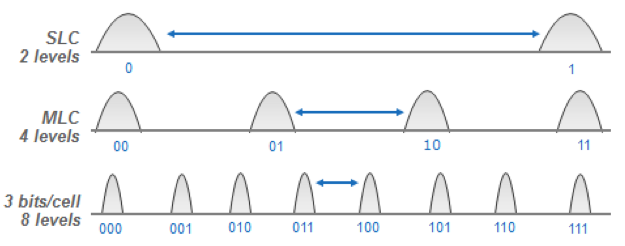
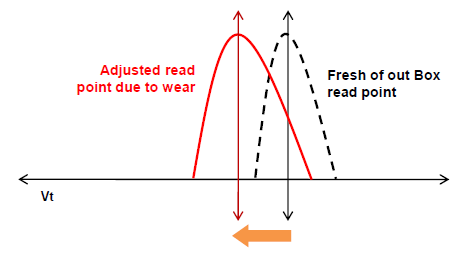
Well, from what I understand, the issue is that the cells of an SSD retain a certain amount of electricity to generate a voltage to indicate the state, which can be two in an SLC, four in an MLC, eight in a TLC or sixteen in a QLC. The problem is that over time, the materials, as Bm4n indicates, wear out, the insulating layers have fewer atoms in thickness, and they lose properties with each write cycle. That's why, when they used to record a state represented by a voltage of 0.8V, after a thousand cycles perhaps that same input voltage records 0.65V, because the insulating layer has worn out and retains less electricity in the cell.
In an SLC cell it's not as serious because with two states, the margins are much higher, so the bands that represent zero and one are wide, with large error margins. In a QLC cell you need sixteen possible distinct states, the error margins are very small, so a variation of a few tens of mV can generate an erroneous data, with the consequent invalidation of the cell by the disk controller.
I don't know if you remember the problem that Samsung had with the 840EVO, which started to slow down a lot after certain use, this was due to the fact that it began to suffer from the wear of the TLC cells (it was the first Samsung disk that used them) and the error correction system of the controller had to work hard. The solution was to alter the read voltage of the data depending on the wear of the disk, to correct the lower retention of electricity by the cells.
In the following link from anandtech it explains what happened, and the solution they gave to the problem:
http://www.anandtech.com/show/8617/samsung-releases-firmware-update-to-fix-the-ssd-840-evo-read-performance-bugPD: Sorry for the delay, I still have a week of exams and studying near forty is hell.
-
@Bm4n said in QLC memory arrives:
@cobito nothing has infinite life, or so my digital electronics professor said, the point is that volatile memory does not make permanent changes while non-volatile memory does, which is why it has more wear. The same thing happens with mechanical hard drives, the point is that they have protective measures so when a sector is faulty, it is omitted. Anyway, I read that SD cards have a lifespan of about 100,000 cycles, SCL, but I imagine it will depend on the type of card and the memory it uses.
Transistors also have a lifespan and depending on the type they are, it is greater or lesser.
P.S. It's curious how what changes is the tolerance to deterioration, the more states it has to detect in the same transistor, the less tolerance to the loss of retention capacity. So each transistor will have its quality and each chip will be different, they will estimate what the approximate duration is depending on the quality of the chip, the working conditions and the layers.
You're absolutely right, Bm4n, I remember the professor from a subject with such a pompous name as "technology of electronic and photonic components" who always told us about the wear of mos transistor materials, the thickness of the oxide layer that acted as an insulator, the possibility of breaking the transistor channel and its incidence on processors.
All chips have a lifespan, overclocking plays with that, you increase the frequency, the working temperature, the input voltage, and with that you reduce the lifespan. The thing is that the user does not need their processor to last twenty years, if it lasts five years with more performance they are satisfied.
-
@kynes said in QLC memory arrives:
All chips have a lifespan, overclocking plays with it, you increase the frequency, the operating temperature, the input voltage, and with it you reduce the lifespan. The thing is that the user does not need his processor to last twenty years, if it lasts five years with more performance he is satisfied.
You will say that for yourself, my 2500K has just turned five


:rofl:
>> i7-2600K Sandy Bridge @4.4GHz || Noctua NH-D14 || ASRock Z77 Extreme4 || 4x8Gb G.Skill Ripjaws X DDR3 1600MHz || XFX RX 5700 XT 8Gb || SSD Samsung 850 PRO 256Gb & 850 EVO 500Gb || WD Caviar Green 1Tb || Barracuda 1Tb || Corsair TX650 V2 || M-Audio Fast Track Pro || KRK RP8 RoKit G3 || BenQ GW2750 27"
>> Athlon 64 X2 5600+ Brisbane @2.9GHz || Gigabyte GA-M61PME-S2 || 2x2Gb DDR2 Kingston 800MHz || Sapphire Radeon HD 5850 Xtreme 1Gb || Maxtor 320Gb SATA2 || OCZ ModXStream 500W Modular || TEAC PowerMax 120/2 || Acer X243w 24"
>> Intel Core2Duo E6600 Conroe @2.4GHz || Asus P5N32-SLI SE DELUXE || 2x1Gb DDR2 Kingston 800MHz || Asus nVidia GeForce 9800GT 1Gb GDDR3 || Seagate Barracuda IDE 80Gb 7200RPM || Linkworld LPK12-35 450W -
@Sylver said in QLC memories arrive:
You say that for you, my 2500K has just turned five
:rofl:
Yeah, well, intel's been crazy the last few years...
-
And at the rate we're going, I think you'll reach 15 years old...






Hello! It looks like you're interested in this conversation, but you don't have an account yet.
Getting fed up of having to scroll through the same posts each visit? When you register for an account, you'll always come back to exactly where you were before, and choose to be notified of new replies (either via email, or push notification). You'll also be able to save bookmarks and upvote posts to show your appreciation to other community members.
With your input, this post could be even better 💗
Registrarse Conectarse