Questions about NAS
-
@cobito is that I once found myself in the same situation as you, I felt like wasting time researching and testing on virtual machines, to get a feel for this little world. I was also lucky enough to see some things at work, where the base is in Xigmanas and I started to get small ideas of how everything works.
But after a lot of testing, researching and realizing that I needed to learn more things to have my data under control...I ended up with OMV because of its simplicity and because when the raid degraded it was easier for me to repair the problem. My biggest concern is having control over my data, which unfortunately Windows gives me.And although I have OMV working, I have practically touched it very little and it frustrates me because if I have to do some rescue I will have to spend some time...although for example with Xigmanas or FreeNas I would probably have an even worse time.
By the way, if you want to do some testing with Xigmanas...it might be an option that interests you, I don't know.By the way, great tests and the information you provide. A thousand thanks for the hard work, really

Take care!
P.D: I am now doing a course on Windows server 2016/2019 but I will see if I finish it and install a machine with Linux to have more knowledge and be able to consider this option for storing data and being able to recover it in case of a possible failure.
I bought an OEM license of 2012 R2 and with a low-power Xeon 1150 I have my small server set up...but in the future it would be great to be able to use a Linux server or to delve deeper into Nas based on Linux distro. -
@Mystique said in nas hardware:
I see it all...
OMV doesn't boot from usb? Most people do and once it loads into RAM it's not accessible...
In my case I have it with a 16GB 2.0 USB (in my case I don't know why but the 3.0 ones wouldn't read for booting, even though it's a 775 board).
The only thing that worries me a bit is the degradation of the flash memory, with what I've read it's a good idea to make a backup of the configuration and when that memory fails you put another one... the only thing is that the restoration thing seemed to cause problems and I directly made an ISO, so I avoided any hassle.
@cobito initially thought about putting a disk but in the long run it seemed like too much space (even if it's 2.5 a usb memory is smaller) and a lot of wasted size.
However if your intention is to do some scraping on that disk of configurations and such, go ahead -
@cobito said in nas hardware:
About the Red and Purple drives, despite all I've read around, I don't see anything beyond the obvious that one is for video surveillance and the other for NAS. That was one of the questions I had pending.
The "Purples" are for surveillance systems since they are constantly writing and their characteristics are to offer good performance for this type of task. I don't know more characteristics, but I bet they will have worse performance for reading information since their mission is to write at full capacity.
The "Reds" are intended for storage because, among other things, they have anti-vibration systems that help improve their durability (small vibrations that the drives emit and, when they are together, can end up damaging the drive), which is why they are used for NAS and some servers.I also didn't know certain characteristics of drives, but in the long run you realize small details that, after years or a few months, could cause problems in the long run.
-
Since the cake has been discovered, I'll tie the thread here.
@Mystique the truth is that I hadn't thought of the USB memory. I have around here a few 2.5" hard drives of 120 and 160GB and I had planned to use one of them.
@_Neptunno_ This week I'll have time, so I'll probably start playing with Xigmanas. The truth is that I didn't know it. At first glance (reading over on their website) it seems that it's cooked in the same pot as FreeNAS.
On the subject of Linux vs Windows, in the end they are two different operating systems. The practical reasons why I like Linux is for its modularity but it's clear that the homogeneity of Windows ends up being more comfortable. In the end I have who knows how many text files with procedures to do things: update the forum platform, Peertube, crontab, SSL certificate management, etc... because they are things that I touch from figs to brevas and I forget. On the one hand it's a pain but on the other hand you have absolute freedom to do whatever you want. In addition, the documentation and support in known distros (Debian in my case) is immense.
Continuing with the USB topic, if @Mystique is right that it loads into a ramdisk, in principle there wouldn't be as much problem of degradation. It would save me 40€ from the controller. It's something I'll think about.
Regarding the types of disks, it's a bit clearer to me. In price the difference is minimal so if the Reds have the vibration issue, I'll go for them.
Toda la actualidad en la portada de Hardlimit
Mis cacharros -
@_Neptunno_ said in NAS doubts:
In my case I have it with a 16GB 2.0 USB (in my case I don't know why but the 3.0 ones didn't read them to boot, although it's on a board for 775).
I also had the same problem with freenas when I started, that the usb 3 gave more problems than the 2
@cobito most distributions for NAS boot from usb and it's not touched again. Using a disk is completely wasting it (and useless in my opinion)
For that, use it as cache, that you might use it more. I put a 250 GB SSD for the movie volume (4x6TB) although I ended up removing itAs I said, I started with freenas and as I couldn't get what I wanted, I moved to xpenology. Much easier to set up and use. And as I said, in my case the usb is a bootloader that loads the system initially and then it's not used. The system and applications are on the first volume that is created at the beginning
-
@Mystique said in Dudas sobre NAS:
xpenology
In case @cobito wants some information about Xpenology (the operating system that uses Synology Nas):
-
Xigmanas
At the suggestion of @_Neptunno_, I've taken a look at XigmaNAS. The essence is quite similar to FreeNAS but with additional options. Of all the interfaces I've seen so far, this is the least user-friendly.
Please note that in these tests I am omitting most of the features, such as the repertoire of communication protocols.
Since ZFS is not capable of adding new disks to a "pool", I will focus on RAID functions.
Preparing the system
Once installed, you have to manually add the disks:
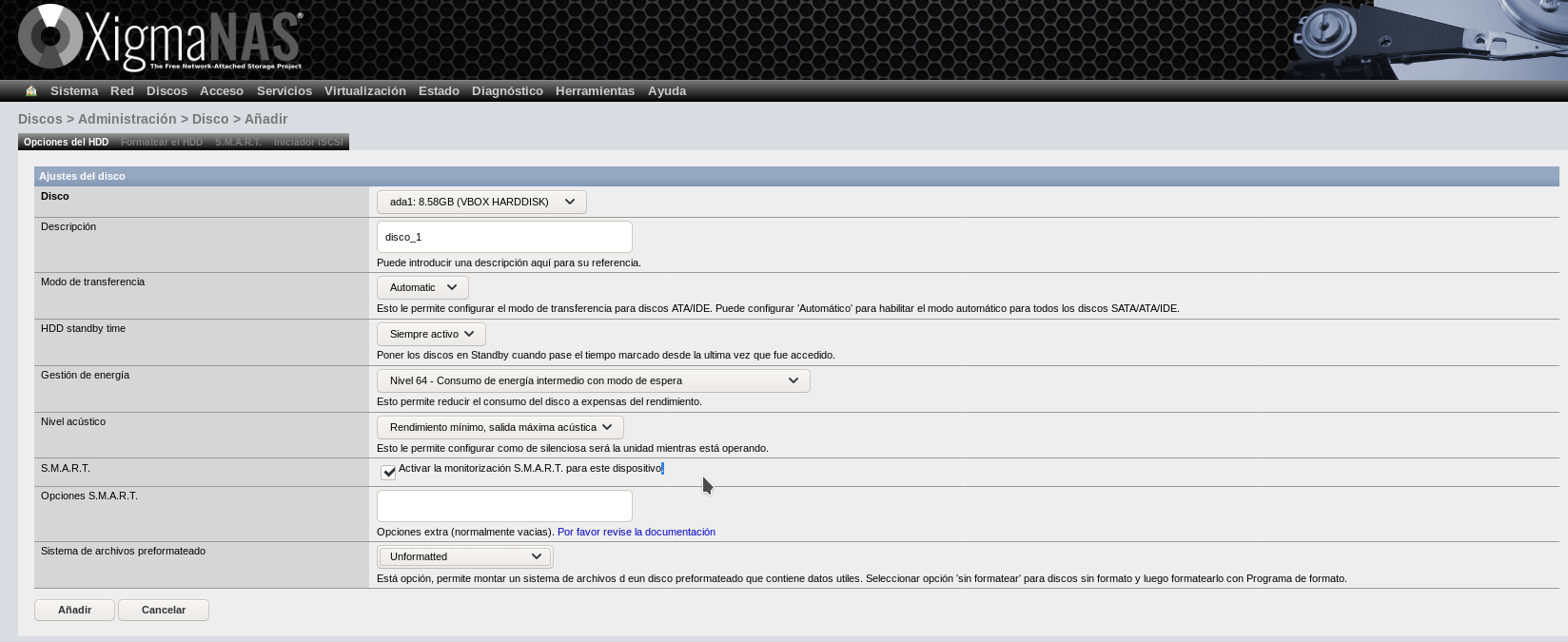
Just like FreeNAS (something I haven't commented on in its mini-analysis) and unlike OMV, it is possible to choose the power consumption policy of each drive.
Once added, you have to format them in "Software RAID" format (otherwise, you can't create the RAID), which I find a bit disconcerting, to be honest:
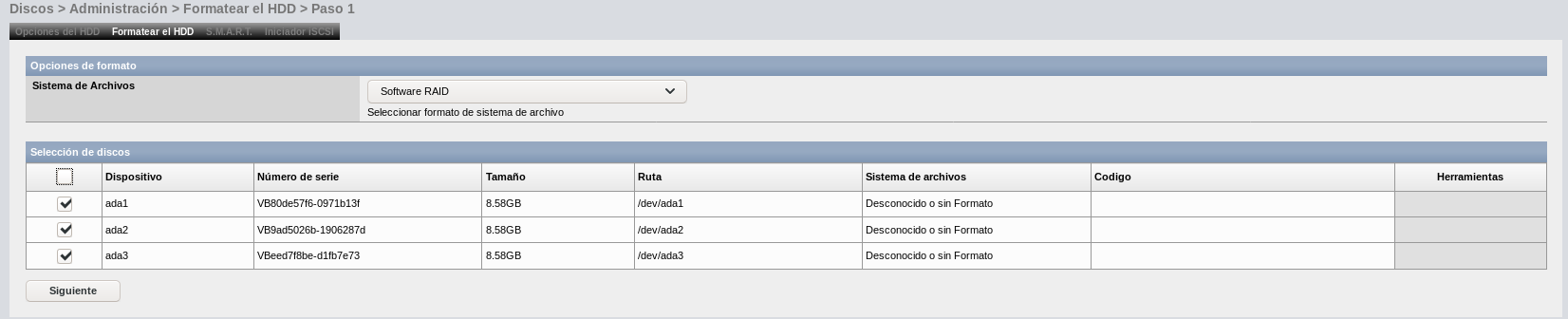
Once formatted, you can now create the RAID:
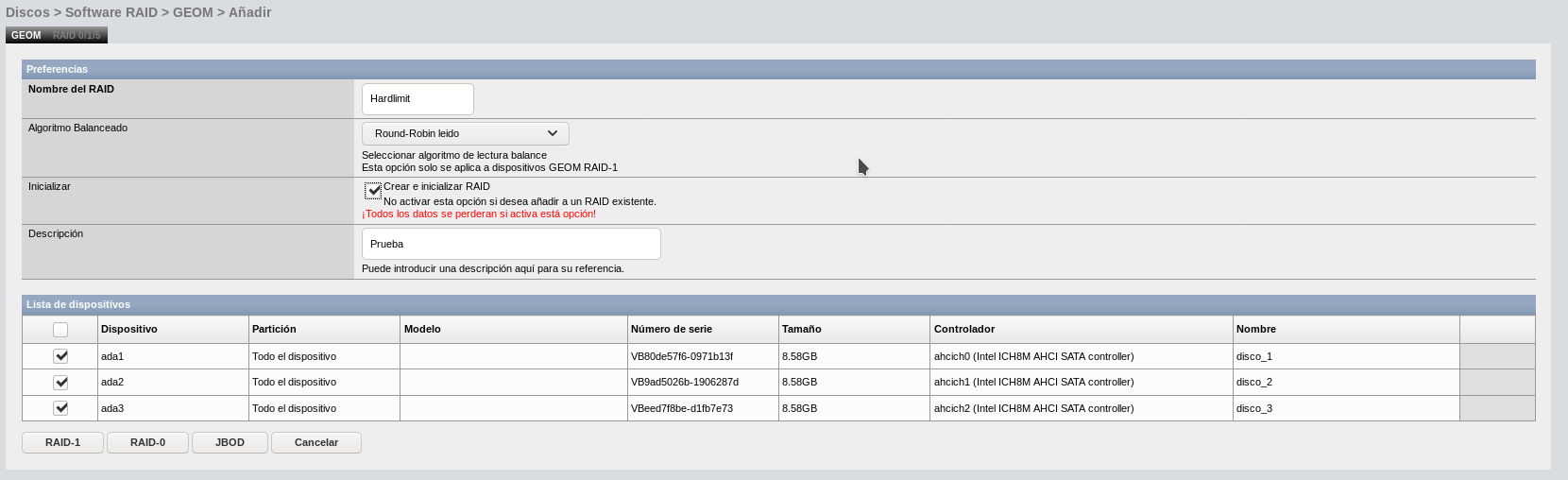
XigmaNAS has the novelty so far of the possibility of creating a "JBOD" drive (acronym for "simply, a handful of disks"). It is not a RAID but what it does is to unite the capacities of different disks (which can have different sizes) and store data contiguously. If one of the disks breaks, you lose the data that was on that disk but not the data on the rest. It may be interesting for storing things without much value, but having a semi-serious NAS with this, I don't think it's a good idea.
As you can see, there is no option to create a RAID 5 and I can't find information about it out there, so if I haven't missed something, this distro is not for me. Having ZFS, it is possible that the higher levels are reserved for this file system.
Xpenology
Reading these instructions, I think I'm going to skip this option directly. In the "Known compatible motherboards" section, only 4 models appear and for one of them, WOL doesn't even work. I imagine it will be compatible with more boards and, in the end, being able to detect the hard drives and the network card is enough. But I don't want to deal with systems that don't detect all my hardware and don't use all the energy-saving capabilities.
Moreover, they ask for an email to download it and on top of that, it has to be valid because they send the link to that address.
Now that, seeing the images, the interface looks impeccable.
Anyway, I think I'm going to go for OMV for the reasons I've already mentioned: it allows RAID 5 (which lets me do the type of expansions I'm looking for) and is based on Debian. For now, I don't need more than that and the rest of the options I've tried fail in one thing or another that I consider essential.
In the coming days, I'll talk a bit about the hardware. I already put a list of components, but the case is mini-ITX and the board I put is microATX. Seeing the few miniITX options for the B450, I'm reconsidering, either the case or the platform because by changing a couple of things, there could be a significant economic saving.
Toda la actualidad en la portada de Hardlimit
Mis cacharros -
@cobito the ZFS system seems to be a strong point in these systems and quite robust, but in the end you go through what happened to me, maybe I'm a bit "square" but I like to be able to have clear what I do and more when I put my data on that Nas/Server.
Taking advantage of my work situation I am doing an online course of Windows Server 2016/2019, precisely yesterday I was with the section of storage and configurations. I realize that FreeNas and XigmaNas operate in a similar way to the storage pool (Storage Groups), so it doesn't seem to me a much more robust way than I thought.
In Win Server 2012-2016-2019 you can group a set of disks and within that group you can generate a simple type (Raid 0), Mirror (Raid 1) or Parity (Raid5), you can even generate three types at once... or two types, according to your need.
And subsequently you add hard drives to that group or groups and expand the capacity.Maybe with FreeNas it works that way, but it seems to me something more simple and effective in Windows Server.
Well, I'm glad you made your decision with OMV. It's always good to consult you when it hits me hard

About Xpenology, it's true it has a brutal look (it's noticeable it's oriented for NAS) but now that you mention it I remember that I found it a bit complicated and decided not to try it.
It's more this system I think would be the best of all... or I have that feeling.Regards!!
-
@cobito said in Questions about NAS:
Xpenology
Reading these instructions, I think I will skip this option. In the "Known compatible motherboards" section, only 4 models appear and for one of them, WOL does not even work. I imagine it will be compatible with more boards and, in the end, being able to detect the hard drives and the network card is enough. But I don't want to mess around with systems that don't detect all my hardware and don't use all the energy-saving capabilities.
In addition, they asked for an email to download it and on top of that, it has to be valid because they send the link to that address.
My board works perfectly and I don't look at whether there was a list of compatible boards. And I'm going in reckless mode with AMD!!!
It's easier to set up than it looks. The only thing that's a bit complicated is preparing the USB to boot, the rest is "windows" mode with everything (yes, yes, next, finish)About the email, don't you know the free email services that last 5 minutes to receive that link? (emailondeck.com for example)
-
@Mystique Yes, I know them but I'm lazy. Besides, why can't they leave a direct link? That style puts me off (I'm talking about "philosophical" issues rather than practical or technical ones). In FreeNAS they do the same but at least you can put a fake email.
The problem with using an operating system that doesn't have support for the chipset, processor and/or iGPU is that you're left with things like pstates or graphics modes (even if it's in text mode) without being properly managed. That's more temperature in all components and sometimes even stability problems. And that's not counting the performance hit that this entails. It's most likely that everything will work correctly, but I prefer to avoid it.
@_Neptunno_ ZFS seems to me a great advance with respect to standard RAID and I understand that there are distros completely focused on it. For me, the perfect system would be a FreeNAS based on Debian with a ZFS that allowed expanding "pools" with new disks. But for now, ZFS only seems to me the best option when you set up something where you're not going to put new disks.
Toda la actualidad en la portada de Hardlimit
Mis cacharros -
This post is being processed/translated. The original version will be shown:
Hardware
Hace unos días puse un post con los componentes, pero fue un poco precipitado. Aquí voy a exponer las distintas opciones para ver qué opináis, porque aquí sí que voy un poco a ciegas.
1. Hardware común a todas las opciones
A continuación mostraré varias opciones con distintos formatos (mini-ITX ó ATX) y distintas plataformas. Todas ellas tendrán este hardware en común:
1.1. Discos duros (WD NAS Red de 4TB)
Serán 3 discos de 4TB. La razón de elegir este tamaño es que en estos momentos es el que tiene el precio más bajo por TB y porque el tamaño total, suple más que de sobra mis necesidades a corto plazo.
Por cierto @Mystique, comentaste que el código de fabricante tiene que terminar en EFRX supongo que por el tema del escándalo de los SMR. La cuestión es (dejando el rendimiento de lado), ¿sería un problema si todos los discos son SMR? ¿O el incremento de rendimiento es algo por lo que realmente merece la pena pillar los CMR? Lo digo porque parece que son un poco difíciles de encontrar en estos momentos. Todo esto lo empezaré a mover en septiembre, así que puede que para entonces no sea ya un problema. Es por saber, más que nada.
Página de producto: enlace
Detalles técnicos: PDF
Consumo al arranque: 3x 21W= 63W
Consumo en operación: 3x 4.5W= 13.5W
Precio: 3x130€= 390€.1.2. Memoria (Crucial Ballistix UDIMM 3000 MHZ PC4 24000 CL15)
Son dos módulos DDR4 de 8GB CL15. Creo que esta cantidad es adecuada para este NAS teniendo en cuenta las futuras ampliaciones de disco duro.
Página del producto: enlace
Consumo: Sin información
Precio: 87€1.3. SAI (Phoenix 850sps)
Todo lo que tengo que tener protegido, lo tengo ya. Para el NAS quiero algo independiente. Quiero que en su conjunto no dependa de terceros PCs y eso incluye la alimentación. He elegido algo básico porque el NAS no va a necesitar grandes potencias y menos una vez que los discos hayan arrancado.
Página del producto: enlace
Detalles técnicos: PDF
Potencia aparente: 850VA
Potencia activa: 480W
Precio: 60€1.4. Pendrive para sistema (Sandisk 32GB Ultra Fit)
Es una memoria USB que físicamente apenas sobresale el conector USB.
Precio: 8€
2. Formato mini-ITX
2.1 Hardware común para todas las opciones mini-ITX
Además de los discos, RAM, SAI y memoria USB mencionados más arriba, el hardware común para este formato, es el siguiente:
2.1.1. Caja (Inter-Tech SC-4100)
He estado buscando cajas NAS con 4 bahías con conexión en caliente y creo que he encontrado dos o tres opciones. De ellas, la única que medio me ha gustado es esta. El problema es que es mini-ITX y el repertorio de placas es bastante limitado en este segmento.
Página del producto: enlace
Detalles técnicos: PDF
Precio: 84€2.1.2. Fuente (Seasonic SSP-300SUB)
En esta opción, el consumo total máximo (con los discos arrancados) es de cerca de 300W. A mi personalmente, me parece una burrada para un NAS y más teniendo en cuenta que las fuentes Flex ATX más grandes que he encontrado rondan esa potencia.
Esta es una fuente Flex ATX de 300W con sello 80+ Bronze sin corrección de factor de potencia.
Precio: 47€
2.2. Opción mini-ITX #1 (Plataforma B450)
2.2.1. Placa base (Gigabyte B450 I AORUS Pro Wifi)
Al igual que con la caja, las opciones son muy limitadas. Sinceramente, me parece una placa excesiva para algo como un NAS, pero es que no hay nada más básico con este chipset en mini-ITX.
Página del producto: enlace
Consumo a plena carga: 210W (fuente)
Consumo en reposo: 46W.
Precio: 128€2.2.2 Procesador (Ryzen 3 3200G)
No hay mucho que comentar. Son 4 núcleos Zen+ sin SMT.
Rendimiento: Resultado HLBM
TDP: 65W
Precio: 98€Total de la opción#1: 902€
(452€ sin discos ni SAI por comparar con cajas NAS).
2.3 Opción mini-ITX #2 (Plataforma A320M)
Aquí se rebaja la categoría del procesador.
2.3.1. Placa base (ASRock A320M-ITX)
Es de lo muy poco que hay.
Página del producto: enlace
Consumo: Sin información
Precio: 92€2.3.2. Procesador (Athlon 200GE)
Nos acercamos a lo más básico de AMD pero nos quedamos en Zen (aunque sean sólo dos núcleos).
TDP: 35W
Precio: 58€Total de la opción#2: 826€
(376€ sin discos ni SAI por comparar con cajas NAS)
2.4. Opción mini-ITX #3 (Plataforma Goldmont Plus)
Nos vamos a la gama más básica de procesadores.
2.4.1. Placa + CPU (Asus Prime J4005I-C)
Una placa con CPU integrada que lleva refrigeración pasiva.
Página del producto: enlace
TDP procesador: 10W
TDP resto de placa: Sin información
Precio: 110€Total de la opción#3: 786€
(336€ sin discos ni SAI por comparar con cajas NAS)
Las opciones mini-ITX tienen un coste más elevado que las ATX debido a que la caja, la fuente y las placas mini-ITX son más caras que sus homólogas ATX. Si nos olvidamos del volumen que ocupa y del caddy para los discos duros (dejándolos internos), estos son los precios para las plataformas anteriores:
3. Formato ATX
Además de los discos, RAM, SAI y memoria USB mencionados más arriba, el hardware común para este formato, es el siguiente:
3.1. Hardware común para todas las opciones ATX
3.1.1. Caja (Nox PAX)
Me da igual el modelo. Que tenga espacio para 4 discos internos de 3.5". Esta me vale.
Página del producto: enlace
Precio: 38€3.1.2. Fuente (Coolbox Deeppower BR-650)
Es una fuente normal, con sello 80+ bronze (equivalente a la Flex ATX) pero con el doble de potencia.
Página del producto: enlace
Precio: 42€3.2. Opción #1 ATX (Plataforma B450)
El procesadores el mismo que en la opción mini-ITX (Ryzen 3 3200G).
3.2.1. Placa base (Gigabyte AMD B450M DS3H)
Esta lleva 4 slots de memoria en vez de los 2 de la mini-ITX.
Página del producto: enlace
Precio: 76€Total de la opción#1 ATX: 791€
(341€ sin discos ni SAI por comparar con cajas NAS)
3.3. Opción #2 ATX (Plataforma A320M)
Mismo procesador de la opción mini-ITX (Athlon 200GE).
3.3.1. Placa base (Asus Prime A320M-R)
Precio: 69€
Total de la opción#2 ATX: 744€
(294€ sin discos ni SAI por comparar con cajas NAS)
3.4. Opción #3 ATX (Plataforma Goldmont Plus)
Misma placa + CPU de la opción mini-ITX (Asus Prime J4005I-C).
Total de la opción#3 ATX: 727€
(277€ sin discos ni SAI por comparar con cajas NAS)
En resumen
Opción CPU Precio mini-ITX Precio ATX #1 Ryzen 3 3200G 902€ 791€ #2 Athlon 200GE 826€ 744€ #3 Celeron J4005 786€ 727€ El rango de precios va de los 727€ a los 902€ (175€ de diferencia que darían para un disco de 4TB adicional y una cena para dos).
Personalmente, la opción que más me gusta es la #3 mini-ITX (786€) por el consumo y porque estoy casi seguro de que la placa va a entrar en la caja. Aquí lo que no tengo tan claro es que ese Celeron J4005 vaya a ser capaz de ofrecer toda la velocidad. Según he visto por ahí, las CPUs de las cajas NAS no son especialmente rápidas. Veo que los fabricantes alardean de meter procesadores Cortex-A15 con dos núcleos a 1.7Ghz y estoy bastante seguro de que ese Celeron rinde mejor que esos ARM.
El problema de las opciones #1 y #2 mini-ITX (placas AM4) es que me da miendo que el disipador choque con algo (no he encontrado información al respecto). Eso sin contar el consumo mostruoso de la plataforma B450 y lo justa que queda la fuente.
Y de las opciones ATX, los ahorros van de los 60 a los 110€ con respecto a la mini-ITX. No sé hasta qué punto merece la pena ese ahorro a cambio de tener tamaño armatoste para un simple NAS.
Por recordar, la velocidad bruta, no es una prioridad para mi (más allá de poder mover datos a unas pocas decenas de MB/s). El cacharro se va a usar exclusivamente como NAS.
¡Gracias!
Toda la actualidad en la portada de Hardlimit
Mis cacharros -
At one point I was tempted to buy new hardware to make a NAS but I saw that it would cost me the same or more than buying a complete one... in the end, I didn't want to spend that much money and opted for second-hand things that, for the use I've given it so far, I have more than enough.
But I understand that each of us has different needs and mine are very basic and simple... especially because I have the NAS turned off for quite a few days and weeks and the use I give it is very light and occasional.
What held me back the most was the price of the miniATX motherboards, which is what makes the equipment more expensive.
I think you're going to waste that Ryzen3, even that Ahtlon. I think that Celeron integrated would be a good option, although you won't be able to upgrade it when time passes. But I think it would be more than enough to do its NAS duties.
Regards!!
-
I agree that the ITX format will be the most expensive but it's the one I like the most... not so much the NAS boxes that are out there, and that force you to mount crappy boards with the stock cooler. As for the power supply, well, with a good 350 - 400 W source there will be no problem. The height for the cooler rarely exceeds 50 mm; in the case of the SC-4100, it's 43 mm. (Not even to put a Cryorig C7 CU, let's go.)

Likewise, for the topic we are discussing, I prefer AMD (3200G) to Intel.
What I would not recommend is to skimp on the power supply, but not drunk; especially when it's something that must be 24/7.
There are also cases, like the SST-CS380 V2 from SilverStone that allow ATX format and some better cooler, (145 mm); maintaining the "hot swap" and increasing the capacity to 8 drives... but it already enters the "armatoste" thing, and it's not cheap either. In the end, what we save on the motherboard we spend on the tower.
In mITX format, the DS380 also from SilverStone. It supports coolers up to 53 mm and SFX/SFX-L power supplies.
What am I looking for boxes with 8 bays when what you need are 4? Because I think (personal and vaguely founded opinion) that there won't be much ventilation and it's better to have the largest possible space between one drive and another... and if you decide to expand, you won't have to change the box.
The cheapest option would be if we dispensed with the "hot swap"; even more so by dispensing with the ITX format.
Edit: Although I consider myself a SanDisk fanboy, forget about USB drives from that brand. They get too hot.
And regarding the UPS, I would suggest APC or CyberPower. I would leave Salicru and "white" brands as a last option. -
@_Neptunno_ In the end, the project ends up being more expensive than I initially thought, but that's just the way it is; half the cost goes to the drives and the other half to hardware that should last me many years. Regarding the cost between a NAS box and a homemade one, I think they are roughly equivalent to about the fourth drive. With more than 4 drives, a homemade one is more economical, and with fewer, a box is more cost-effective. Although I haven't done a thorough comparison, so I might be wrong; it will also depend on the brand and model of the NAS box and so on...
My needs are not that great beyond reliability. At the moment, I don't have old hardware that I want to use; I have the Xeon E5472 with 8GB of RAM collecting dust, but the consumption seems disproportionate for something like that. Besides, I think I've already found a home for it. The rest of the things I have are either too old or their reliability is far from what something like this requires.
@whoololon Regarding the Flex ATX power supplies, the most powerful one I've found was that 300W one. So if I finally decide on the mini-ITX option, the Ryzen 3 is out of the question due to excessive consumption.
The ATX case you mention, although it's big, I don't consider it a monstrosity in itself because the space is dedicated to drives (unlike a generic ATX case, where the vast majority of the volume would be empty). It's true that it's expensive, but the fact that ventilation is better, the ability to choose between ATX boards and power supplies, the ability to add up to 8 drives (although I probably never need it), gives it a flexibility that in mini-ITX will be difficult to match without spending a fortune. I'm considering it as an option.
The DS380 is actually pretty good. But it's almost 200€ just for the case plus the mini-ITX board. It's too much, especially considering that I'll be okay with 3-4 drives for a good season (changing them occasionally, hopefully forever
 ).
).By the way, I'll take note of the pendrive and the UPS.
With your comments, for now I'm left with two possible options:
· Celeron J4005 with mini-ITX case Intertech SC-4100 (790€)
· Ryzen 3 3200G with ATX case SilverStone SST-CS380 (900€)Thanks to both of you for the answers!
Toda la actualidad en la portada de Hardlimit
Mis cacharros -
@cobito I agree that it's more cost-effective to build it if you're going to have more than 4 drives
I started with a Netgear ReadyNAS Home RN21400, which works very well for what it is. Storage, Plex, backups, etc. without any problem
The drawbacks come when you start running out of storage (4x4TB seems like a lot at first) and you have to think about expandingAt that point, I considered a custom NAS and that's the one I have now with xpenology with a volume of 4x6TB and another with the 4x4TB that I had on the old one (now unused and available to anyone interested
 )
)I also started my custom NAS with an ATX case with plenty of room and, as some of you already know, I ended up buying a 2U rackable one in which I think everything is better mounted (but not necessarily better cooled)
All in all, for more than 4 drives, the ATX case option is the best, even if it's not the most practical or beautiful
*All the volumes mentioned are in RAID5 (or equivalent depending on what they call it)
By the way, WD SMRs seem to only lose performance with ZFS
-
@Mystique said in NAS doubts:
... and another one with the 4x4TB that I had in the old one (now unused and available to anyone interested
)If you still have them in September, I might be interested.
Toda la actualidad en la portada de Hardlimit
Mis cacharros -
@cobito said in Dudas sobre NAS:
@Mystique said in Dudas sobre NAS:
... and another one with the 4x4TB that I had in the old one (now unused and available to anyone interested
)If you still have them in September, I might be interested.
No, I use the disks. It's the Netgear NAS that's sitting idle...
-
I already have everything (or so I thought)...
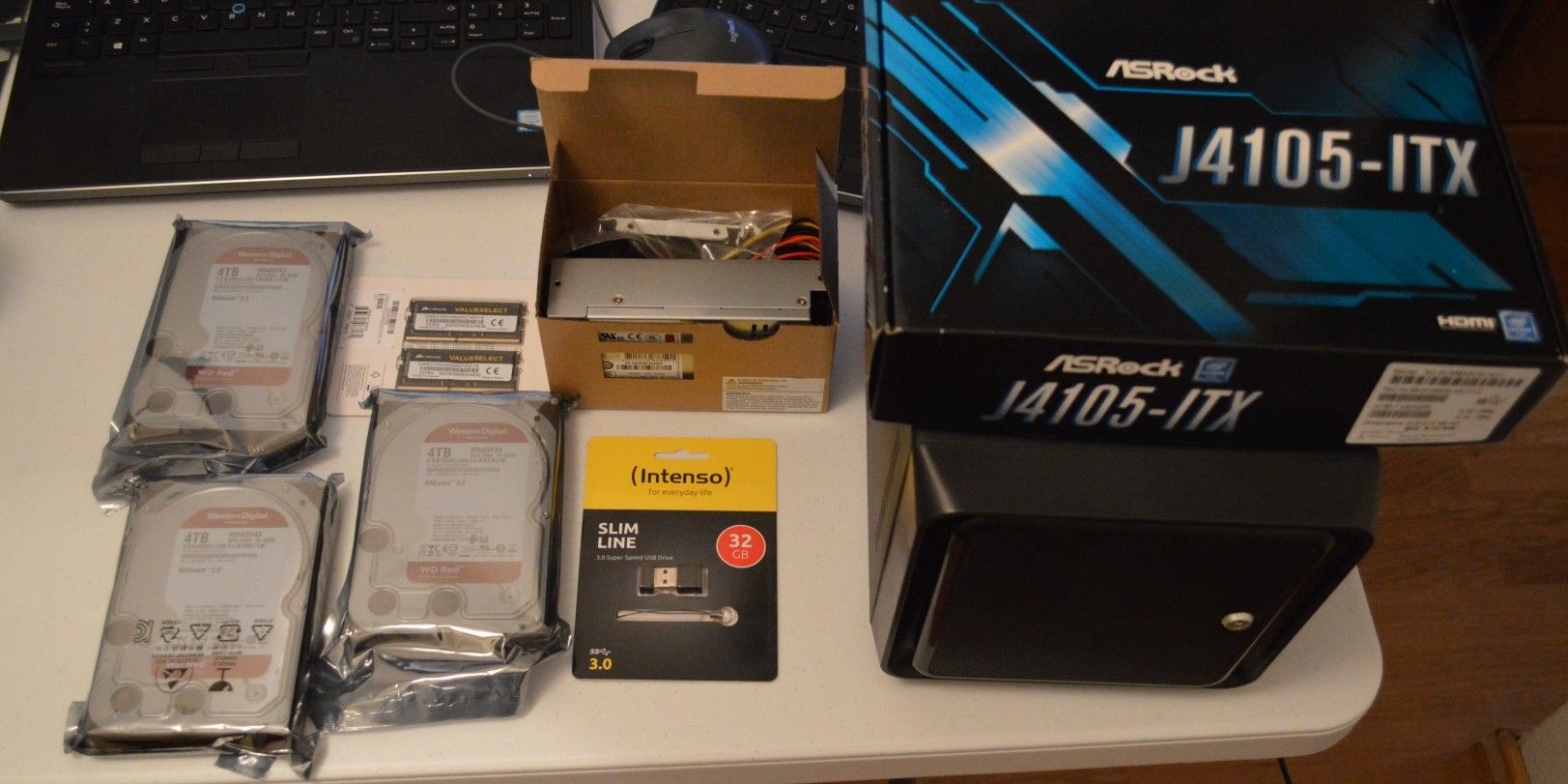
The final list of components has been this:
· 3 WD 4TB SMR drives. I chose these instead of CMR because I saved €120 and as long as the 3 are the same, there shouldn't be any problems. I hope that in the future they won't be difficult to find for a possible expansion.
· 2x8Gb Corsair ValueSelect DDR4 2133MHz CL15 (chosen because they are on the list of memories compatible with the motherboard).
· ASRock J4105-ITX motherboard. I changed it because the other only had 2 SATAs. This one has 4 and also a 4-core processor (instead of 2).
· 32GB Intenso USB 3.0 pendrive.
· Intertech SC-4100 case.
· Seasonic SSP-300SUB power supply.
· About the UPS, I took one of 1200VA that I had in the storage room and I am waiting for some batteries to arrive that I have ordered.At first, I detected 3 small problems related to the motherboard:
-
Putting the motherboard in was a real pain. To be able to put it in, you first have to connect the power supply and the case connectors (leds and buttons), so it is very difficult to do it without it rubbing against the metal. I sweated here, but I suppose these are the occupational hazards when the spaces are so reduced.
-
Although it comes with 4 SATAs, it only brings 2 cables and one of them has the plug at 90º, so it can't be used because of how the connectors are arranged both on the motherboard and on the case. So it only has 1 useful cable.
-
The motherboard doesn't have support for "legacy" mode, so it only allows booting with UEFI. This is the first time I encounter a motherboard like this and apparently it is an imposition of Intel in its Gemini Lake. This is something to keep in mind when choosing recent platforms and it is something I hadn't thought about. I think there won't be a problem with OMV but there might have been a problem if I had opted for distros based on FreeBSD (this would have to be confirmed).
Regarding the case + power supply, one of the two manufacturers has ducked out on the screws, because neither of them had screws to anchor the power supply to the case. As they are standard ones, I was able to use others that I had around here. On the other hand, the length of the power supply cable is very tight. The one that connects to the motherboard has been left a bit tense (not too much but more than I would have liked). In addition, with such tight spaces and the cables being so thick, in some places you have to bend them more than I am used to with other types of cases.
In general, everything fits in its place, but the spaces are measured almost to the millimeter and that makes assembly difficult. As an advantage, the volume occupied is reduced to the minimum physically possible in mini-ITX format.
It's all assembled waiting to receive 4 SATA cables that I have ordered and to mount the 3 hard drives. Now I am installing Windows 10 on a hard drive that I had around here to tinker with the machine a bit, to see how it goes with things I know.
Until the batteries and cables arrive, apart from finishing testing things in Windows 10, I have to run a memtest to make sure there are no strange things and a physical surface check of the 3 drives.
Now that I still have it open, if anyone wants a photo of the inside, they can ask for it.
Toda la actualidad en la portada de Hardlimit
Mis cacharros -
-
Of course we want to see the inside, damn YES...
But...

Intel i5 3570k / ASRock Z77 Extreme 4 / G.Skill F3-12800CL9D-8GBRL / Sapphire HD5850 / Samsung HD103UJ / TR TrueSpirit / NZXT Source 210 / OCZ ZS550W
Intel i5 4570 / ASRock H87 Pro 4 / 2x G.Skill F3-14900CL8-4GBXM / Samsung 850 EVO 250Gb + ST1000DM003 + ST2000DM003 + HGST HDS723020BLA642 + Maxtor 6V250F0 / CM Seidon 240M / Zalman MS800 / CM MWE 550
AMD Ryzen 7 1800X / B350 / 2x8GB Samsung DDR4-2400 CL17 / NVIDIA GTX 1070 8GB / SSD 120GB + ST4000DM004 + ST6000DM003 / EVGA Supernova 650 G2 -
@Fassou hello, I tend to be quite austere with aesthetic issues. Now, that said, the case has a generous amount of LEDs on the front that I will show when everything is assembled.
This is the top:
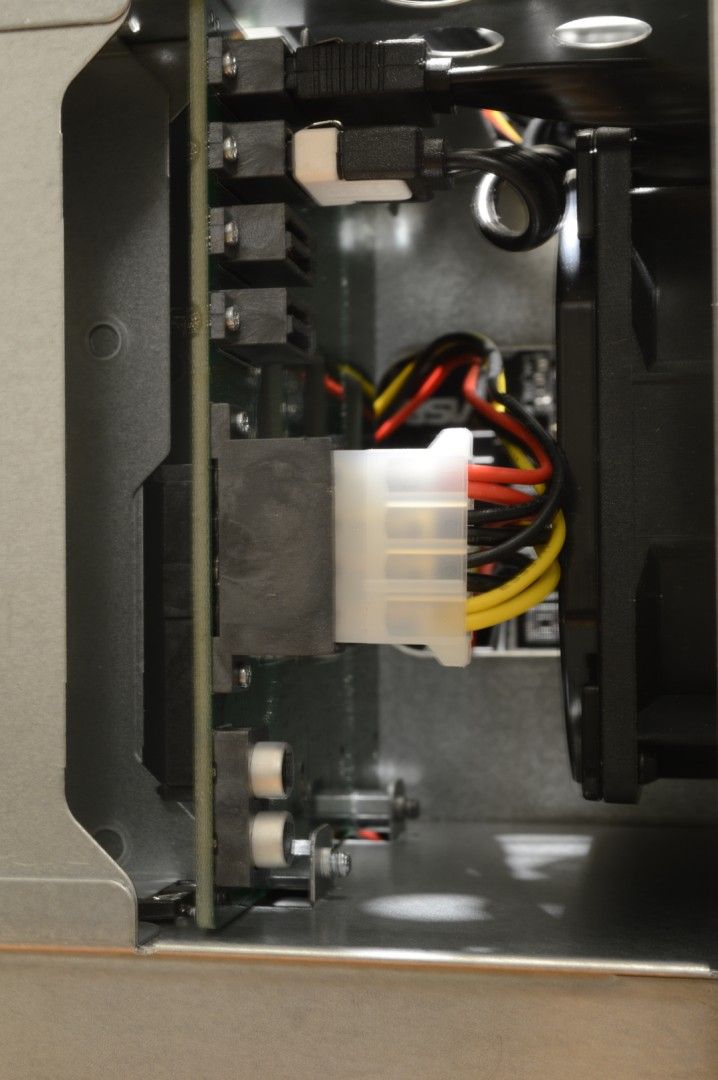
From here you can see the layout of the 4 SATA connectors and how it is not possible to use 90º elbow cables. One of the things I liked is the fact that the 4 drives are powered by a single molex, which is very appreciated for saving cabling.
The fan that is right behind the SATA connectors (the PCB has holes to help with ventilation), I found to be very quiet and the airflow is not bad.
This is one of the sides:
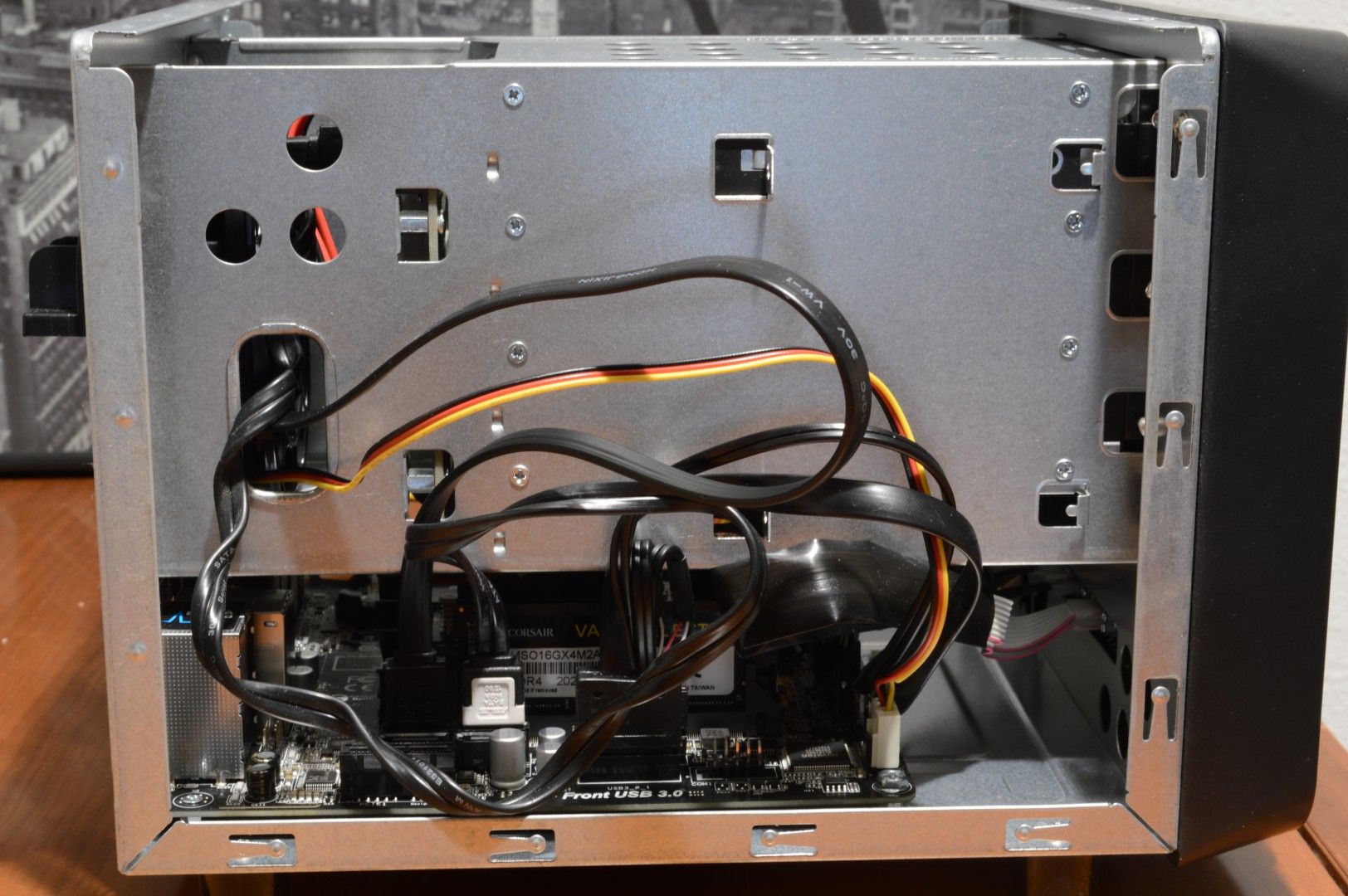
Two more SATA cables will be connected to this side of the board. In total: 4 sates and the one for the ventilation power. There is plenty of space here because they have left 4cm to be able to put a PCI-e card.
The other side:
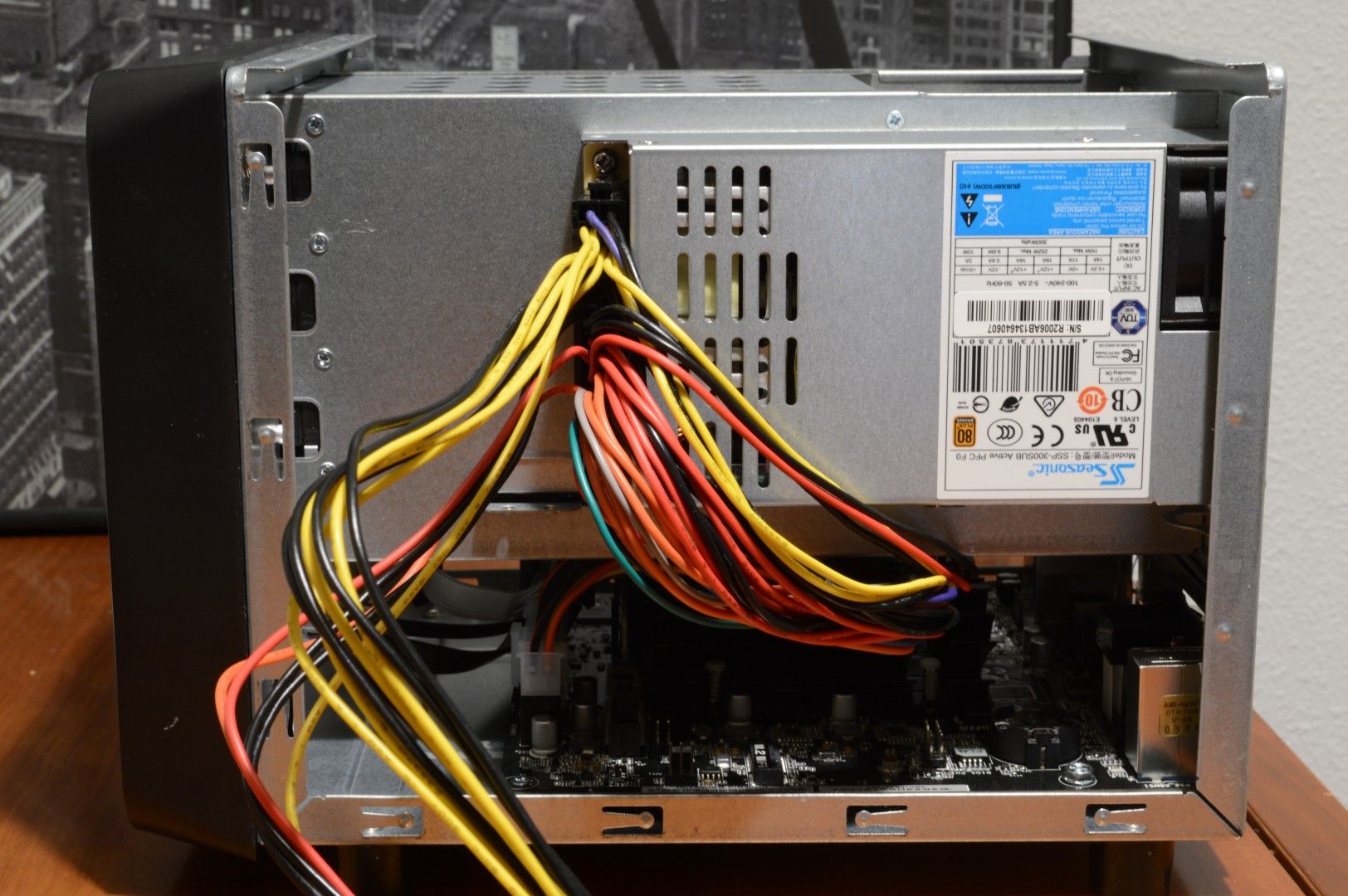
Here you can see the mess of power cables. 8 wires go to the molex (it has 2 cables per pin) and then the ATX bundle to the board. The power supply, by the way, is cantilevered and anchored only by the 4 screws at one end. It is well fixed but being so long and heavy, it would not have been bad to have the possibility of screwing it at the other end. The power supply comes with a metal piece for that but the case does not have holes for screws.
And this is what I like the least:
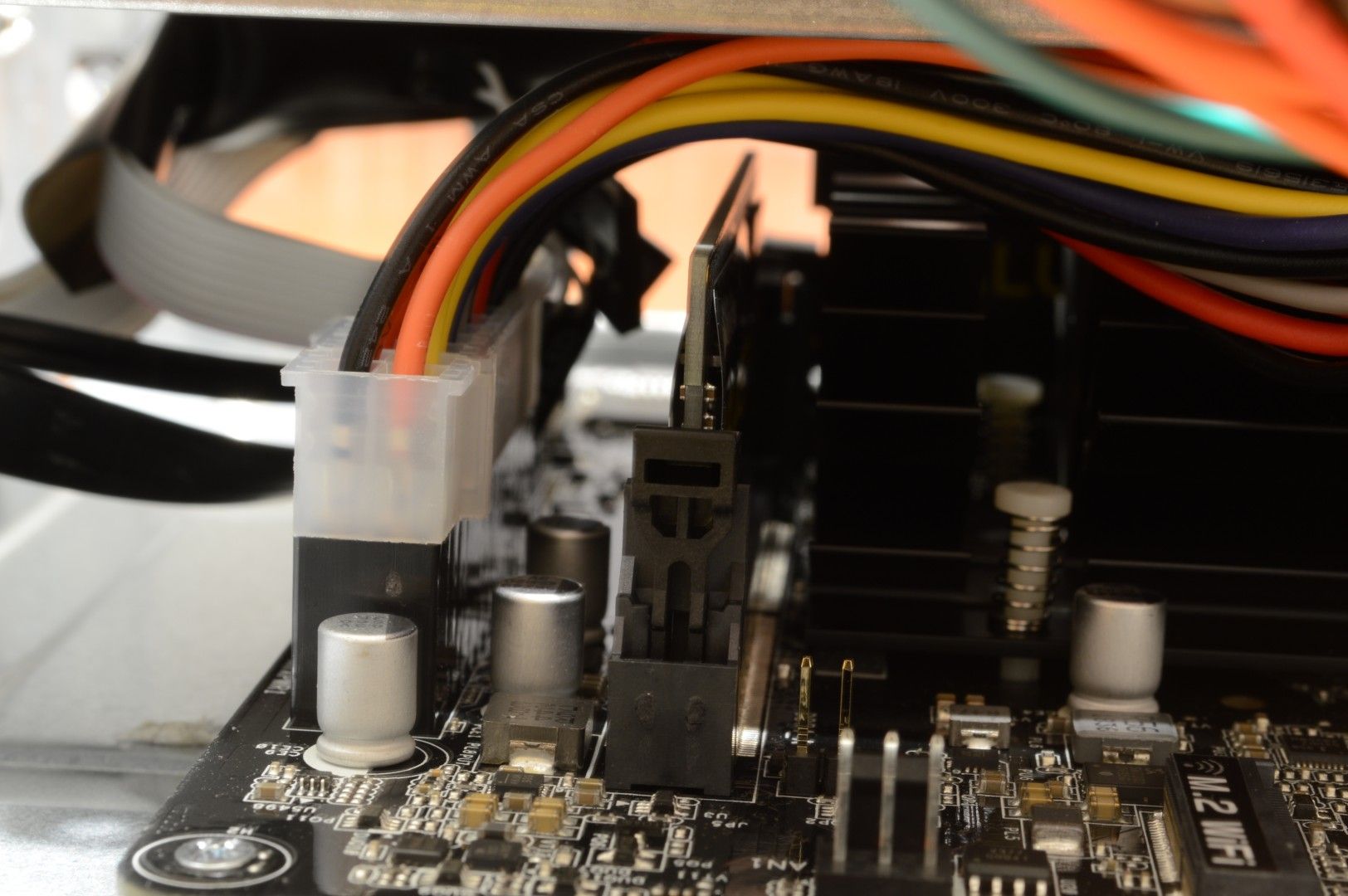
The memory modules are mounted vertically, the ATX power connector is right in front of this module and the caddy plate is right above. Here the cables have to be quite bent. And right to the right of the power supply, there are the connectors for the case buttons and leds. So with these two cable bundles connected next to the memories and with that distance, you have to put the board in with great care so that it does not rub at the bottom.
Toda la actualidad en la portada de Hardlimit
Mis cacharros




Hello! It looks like you're interested in this conversation, but you don't have an account yet.
Getting fed up of having to scroll through the same posts each visit? When you register for an account, you'll always come back to exactly where you were before, and choose to be notified of new replies (either via email, or push notification). You'll also be able to save bookmarks and upvote posts to show your appreciation to other community members.
With your input, this post could be even better 💗
Registrarse Conectarse