OC to a 4790K
-
That noctua will be as beastly as one wants, but those temperatures at full dismantle any argument: either there are too many megahertz or there is not enough dissipation.
For me, in part, it is the fault of the TIM (Thermal Interface Material) between the IHS and the DIE… because between 4.4Ghz at 1.1V and 5.1Ghz at 1.35V there should be a frequency and voltage that could be stabilized without frying the micro… a range of 700Mhz without exceeding infernal voltages I think is a lot… although of course, I come from an AMD
Personally, for a 24/7, I think that level can only be eaten by an RL, and with more than one radiator
It is possible but we will never know :nono:
As soon as I can, I will uncover it and we will see what improves

An example is this article: Analysis of the thermal conductivity of the 3770K Tutorial Part 2

To summarize, the guy has done lapping on the CPU and the block, then he has been increasing the micro while taking temperatures with LinX, first stock, then he has removed the IHS and put NT-H1 but left 0.06mm of space (the same thickness of thermal paste that intel puts in, using a paper) and finally he has tested without the paper, spreading the thermal paste… the results are interesting, especially considering that he has not used liquid metal TIM which would be ideal.
-
I am also a big advocate for removing it. The more expensive the micro, the more respect it commands and the more you want to do it carefully and without any rush, but it is a shame what is lost for not having the ihs soldered.
I have not had the pleasure of removing one and observing the difference (mostly because I do not have another one to switch to and thus be able to do it calmly and with extreme care), but you can clearly notice the "thermal lag" that occurs between the ihs and the die. Even playing with ice and lowering the temperature a lot does not make good use of the setup.
In my case (A64 x2 brisbane) it would improve but I would not gain much more oc threshold, but that beast you have already is definitely worth it, between the thermal throttling, and it seems like it only asks to have the heat removed to go up more and more…. what a joy that must be with the ihs removed, even better than one with the ihs soldered.
Well it seems like you are already decided, good luck, take a good look at it and take your time hee
 and +1 following
Best regards.
P.D:
Liquidate it the same way if you put it on next summer, but make it a real one, of the ones that get a lot of margin out of any air cooler. -
Yo tambien soy muy partidario de destaparlo, cuanto mas caro es el micro mas respeto da el asunto y mas se quiere hacer con tiempo y sin ningunas prisas, pero es que es una lastima lo que se pierde por no estar el ihs soldado.
No es tanto porque sea nuevo, no tengo micro de reserva y ando liado con la tesis de un master (bueno ahora no tanto porque ya no podre presentarla hasta como pronto diciembre :wall: )
No he tenido el gusto de destapar uno y observar la diferencia (mas que nada por no tener otro con el que ir tirando y asi poderlo hacer con calma y extremo cuidado), pero se nota un monton el "lag termico" que se produce entre el ihs y el die. Incluso jugando con hielo y bajando mucho la temperatura no se aprovecha bien el tinglado.
El "lag termico" que dices técnicamente es un deltaT entre dos focos devido a la conductividad térmica del material que los separa… y es como cuando tenemos resistencias en serie:
- El voltaje son las temperaturas
- La intensidad de corriente la potencia disipada
- La resistencia es la conductividad térmica de todos los elementos que transfieren la energia del foco caliente al foco frio.
Fijando un equilibrio térmico (condiciones estacionarias de temperatura ambiente (foco frio) y potencia disipada constante) una mayor resistencia a la transferencia de calor, es decir una peor conductividad térmica derivan en que el diferencial del temperaturas (deltaT) sea mayor... como el foco frio (el ambiente) no varia son todos los elementos por los que se transmite la energia en forma de calor los que determinan cual sera la temperatura del foco caliente.
Por eso si hacemos un análisis tenemos el siguiente diagrama:
- Resistencia del silicio-> resistencia de la pasta termica-> resistencia del IHS-> resistencia del Disipador
Cabria destacar que la resistencia del disipador es para darle de comer a parte porque habría que calcularla estableciendo un análisis muy complejo por la constante evaporacion/condensacion del vapor de agua que hay en los heatpipes y luego el coeficiente de pelicula por la conveccion forzada del ventilador echando aire por las aletas del disipador. No obstante se podria calcular una tabla que nos indicara dicha conductividad en función de las temperaturas de la base, la del ambiente y el flujo de aire.
Añadir también que a medida que aumenta la temperatura el silicio empeora otra propiedad, su conductividad eléctrica y por tanto cuanto más caliente esté más perdidas joule... esto se traduce en un incremento de la potencia disipada... consecuentemente esto limita el OC.
En mi caso (A64 x2 brisbane) mejoraria pero no ganaria casi mas humbral de oc, pero ese bicharraco que tienes tu ya lo creo que merece la pena, entre el termal trotling, y que parece que solo pide que le quiten el calor para subir mas y mas…. que gozada tiene que ser eso con el ihs quitado, mejor todavia que uno con ihs soldado.
Mi experiencia con un opteron 175 es que ciertamente la mejora fue ínfima y no mejoró sustancialmente el OC, las temperaturas un poco si pero no tenia mucho margen de mejora.
Si nos ponemos en plan malpensados diría que Intel esta haciendo con la gama media algo un poco feo que es garantizar que sus producto tope de gama no se vean demasiado inferiores en las reviews. Pues sus hexacore y octocore pese a ir soldados no pasan con liquida de 4.4Ghz… da la sensación de que quieren que si haces OC sea bajo tu propia responsabilidad... es decir que tengas que perder la garantía destapando el micro y algo parecido pasaba con los IHS combados o convexos, no era un fallo de fabricación sino algo que se hacia intencionadamente y que ya no se hace.... o por lo menos mi micro le hice la prueba de la cuchilla y se veía perfectamente plano.
Liquida igual la pones el verano que viene, pero que sea de verdad, de las que le sacan mucho margen a cualquier disipador por aire.
No creo, ya trastee en su dia y el tema de mantenimiento es 50 veces peor que el de un disipador normal… de echo tengo material a estrenar para montarme una liquida y lo voy a vender todo a precio de saldo/regalado porque no me motiva lo más mínimo... por eso ando trabajando en ver la viabilidad integrar sistemas de refrigeración liquida de alta gama en cajas normales o compactas y reduciendo el mantenimiento... el problema es que es caro :facepalm:
Como se que en internet hay mucho vocas cuelgo un trabajo sencillito que hice para el master... podíamos elegir la pieza y el análisis por elementos finitos que quisiéramos (yo elegi un CFD [Computational Fluid Dynamics] con NX Nastran)… en un principio iba a hacer un circuito de RL completo con un análisis térmico y con doble flujo (aire y agua) pero se me echo el tiempo encima y solo modelar el HW GTX480 y el volumen de control del agua fue una pesadilla por lo que acabe haciendo solo el análisis de fluidos del radiador... solo con esto me pusieron matricula, hago lo otro y me envisten dr onoris causa :troll: (lo que pasa que el profesor el CFD no lo dominaba mucho y meter el comportamiento de una bomba dentro del programa ni sabia el que eso se podía hacer ni como)
Link: Dropbox - Memoria_gtx480_Censu.pdf
Añadir que esto es solo un pequeño informe paso a paso del análisis con las conclusiones ya que el trabajo completo era en formato digital y pesaba unos 500Mb… de echo tenia instalada la version 32bits (por usar la misma versión de software que en la universidad) y no fue posible realizar el análisis porque cuando los calculos del problema por elementos finto llegaba a 3.4Gb petaba y lo más chungo es que superaba los 8Gb por lo que le tocaba tirar de memoria paginada... de ahí que me haya puesto 32Gb... de echo hice unos bancos de trabajo para subensamblar el parachoques del nuevo Leon (una subcontrata para la empresa que los suministra a la planta de Martorell) y el equipo rascaba disco duro cosa mala solo con el modelado... que maldita pesadilla.
Que no me estoy tirando el pisto muchachadaaaa ;D:


Que os pensabais que me he estado rancando las bo… :troll:
He estado estudiando para tener una formación superior y así tener un buen trabajo... que seguramente acabaré al final encontrando en el extranjero :vayatela:
(por eso este pais se está yendo a la m…):mudo: -
How beautiful those K7 Thunderbirds for 462 looked...
-
Hey Espi, can you help me with the design of a new modding for my cutrecaja? You seem handy

Great job, good luck with that tragoncete, and try the pasta thing that Obione told you if you dare to uncork :sisi:
Best regards
-
How beautiful those K7 Thunderbird for 462 looked...
Those were the days... it seems like a seventh of a century has passed... but it's a little less :risitas:
Hey Espi, can you help me with the design of a new modding for my cutrecaja? You seem handy
Only if you take care of my sheep in farmville
Great work, good luck with that fancy machine, and try the pasta thing that Obione told you if you dare to uncork it :sisi:
Thanks, I'll keep you updated
-
I premiered the proce this weekend, and of course I haven't even thought about lapping or similar things... 240€ hurt a lot if I mess it up:llorar::ugly: Anyway, until I save up to put proper cooling on it, I won't do OC... and at stock I'm delighted with the difference from the i7950. I'll follow this thread, for when I do OC.
-
Estrené el proce este finde, y desde luego ni he pensado en lapping ni cosas similares… 240€ duelen mucho si me lo cargo:llorar::ugly:
Yo con mi antiguo Opteron 175 emplee el típico método de la cuchilla… es el peor porque es muy facil cortarse, llevarte por delante resistencias o que la cuchilla se clave en el PCB... el mejor método y el que voy a usar yo es el del "Vice":
Puede parece una burrada "quitarlo a matillazos" pero os puedo asegurar que tiene su explicación técnica de porque se despega si se hace bien: Tensión cortante - Wikipedia, la enciclopedia libre… básicamente para los no iniciados en elasticidad y resistencia de materiales la fuerza que se aplica actúa como si una cuchilla de espesor infinitesimal en toda la sección... puesto que el cobre del IHS y el material del PCB tienen mayor resistencia que la silicona de la junta esta se deforma superando su limite elastico y rompe.
También decir que esto se debe hacer con mucha calma y aplicando la fuerza lo más paralela al plano de corte sino no aparecerá el cortante... aparecerán otras tensiones que pueden romper el PCB.
De todos modos hasta que no ahorre para ponerle refrigeración en condiciones, ni le hago OC…y estado stock estoy encantado la diferencia con el i7950.
Yo tambien lo tengo de stock y con el Noctua parece que el equipo esté apagado, además rinde genial y no gasta nada aunque creo que deberias testear ahora que esta de serie cuanto se calienta y los vatios que disipa o incluso el undervolt que acepta porque lo que yo me estoy dando cuenta es que como no bajen mucho la temperaturas al destaparlo ni de coña le voy a poder subir el voltaje para uso 24/7… es decir le pones 4.6Ghz/1.2V con 4.4Ghz de cache y puedes benchear lo que quieras o comprimir vídeo de alta definición en H264 que no peta pero en cuanto le metes Prime o LinX la temperatura se dispara y se acabo.
Está claro que hay gente para la que esta estabilidad que yo exijo es excesiva pero voy a usar el equipo para trabajar y busco el mayor rendimiento pero también la mayor fiabilidad... bastante inestables por si solos se vuelven algunos programas para andar preocupándome del OC :ffu:
Seguiré este hilo, para cuando le haga OC.
Iré poniendo cosillas y si alguien más se une al club que ponga su batch y sus resultados.
PD: Lo que comento de los programas que fallan lo digo porque el software de diseño que uso no autoguarda… tiene para hacer y deshacer pero no autoguarda como Word porque cuando le das a guardar te puedes ir a tomar una cafe si andas con un megaensablaje y te da para un croissant. Claro me tire 4horas a saco haciendo tareas de desdoblado de chapa y sus respectivos planos para enviarlas al cortar... elegi no se que opción para plotear /exportar los planos y el programa colgado 100% por culpa ADOBE... 4horas tiradas a la basura, me dio un gusto :ffu:
-
I saw him hit the computer with a couple of hammer blows, and that's when I realized that I would never do that with a new computer :wall:
Anyway, good luck and you'll tell us.
-
@Espinetenbolas What were you saying was the master you were preparing, man? ;D
It was very nice when you theorized the hammer method hehe. The truth is that the other day I thought I saw that some bring a capacitor very close to the putty, literally on top of it.By the way, is the blade test looking at it backlit to see if there's a gap? Better to move it 2 millimeters over fine sandpaper, or if not, to trace a little on carbon paper with a sheet in between, or something like that.
-
I've seen them hit the micro with a couple of hammer blows, and that's when I realized I would never do that with a new micro :wall:
It all depends on how you want to see it… as soon as you take it out of the box, it's no longer new to me :troll:
@Espinetenbolas ¿What were you saying about the master you're preparing, man? ;D
Integrated design and manufacturing assisted by computer CAD-CAM-CIM
You learn to model, parameterize, assemble and make plans with NX Unigraphics and Pro/ENGINEER, to perform multiphysics analysis by finite elements with Nastran and ANSYS, CNC/Lathe programming (by hand and assisted for complex parts), plastic injection simulation with MoldFlow, composite part forming with PAM-RTM, manufacturing project management with MS Project, industrial automation, robotics with Matlab, ecodesign, optimization, integration (basically consists of selecting materials or the productive process according to the type of part, DFM (Design for Manufacturing) analysis and some other things about cost calculation and tolerances), prototyping… although some are optional and I haven't taken them but I have the notes.
It was very funny when you theorized the hammer method lol. The other day I actually saw that some bring a capacitor very close to the putty, literally on top of it.
I learned that in college… and if it's too close those resistors/capacitors... from my experience the blade, no matter how thin, doesn't go in without a lot of force.
By the way, is the blade test looking at it against the light to see if there's a gap? Better to move it 2 millimeters over fine sandpaper, or if not, trace a little on carbon paper with a sheet in between, or something like that.
If the blade test is against the light:

Who says a blade says a caliper or something straight

If not, we go to the Pro engineering level we have a white paper film that changes color under pressure:

The best part is the version where you digitize the sheet and with the specific software you can see the real pressure distribution and compare it with the theoretical one (the one you calculated). Basically, this is used to verify prototypes of parts that need to fit under pressure and also later in quality control if we're dealing with high-responsibility parts that won't be disassembled again… petrochemical and aerospace industries $$$$.
-
it's the worst because it's very easy to cut yourself, to overcome resistance
This is how I ruined the FX-55 after paying €900 for it… :ffu::ffu:
-
Not bad, mine came out a little better
Prime95
4.5Ghz 1.1v
4.7Ghz 1.2v
It does 5Ghz with 1.36v
5.11Ghz with 1.43vWith two cores it benches at 5.35Ghz with less than 1.5v
It's a lottery these 4790k :facepalm:
-
Okay, but you have the NB at 4ghz thief
As for what is better, I don't know what to say, it depends on the cooling and ambient temperature you have, we can compare. For example, I run the SupePi32M 5Ghz with NB at 4.7ghz with VCore1.326V and Vcache 1.25V
With the same configuration (which is not optimized because I've tinkered little) for 5.1Ghz and 1.35v it's not stable and I don't want to put more heat into it
I suppose you mean by better that your IHS is better placed because what mine is for headbutting a wall... :wall: :wall: :wall:
By the way, could you post some screenshots with the HWifo to see how much it consumes, mainly to compare the watts dissipated and also your Batch
By the way, Xevipiu, I sent you a PM about a matter in which you could help me, since you've been involved in extreme cooling issues and stuff.
-
Lo comfieso, has changed the paste on the IHS, I put

Yesterday I overclocked a 4690k by removing the IHS, I overloaded the communication channels, since I was doing it while talking on the phone on an erotic line and I had no concentration :ugly:


Regarding voltages, I go by feel, I always put something more, since I'm jumping parameters from software, but here I leave you some sample


This test is one of the most balls to the wall, but I'll go through it
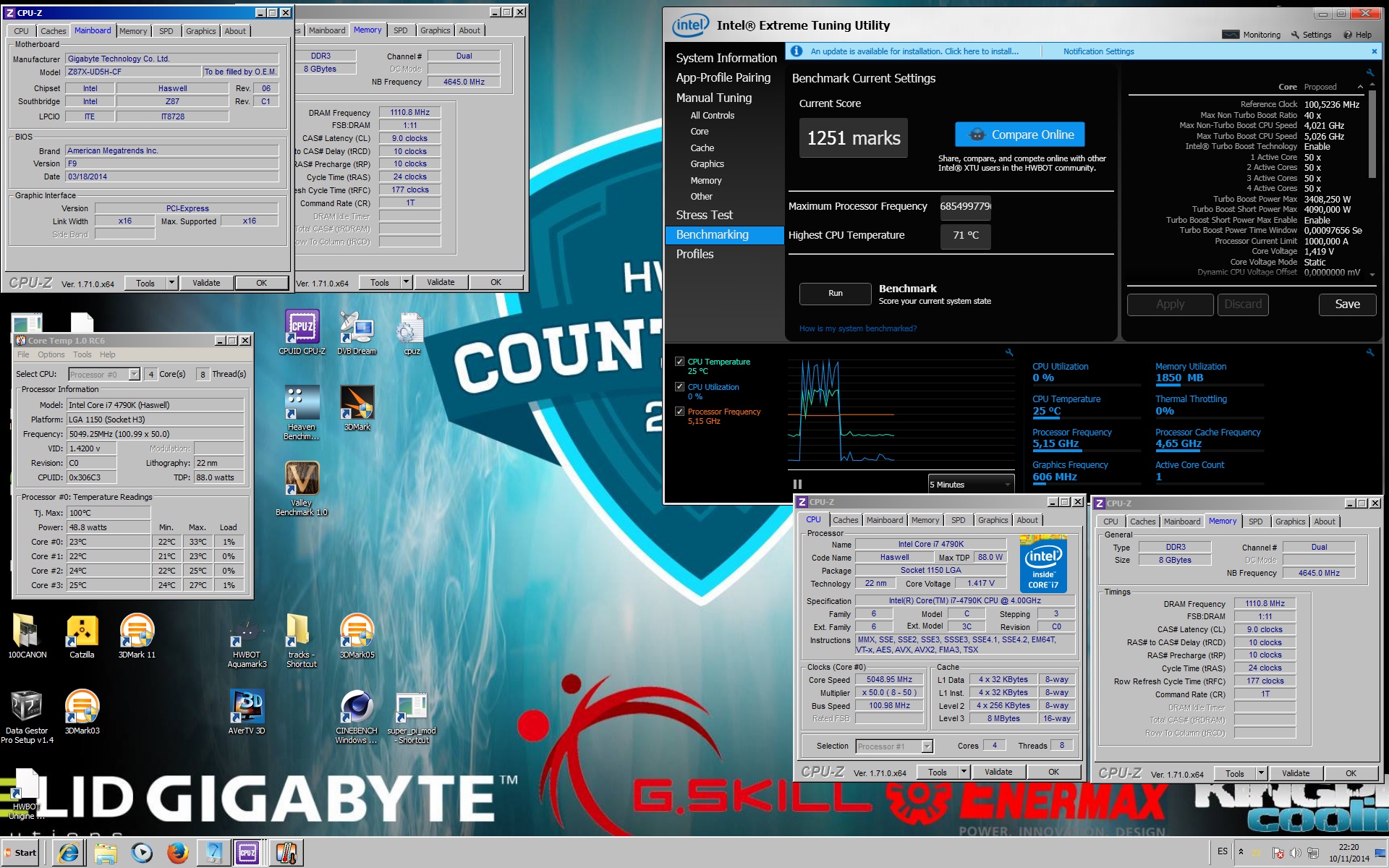
The cooling is water, which now we have better ambient temperatures to test ;D
-
Ah, I have not tried with uncore/NB at x47, for SuperPi it does not go below x48 or x50 if I have it stabilized

-
Jopeta, I see that you can't edit the posts, I'll keep following


I only have one of these 3 micros left, the other two have passed on :wall:After that I have to go back to see if the 4690k shows any signs of life, so I can take the opportunity to give you the Step of the 4790k that I'm using now ;D
Intel 8088 7.15Mhz, 512Kb RAM, CGA 4coleretes, HD 10Mb
-
I'm already here again, I checked the voltage it needs for 5Ghz the Spi32 with more than x47 of unicoreSpi32 5Ghz 1.29v - x48 uncore

For the Spi2 with a lot of over-voltage on top
Spi2m 5.35Ghz

-
HWinfo
5Ghz at 1.34v

5Ghz at 1.37v

Here you have the consumptions, without giving you the step of this
-
The truth is that it is noticeable that you have opened it and that you are going by liquid and I by air now I have not looked at it but I suppose that something will have improved… in any case I am going to open it as soon as I have a moment.





Hello! It looks like you're interested in this conversation, but you don't have an account yet.
Getting fed up of having to scroll through the same posts each visit? When you register for an account, you'll always come back to exactly where you were before, and choose to be notified of new replies (either via email, or push notification). You'll also be able to save bookmarks and upvote posts to show your appreciation to other community members.
With your input, this post could be even better 💗
Registrarse Conectarse