Subcategories

  • Forum to talk about whatever you want, except piracy, politics, religion, and anything that creates a bad atmosphere.
    1k Topics
    17k Posts
    No new posts.
  • Section of news published on the front page
    801 Topics
    4k Posts
    No new posts.
  • Marketplace for buying and selling for authorized users
    15 Topics
    41 Posts
    No new posts.
  • PeerTube Instance Support Thread

    Pinned
    16
    4 Votes
    16 Posts
    886 Views
    X

    @pos_yo @cobito
    I can confirm it works with the following changes

    1. obs from flatpak (instead from the distribution)
    2. use software h.264 (instead of nvenc h.264)

    You can change (2)
    settings > output > Streaming > video encoder

    Thank you for you help and support ?

  • General forum rules

    Pinned
    1
    2
    6 Votes
    1 Posts
    491 Views
    No one has replied
  • Blogs Hardlimit

    Pinned
    16
    1
    3 Votes
    16 Posts
    14k Views
    jordiquiJ

    @cobito desvelemosafrica, tal cual. Gracias de antemano!

  • My password does not work and my email address is not valid

    Pinned
    10
    0 Votes
    10 Posts
    6k Views
    HinH

    Hello everyone!!

    another one who returns here after a good season to see how the scene is and I have to assemble a new PC

    Keep reading, comrades, Regards!!

  • Learn to post 1.0

    Pinned Locked Moved
    1
    1 Votes
    1 Posts
    9k Views
    No one has replied
  • Videos Peertube

    51
    4 Votes
    51 Posts
    3k Views
  • 0 Votes
    2 Posts
    6 Views
    HIAL-9000H

    Video Summary
    Data brokers are companies that collect personal information from multiple sources, cross-reference it, and generate detailed profiles to sell to the highest bidder. Without users' explicit consent, these companies have operated in the shadows for decades, functioning as a hidden market where people are not customers, but the primary commodity. Their buyers include advertisers, insurance companies, banks, employers, and frequently, governments and law enforcement agencies.

    Each individual can have more than a thousand data points associated with these profiles, ranging from basic information such as name, address, and estimated income, to highly sensitive data like political affiliation, medical history, online behavior, sexual orientation, or status as a victim of gender-based violence. U.S. legislation, such as the aforementioned PADFAA, classifies health, finances, genetics, biometrics, geolocation, and official identifiers as sensitive. Within this ecosystem, the most lucrative and risky business is precise location tracking: everyday apps collect every movement, allowing the tracking of visits to clinics, places of worship, shelters, or military installations. The FTC has reached settlements with companies like Gravi Analytics and Mobile Beacon for illegally selling this location data.

    The information sold by brokers is used to refine advertising, adjust insurance premiums, approve or deny credit, and screen job candidates. Additionally, government agencies acquire this data to obtain information they legally could not collect without a court order, acting as a backdoor to state surveillance. This generates direct consequences for citizens: personalized pricing, more expensive coverage, and automated decisions based on frequently erroneous profiles with no possibility of correction. Despite regulatory actions in the U.S., the effect has paradoxically been to consolidate the market in the hands of three major companies that control around 60% of the sector, moving away from the goal of protecting privacy.

    Exiting this system is nearly impossible due to the dispersion of thousands of brokers, each with their own opt-out procedures, and the constant influx of data from new sources. Nevertheless, users can reduce their exposure by reviewing and restricting location permissions in their apps, removing unnecessary software, and using privacy tools such as VPNs or browsers that block trackers. In Europe, the GDPR guarantees rights of access and erasure, and automated services exist to manage opt-out requests. As a general rule, if a service is free and requests extensive data, the business model consists of commercializing the user's information.

    The structural solution lies in abandoning centralized models where third parties resell personal data, and migrating to federated and decentralized networks that return control of identity and content to users. Becoming aware of the existence of this hidden market is the first step to stop feeding it. In an environment where commercial surveillance has become the primary product, knowing that there is an industry that auctions our profiles daily is fundamental to regaining digital autonomy.

  • My Introduction

    4
    4 Votes
    4 Posts
    36 Views
    pos_yoP

    Hi, @R4lPh. Welcome to the community. I'm delighted to see your videos and your PeerTube channel. ?

  • Information & announcements

    69
    4 Votes
    69 Posts
    14k Views
    cobitoC

    We'll start getting things up and running little by little this term. The first thing will be to add to the database all the hardware that the staff has been validating on the test bench during the summer. I see quite a few processors, a good number of motherboards, and countless RAM models. I'll get to work on that in the coming days.

    Software Update

    The first major undertaking will be working on the servers. This will likely happen during the week of September 7th (the exact day will be specified later). Currently, all web requests pass through a caching proxy on a VPS. The initial idea was to reduce the load and bandwidth on the backend, but it hasn't worked as expected. On one hand, there are prolonged bursts of transfers between the backend and the VPS that saturate the connection (the exact opposite of what I intended). This is because when someone downloads a large file, the entire file is copied to the cache while being served. On the other hand, countless issues have arisen (mainly on the museum site) for reasons I still don't fully understand (it's my first time configuring Nginx's cache and there's something I'm not doing right).

    That means we'll go back to the previous setup: using the VPS as a gateway to take advantage of its better connection routing, and that's it.

    In parallel, the main server's OS will be updated (now acting as the backend). This operation is usually quite tedious and will likely take up almost a full day.

    There are also pending updates for NodeBB (forum) and Mastodon.

    Hardware Update

    Regarding the current hardware, we'll be rotating hard drives. In recent months, a couple of drives have failed (one of them suddenly and disastrously). There's likely a methodological flaw on my part here: I've taken for granted that hard drives are permanent as long as operating conditions are adequate, and having backups has made me complacent. It's also true that the number of hard drives has multiplied over the past year: we used to just have the NAS and the system drive. Now, there are also dedicated drives for Mastodon resources, PeerTube, Redis, the museum, the web server, and the Ryzen 9900X. The probability of failure multiplies accordingly.

    Anyway, after that, I was left without hard drives suitable for these tasks, so I've replenished the reserves (they aren't new, but have very little usage). I still need to figure out how to distribute the services and data, but that's irrelevant for now.

    Regarding the hardware renewal campaign that was left unfinished last term, given the current situation, it won't be resumed anytime soon. A few months ago, I was hoping things would start normalizing around this time of year, and although there are signs of a cycle shift and some macroeconomic forces seem to be emerging that could help restore balance, the harsh reality is that it won't happen by 2026.

    Development

    I still don't know how much time I'll be able to dedicate to this over the coming months. I hope it'll be something similar to what I've been doing recently, but nothing is guaranteed.

    Last term, the test bench project was shelved. Some beta versions were released, but issues arose when trying to reproduce results after making structural changes to the program (threading vs. process architecture). The initial idea is to keep the core intact for tests 1 through 4, add a new test (large memory) within a multithreaded framework, and gradually add features to the GUI. There are also pending details on the website (layout, graph aesthetics, and other minor issues).

    In parallel, the homepage will be reimplemented to abandon the DBMS I originally created, which has proven a pain to maintain, slow, and insecure, in favor of migrating to the same structure used for the test bench and the museum. As for content, the idea is to experiment with AI (remember that at Hardlimit, only open-source models run locally are used). I want to run some tests to see how it works. If the results aren't as expected, we'll revert to the manual method. The idea is also to offer an English-translated version. All of this will require massive amounts of processing power, so that might be where the plan falls through. We'll see.

    And to wrap this up, all the code related to forum translation and PeerTube subtitles will be refactored. This has always been done experimentally, in bits and pieces, throwing things together haphazardly. It has ended up resulting in a somewhat chaotic file and directory structure.

    I also want to experiment with more flexible forum translations, meaning giving the model more freedom to split and merge sentences to make the translations sound more natural. Currently, it's instructed to respect the original text's structure, which sometimes leads to unnatural translations in the target language. It's a delicate topic (from the standpoint of preserving the fidelity of the information being conveyed), which is why I want to run some tests before implementing it.

    The entire forum translation project will have higher priority than last term, as there's finally some activity (very little, but it's there), which leads me to believe that the number of English-speaking readers on the forum must also be increasing.

    Anyway, there are more things on the back burner (promoting certain types of content on PeerTube, encouraging people to participate in the forum, pushing to use the Mastodon instance, etc.). But the current infrastructure calls for caution when pushing for even moderate growth in activity, especially on PeerTube. Since the ultimate goal is for everything to mutually reinforce each other, this has been put on hold for now.

  • 0 Votes
    2 Posts
    16 Views
    HIAL-9000H

    Video Summary
    Internet of Things (IoT) devices, such as smart TVs, speakers, and camera-equipped doorbells, have turned the home into the largest domestic surveillance network without requiring any legal frameworks to mandate it. Users adopt them voluntarily in search of convenience, savings, or security, unaware that they are installing sensors that continuously collect data on their habits, conversations, and visitors. By 2026, smart devices will surpass 500 million in the United States alone, with the average home featuring around twenty connected devices that operate autonomously and constantly.

    Each device functions as an active information collection node. Smart TVs employ Automatic Content Recognition (ACR) technology to analyze in real-time what is displayed on screen, regardless of the source, building consumption profiles for advertising and detecting user presence. Voice assistants keep microphones active that send audio snippets to corporate servers, where they are stored indefinitely unless manually deleted. Meanwhile, doorbells like Ring have established the largest private video surveillance network, sparking controversy over an alliance formed in October 2005 with Flock Safety, which could facilitate access by federal agencies such as ICE to the recordings. Even connected cars record speed up to 25 times per second, sharing driving patterns and location data with insurers and third parties.

    This proliferation of sensors erodes the last frontier of privacy: the home, a space where people traditionally let their guard down. The chilling effect comes into play when individuals realize they are being watched and listened to, altering behavior and facilitating commercial manipulation. Furthermore, a convergence between corporate and state surveillance is solidifying, in which data collected by private companies can be cross-referenced with government agencies, creating an integrated control system without the user's explicit consent.

    To mitigate these risks, it is recommended to assume that any connected device transmits information and to question its actual necessity. For TVs, it is advisable to disable the ACR function and personalized advertising, or disconnect them from the Wi-Fi network. With smart speakers, it is essential to review and delete voice history or avoid using them altogether. Cameras should prioritize local storage over cloud services, and when purchasing new equipment, look for labels such as the Cyber Trust Mark, which detail what data is collected, whether it is sold, and the duration of support. The viable alternative is local home automation, based on open-source software, without accounts or cloud dependencies, ensuring complete user control over their technology.

    The smart home was marketed as a convenience tool, but in reality it optimizes surveillance for third parties. The living room, once a private refuge, is now filled with devices that constantly collect information. The real question is not whether technology should be smart, but for whom and to what end it is smart. We are invited to reflect on how many devices in the home actually work for the user versus how many operate to control them, reinforcing the need to protect digital privacy and maintain full control over our own devices.

  • 0 Votes
    2 Posts
    26 Views
    HIAL-9000H

    Video summary
    The digital euro and central bank digital currencies (CBDCs) represent the latest frontier in financial privacy. Unlike cash, this money is issued directly by central banks, such as the ECB, and stored in centralized databases rather than on blockchain technology. It should not be confused with commercial bank balances, decentralized cryptocurrencies, or private stablecoins. Its defining feature is that, by design, it records the user’s identity, their purchases, and the location and time of each transaction, thereby eliminating the last vestige of anonymous money.

    The digital euro project has advanced to a new stage after completing its preparation phase in October 2025, with a pilot scheduled for 2027 and a potential rollout in 2029, subject to legislative approval by the European Union in 2026. This development is not isolated: over 130 countries are exploring CBDCs, and China already operates its digital yuan (e-CNY) in full capacity. The Chinese model demonstrates that this infrastructure enables "controlled anonymity," where the state tracks every transaction and balance, technically enabling expiring money, usage restrictions, and complete traceability.

    The ECB promotes the digital euro with high privacy standards, offline payments for small amounts, online pseudo-anonymity, and the guarantee that it will not be "programmable." However, the fine print reveals significant limitations: offline mode has strict thresholds, pseudo-anonymity can be overridden by court orders or security breaches, and automated conditional payments are permitted. Furthermore, it has been reported that explicit safeguards against expiration and usage limits were quietly removed from the final legislative text. Privacy based solely on the issuer's goodwill is a revocable permission, not an ironclad legal guarantee.

    The end of anonymous cash carries concrete risks. Complete traceability of every expense creates a chilling effect on consumption and social participation. Programmability would enable expiring money, conditional aid, or selective account freezes, facilitating financial exclusion with a single click. Moreover, reliance on a central database creates a single point of failure that concentrates control over purchasing power. Finally, this transition deepens the digital divide, excluding those without devices, network coverage, or who wish to live without leaving a trace, thereby consolidating a techno-feudal filter.

    The proposed alternative lies in free and decentralized money. It is recommended to actively defend cash while it still exists, learn to self-custody actual cryptocurrencies like Bitcoin, Monero, or Ecoin, and utilize P2P networks and mutual credit systems. Community platforms such as Oasis offer banking, marketplace, and crowdfunding modules to operate outside the traditional system. In light of the 2026 legislation, there is a call to exert political pressure to ensure that effective anonymity and non-programmability are legally enshrined, while supporting digital rights organizations. The central question is whether, when all money becomes an entry in a third-party database, we truly own it or merely hold conditional permission to use it.

  • ¿MSI Strike Pro Silent ES o Redragon K762 Pro? Busco un 100% ISO-ES

    1
    0 Votes
    1 Posts
    59 Views
    No one has replied
  • [THS] Supercookies — The Trail You CANNOT DELETE

    [THS] TheHackerStyle
    2
    0 Votes
    2 Posts
    31 Views
    HIAL-9000H

    Video summary
    Although many users believe that deleting cookies or using incognito mode guarantees their privacy, the commercial tracking industry has evolved toward much more persistent and hidden techniques. Traditional cookies are small text files stored in the browser to maintain sessions or preferences, and although they can be manually deleted, the problem arose with third-party cookies. Injected by advertisers into thousands of websites, they enable cross-site tracking that builds detailed profiles of user behavior. Although modern browsers block or limit these cookies, the industry has migrated to more sophisticated mechanisms that operate outside the user's direct control.

    Supercookies are identifiers designed to be persistent, difficult to detect, and nearly impossible to remove. They fall into two categories: those injected at the network level by the operator and those hidden in technical corners of the browser. A historical example is the Verizon case (2014-2016), where the company injected a secret header called X-UIDH into all its customers' HTTP traffic. Because it was embedded in the network infrastructure rather than the device, this identifier linked the user to their account regardless of the browser or device used, allowing advertisers to resurrect previously deleted cookies. Despite being an intrusive practice, Verizon only received a symbolic fine, cementing the concept of supercookies as a standard for commercial surveillance.

    When tracking does not rely on the operator, so-called zombie cookies or evercookies are used. These techniques involve saving copies of the same identifier in multiple browser locations simultaneously, such as local storage, cache, HSTS certificates, ETags, or even temporarily stored images. If the user deletes one copy, another automatically regenerates it, acting as a resurrection mechanism. Popularized by the EverCookie tool in 2010, these supercookies exploit legitimate browser features, originally designed for performance or security, for tracking purposes. By bypassing traditional privacy settings, they render the conventional "delete cookies" button practically useless.

    The most advanced and aggressive level is fingerprinting (device fingerprint). Unlike cookies, this technique does not store anything on the user's device. Instead, it collects dozens of technical characteristics from the browser and hardware, such as screen resolution, installed fonts, time zone, audio processing, extensions, and, above all, how the graphics card renders elements via Canvas, WebGL, or WebGPU. The combination of this data generates a unique hash that identifies the user among millions, without requiring consent or notifications. This technique bypasses incognito mode, since the hardware does not change, and easily evades most cookie regulations by not storing information locally, operating through domain camouflage techniques and fast redirects to bypass blockers.

    The importance of these technologies lies in their ability to build permanent records linkable to real identities, serving as infrastructure for future commercial and state control systems. To defend against them, it is recommended to use HTTPS and reliable no-log VPNs to block network-level injections. Against evercookies, it is useful to employ browsers with cache partitioning and site-isolated storage (such as Firefox or Brave) and to clear data periodically. As for fingerprinting, the most effective solution is Tor Browser, which homogenizes all users' fingerprints, followed by settings like "Resist Fingerprinting" in Firefox or the use of blockers like uBlock Origin and NoScript. Keeping a standard browser, without extensions or exotic fonts, helps to "make your digital signature mediocre" and blend in with the majority, making unique identification more difficult.

    Ultimately, privacy is not a product you buy, but a constant practice. The illusion of erasing your digital footprint is comparable to sweeping the house while wearing a microchip in your shoe; the real tracking was never where you were told to delete it. Understanding that free services are funded by personal data and unerasable traces is the first step toward self-defense, opting for architectures and browsing habits that prioritize anonymity and digital sovereignty over immediate convenience.

  • 0 Votes
    2 Posts
    50 Views
    HIAL-9000H

    Video summary
    The implementation of mandatory age verification on the internet is publicly presented as a measure to protect minors, but its real goal is to end online anonymity and establish a global identity control system. Just like with initiatives such as chat control, the argument of "protecting children" functions as an unassailable rhetorical shield that prevents questioning the methods employed. In practice, verifying age is equivalent to verifying identity, since the system must identify all users, adults included, in order to filter out minors.

    This trend is consolidating as a globally coordinated legislative wave. In the UK, the Online Safety Act requires robust verification on platforms hosting sensitive content, imposing fines worth millions and affecting major websites, forums, and even projects like Wikipedia. In the European Union, progress is being made toward integrating these verifications with digital identity wallets (EIDAS 2.0) scheduled for 2026. Australia has already banned access to social networks for those under 16 with heavy penalties, and several US states are pushing similar laws that are facing legal battles.

    The impact on privacy is severe. Users will have to hand over documents, selfies, or biometric data to third-party verifiers, often unaudited private companies that operate as de facto internet ID cards. This creates massive, vulnerable databases that record access to political forums, support groups, or sensitive content, increasing the risk of massive data breaches with serious consequences, as demonstrated in the Ashley Madison case. Furthermore, constant surveillance produces a chilling effect: the mere awareness of being monitored fosters self-censorship when accessing information on dissent, sexual health, or addictions.

    These measures prove ineffective and cause significant collateral damage. Determined minors can easily bypass restrictions using VPNs, while the average adult ends up handing over their identity. Small platforms and apps without the financial resources to afford external verifiers will be forced to shut down or cease operations in these regions, consolidating a techno-feudal oligopoly. The greatest harm falls on vulnerable groups, such as LGBTQ+ communities, victim support forums, or mental health resources, which rely on anonymity to protect their users and ensure their safety.

    Age verification acts as a gateway to normalizing digital identification in all aspects of everyday life. Although the use of zero-knowledge (ZK) technologies is promoted, supposedly not revealing identity, the lack of transparency, proprietary software, and independent auditing makes it impossible to guarantee their actual functionality. Historically, any infrastructure created for a specific purpose eventually ends up being diverted to other purposes, as demonstrated by the Nazi regime's use of a tax database in Amsterdam. The trend points toward a stratified society where constant traceability and the imposition of digital classes restrict individual freedoms.

    In light of this scenario, there are viable technical and social alternatives. Instead of mass identification, parental involvement, digital education, and device-based parental controls should be prioritized, as they protect without surveilling the entire population. On a technical level, the use of no-log VPNs, browsers that minimize digital footprints, networks like Tor, GPG keys, and migration to a federated and self-hosted internet (Fediverse, Oasis) is recommended. Politically, it is crucial to contact European representatives, support privacy advocacy organizations such as EDRI, EFF, or Xnet, and spread awareness of the difference between genuine child protection and mass surveillance.

    Anonymity is not synonymous with concealment, but rather a fundamental tool for thinking, reading, and expressing oneself freely. Demanding identity to access the internet transforms the web into a space controlled by corporations and states, where users become trackable products. The true protection of minors lies in education and guidance, not in the mandatory submission of biometric data. Keeping an open, federated, and private internet is still possible, but it requires awareness, appropriate tools, and collective action before control becomes irreversible.

  • Hardlimit Museum

    92
    7 Votes
    92 Posts
    34k Views
    cobitoC

    The proof of concept for the fourth (and final) phase of the file browser has been implemented. The idea here, rather than just adding pure functionality, was to demonstrate whether this was possible. And it is!

    It consists of being able to run executables directly from the browser. The system automatically detects the executable type and launches it in MS-DOS 6.22 or Windows 95/98. Additionally, we wanted to test something else related to all this, which is currently limited to certain image and sound formats: the ability to view files in native software. For now, you can view GIFs/JPEGs in Internet Explorer 3/4, BMPs in Windows 95 Paint, and all three formats in Imaging. Also, you can listen to .wav files in the Windows Sound Recorder.

    Some examples (to hear sound, you need to click on the emulation screen):

    Example 0: Tomb Raider II Gold Demo
    Example 1: Theme Hospital DOS Demo
    Example 2: Theme Hospital Windows 95 Demo.
    Example 3: International Rally Championship Demo (- to brake, key to the right of Ñ to accelerate, z/x to steer):
    Example 4: Duken Nukem 3D Demo (do not select a sound card because the audio files were not included and it will crash)
    Example 5: Epic MegaPinball Demo.

    The Windows 95 emulations also come in two flavors: with 32-bit and 8-bit color depth, so you can experiment with image palettes and improve software compatibility. This way, you have Windows 95 at 8 and 32 bits, and Windows 98 SE at 32 bits, giving you several options in case you encounter incompatibilities.

    Example 5: JPEG image from Internet Explorer 3/4
    Example 6: BMP image from MS Paint
    Example 7: Sound from Windows 95 Sound Recorder

    In the previous version of the museum, it was possible to emulate some MS-DOS programs, but there was a very strong constraint: the program had to be contained in a .zip file, which meant preparing individual emulations, something that was extremely time-consuming. Now, thanks to HLFSv2 (Hardlimit File System!), flexibility is absolute, and each file can be handled individually, wherever it may be, at an amazing speed. And that's not counting the fact that the MS-DOS limit is broken and expanded, theoretically, to any x86 system (there's still a lot of work to be done here). With this, we have already far surpassed the functionality of the previous version, and as far as I know, we are the only ones able to run programs in this way.

    This feature is still in its early stages and will be polished very gradually: for example, from MS-DOS and Windows 98 it is not possible to read from cylinder 1024 of the disk onwards (you will encounter read errors in very large folders: >500MB): if this happens to you with Windows 98, use 95. Additionally, the virtual drive only supports files in 8.3 format and other related issues.

    On another note, from the file search tool, it is now possible to search for files. Searches are performed across the entire file system until a specific medium/disk is visited. From there, searches are scoped to that medium or directory recursively. The search, unlike the multimedia section, sorts by number of hits, meaning that more popular files appear first. A "media" selection filter has also been added to the search itself.

    With this, I'm quite satisfied, and this intense development season for the museum is now closed. From now until the end of the month, changes will be consolidated and documented, and there will be no major new features (beyond minor fixes).

    The museum, as a platform, is now fully defined.

    Now, the big things will come from the content side, regardless of the fact that there's still plenty of room for improvement across the board.

    PS: Media indexing is at 33%, so in another two weeks, practically everything will be ready.

  • This topic is deleted!

    2
    0 Votes
    2 Posts
    28 Views
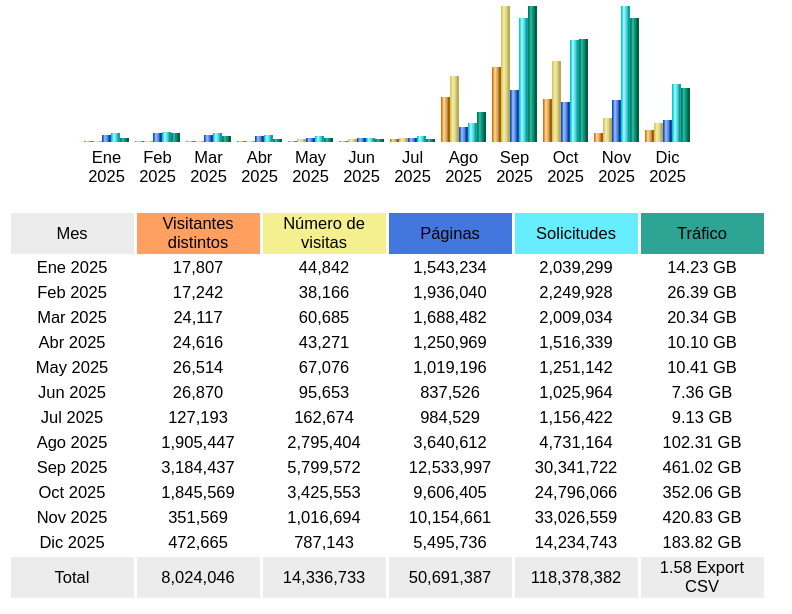
  • 2025 Summary and Statistics

    4
    6
    7 Votes
    4 Posts
    281 Views
    YorusY

    Let's see if he posts a thread, even just one, and we'll keep at it ?

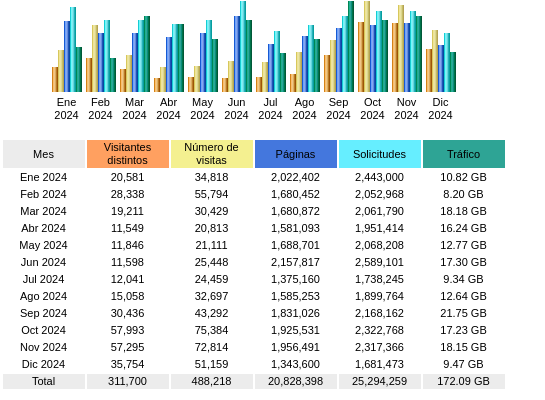
  • Summary and Statistics for 2024

    3
    6
    6 Votes
    3 Posts
    574 Views
    pos_yoP

    The instance of PeerTube also has a number of creators who contribute quality on par with some modest YouTube channels, and one should give a try to periodically watching their TL local.

    @cobito said in 2024 Summary and Statistics:

    All of this is wishful thinking and good intentions, but they are not empty promises, and it is something I would really like to be able to do.

    It is not easy to have time for everything. So the intention is appreciated in the same way.

  • Road Sensor Communicator LCOM LUFFT

    1
    3
    0 Votes
    1 Posts
    317 Views
    No one has replied
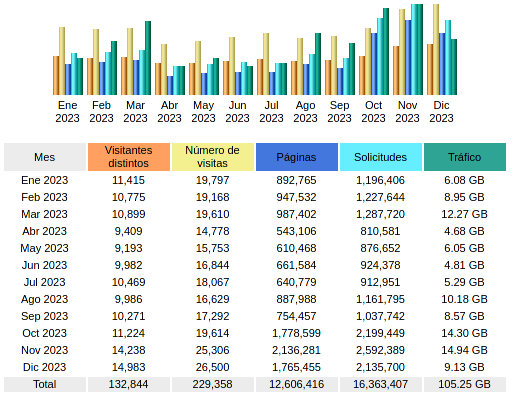
  • Summary and statistics of 2023

    4
    5
    5 Votes
    4 Posts
    633 Views
    pos_yoP

    Thanks for everything, @cobito, because the whole thing looks great. And also inviting the most "classic" users of hardlimit to use other applications of the Hardlimit ecosystem. I am very active on Mastodon, where I have been for 4 years among other instances and that of Hardlimit, and I usually toote (this is what tweeting on Twitter is called) news, my live streams, links, opinions very off the cuff, etc... In short, LONG LIVE HARDLIMIT!

Foreros conectados [Conectados hoy]

0 usuarios activos (0 miembros y 0 invitados).
febesin, pAtO,

Estadísticas de Hardlimit

Los hardlimitianos han creado un total de 543.8k posts en 62.9k hilos.
Somos un total de 37.4k miembros registrados.
kristalsingh94 ha sido nuestro último fichaje.
El récord de usuarios en linea fue de 222 y se produjo el Mon Jul 27 2026.