Hardlimit Museum
-
@jordiqui said in Museo Hardlimit:
@sylver Don't even doubt it - If needed, I grant remote access and voila. I just read it, sorry for the delay.
Thanks for the offer. It won't be necessary, even though I'm envious of your 64GB of RAM

Toda la actualidad en la portada de Hardlimit
Mis cacharros -
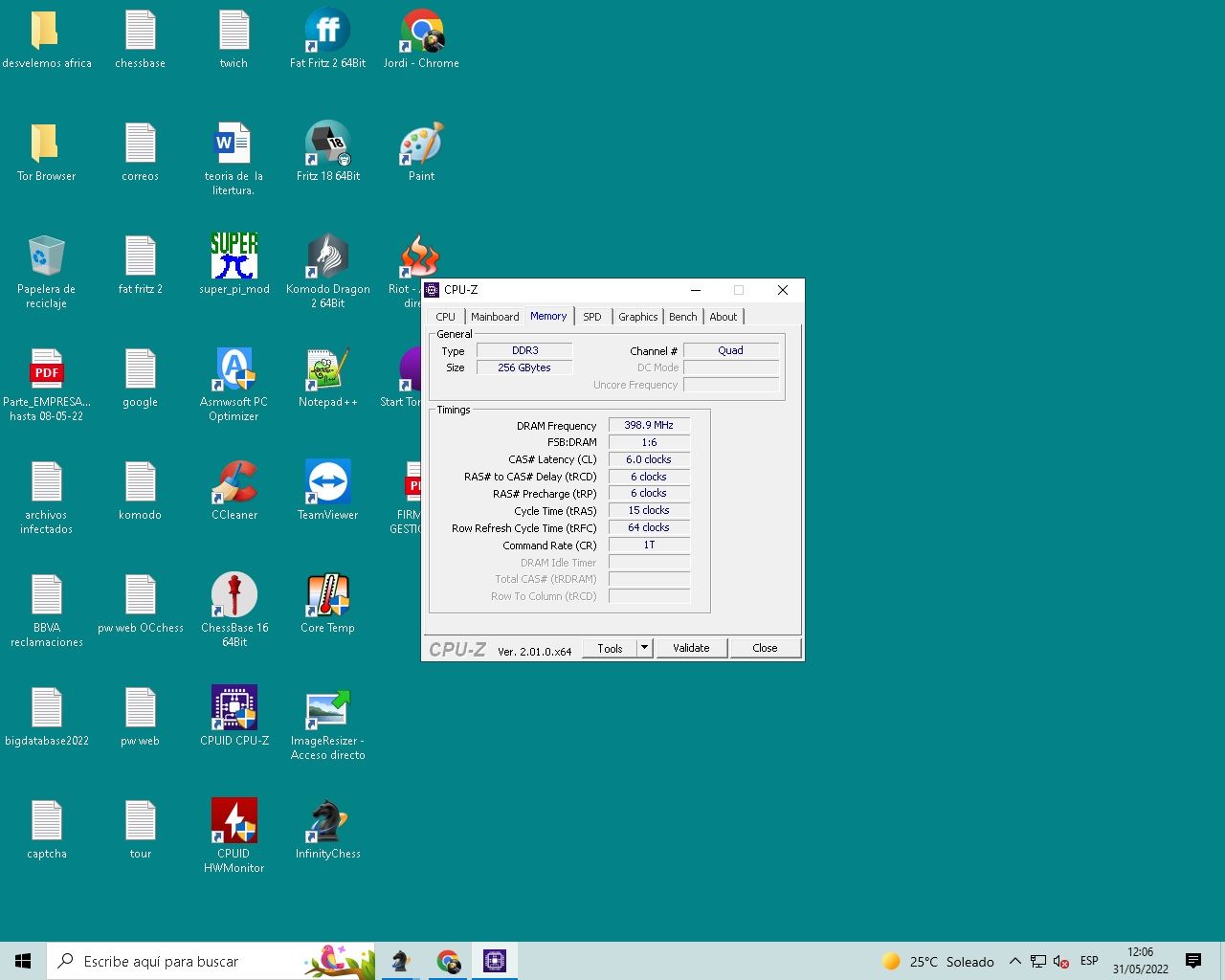
Cluster MPI de tres nodos formado por tres SERVIDORRES HP PROLIANT DL360P 1U 2X E5-2680V2 CPU'S, 20 cores, 40 hilos a una frecuencia base de 2,8GHz. 192 GB de memoria RAM DDR3 ECC (8 x módulos de16 GB 800Mhz)´+ 1U 2X E5.-2697 V2 a una frecuencia base de 2,8 Ghz 192 GB de Ram ECC (8 módulos de 16 Gb 800 mhz) 24 Cores 48 hilos ( 44c/88T)+ 1u 2xE5 2603v2 con una frecuencia base de 1,9ghz 64 Gb DDR3 ecc (4x módulos de 16)
-

Toda la actualidad en la portada de Hardlimit
Mis cacharros -
@jordiqui Jejejee I would go and set up a hosting service and offer it to websites like this one, you can make a lot of money from that great server

Best regards!
>> i7-2600K Sandy Bridge @4.4GHz || Noctua NH-D14 || ASRock Z77 Extreme4 || 4x8Gb G.Skill Ripjaws X DDR3 1600MHz || XFX RX 5700 XT 8Gb || SSD Samsung 850 PRO 256Gb & 850 EVO 500Gb || WD Caviar Green 1Tb || Barracuda 1Tb || Corsair TX650 V2 || M-Audio Fast Track Pro || KRK RP8 RoKit G3 || BenQ GW2750 27"
>> Athlon 64 X2 5600+ Brisbane @2.9GHz || Gigabyte GA-M61PME-S2 || 2x2Gb DDR2 Kingston 800MHz || Sapphire Radeon HD 5850 Xtreme 1Gb || Maxtor 320Gb SATA2 || OCZ ModXStream 500W Modular || TEAC PowerMax 120/2 || Acer X243w 24"
>> Intel Core2Duo E6600 Conroe @2.4GHz || Asus P5N32-SLI SE DELUXE || 2x1Gb DDR2 Kingston 800MHz || Asus nVidia GeForce 9800GT 1Gb GDDR3 || Seagate Barracuda IDE 80Gb 7200RPM || Linkworld LPK12-35 450W -
@jordiqui said in Museo Hardlimit:
Buah!! you already have us all more "excited" than a child in a candy store hahaha
Greetings!!
-
@sylver I have to install the windows server on the two HP proliant mount several ssd with TB of storage and the cluster will have to be installed by them. And I will test it locally with my chess web. to see how it works. Then we will see, because if I can save myself the hosting service of the other web (it weighs a lot because of photos, etc.) we will see. But they have confused me to study anthropology and my brain can't handle everything...

Cluster MPI de tres nodos formado por tres SERVIDORRES HP PROLIANT DL360P 1U 2X E5-2680V2 CPU'S, 20 cores, 40 hilos a una frecuencia base de 2,8GHz. 192 GB de memoria RAM DDR3 ECC (8 x módulos de16 GB 800Mhz)´+ 1U 2X E5.-2697 V2 a una frecuencia base de 2,8 Ghz 192 GB de Ram ECC (8 módulos de 16 Gb 800 mhz) 24 Cores 48 hilos ( 44c/88T)+ 1u 2xE5 2603v2 con una frecuencia base de 1,9ghz 64 Gb DDR3 ecc (4x módulos de 16)
-
I leave you here a new episode of The Computer Chronicles subtitled for you to pass the sweltering night:
Toda la actualidad en la portada de Hardlimit
Mis cacharros -
@cobito To kick off the season, the Hardlimit translation team has subtitled another episode, this time dedicated to the controversial version 6.2 of MS-DOS:
Toda la actualidad en la portada de Hardlimit
Mis cacharros -
In the coming days, the Hardlimit translation team will subtitle another episode of The Computer Chronicles.
The following titles are proposed:
- Internet (1993)
- Atari ST (1989)
- The Megahercios Race (1989)
- Virtual Reality (1992)
- CD-ROMs (1988)
- Amiga and Atari (1985)
- Windows 3.0 (1990)
- Windows 95 (1994)
- Pentium Computers (1993)
You can vote by replying to this toot: https://social.hardlimit.com/web/@cobito/109325523271022485
Toda la actualidad en la portada de Hardlimit
Mis cacharros -
The fifth generation of x86 processors was a big leap from the 486s. At a time when competitors like PowerPC and Alpha were starting to appear, Intel wasn't worried because they were confident that the Pentium's backward compatibility and the extensive software library would work against the new options. But with the Pentiums and their 3.1 million transistors, a new problem appeared: excess temperature. To solve it, manufacturers mounted a fan on top of a heatsink, something not seen to date in home computers. Upgrading to Pentium cost $2000 of the time, which didn't sound so bad when compared to the $4000 of a new PC. But this investment had to be justified, so performance comparisons between Pentium and 486 were the order of the day.Toda la actualidad en la portada de Hardlimit
Mis cacharros -
@cobito What times! And yes they cost a fortune, I don't think I could have bought a pc a few years later. Of course I didn't need it, but the thing with the fan has left me baffled, I didn't know that. Thanks, one more curious and interesting fact.
Cluster MPI de tres nodos formado por tres SERVIDORRES HP PROLIANT DL360P 1U 2X E5-2680V2 CPU'S, 20 cores, 40 hilos a una frecuencia base de 2,8GHz. 192 GB de memoria RAM DDR3 ECC (8 x módulos de16 GB 800Mhz)´+ 1U 2X E5.-2697 V2 a una frecuencia base de 2,8 Ghz 192 GB de Ram ECC (8 módulos de 16 Gb 800 mhz) 24 Cores 48 hilos ( 44c/88T)+ 1u 2xE5 2603v2 con una frecuencia base de 1,9ghz 64 Gb DDR3 ecc (4x módulos de 16)
-
@jordiqui a cousin of mine had to get a pc to study, it had a turbo button on the front, and I'm not sure but it seems to me that it went from 33 to 66Mhz, or it was something in the range below 133Mhz for sure.
-
@defaultuser Then it was a 486. On the Pentiums you couldn't modify the speed even though the towers continued to sell them with the turbo button and the 7-segment display, I suppose for compatibility and the inertia of so many years with that functionality.
With the Pentium II and the introduction of the boxes and ATX power supplies, all of that disappeared definitively.
Toda la actualidad en la portada de Hardlimit
Mis cacharros -
I say this in case, when I have time, I can give you an old CPU like a K7 or Pentium III.
-
What was the Internet like 30 years ago? There was excitement and enthusiasm, and above all, it was an innocent place. Very innocent.
There was also a vision for the future: a video conferencing system that can be considered an early version of what Skype is today and a video on demand system that looks a lot like Netflix.
Online communities were places where people from all over the world interacted with each other years before the first social network appeared. But there were also those who found very creative applications, such as producing a radio show that is then uploaded to the Internet. Long before the term was coined, these radio producers were already giving a precise definition of an idea that we now know as a podcast.
It was an unknown world to most. So how did you explain the most basic concepts? Cyberspace? Superhighways of information? Online communities? Analogies with the real world were essential.
In a field dominated by text interfaces, something completely revolutionary appears: a point-and-click hypertext graphical interface. Mosaic was what we now know as a web browser.
And all this, what impact does it have on society? Why all this fuss about the Internet? Is it really a paradigm shift in the way humans relate to each other?
Here I leave you a juicy piece of the history of the Internet with subtitles:
Toda la actualidad en la portada de Hardlimit
Mis cacharros -
@cobito Huf in companies the internet was like there was something mystical hidden in a room, it was used by 3 or 2 people, and the rest didn't even know there was such a thing in the company
.
Shortly after I had access to a Windows 3.1 but no internet, and apart from the fact that you had to install the cable, they took such care and fear of it that you couldn't see.
Back then it was like a new frontier for good and for bad.
With the first internet cafes you went to investigate the matter, and at home they stayed worried while others had been using napster in the background on the company pc of some family member for a while.
 -
This time we have a video of an ecosystem that I didn't know about. It's about two machines based on Motorola's 68000 architecture with features that I thought only came to the home market in the mid-90s.
To be honest, I find it incredible that there were such sophisticated computers at popular prices in the mid-80s. And it's a bit depressing to me that two machines that were eating the options of Apple (much more expensive) and IBM/Microsoft (much more primitive) didn't catch on.
But it seems that the prediction they make in the video was correct and in the end, if you don't have the software, you have nothing.
About the video, if you want to watch it in full screen, click on the Hardlimit logo in the bottom right corner when it's playing.
Toda la actualidad en la portada de Hardlimit
Mis cacharros -
The 386 was a commercial success even before the software that would squeeze all its potential appeared. Was it just hype or did it really represent a revolutionary change? Curiously, IBM was not the first to participate in the 32-bit generation of the PC that it had invented itself, but Compaq and Zenith took the lead. Faced with this delay, everyone was wondering what the blue giant was going to do and if, by adopting the 386 in its PCs, it would respect the industry standards.Toda la actualidad en la portada de Hardlimit
Mis cacharros -
In the 80s, professional users of IBM PCs were wary of using a graphical interface. Using a device called a "mouse" to work was not well seen.
With the arrival of Windows 3.0, that skepticism began to dissipate and the success of the third version of Microsoft's window manager would lay the foundations for creating Windows 95. It was an operating system focused on multimedia systems, which brought proprietary multitasking to the home PC and introduced an interface, of which, many paradigmatic elements are still preserved today.
The change was such that many wondered what would happen to their MS-DOS programs, since the previous versions of Windows did not go beyond resting on the old operating system.
Here I leave you the last subtitled chapter of the year:
Toda la actualidad en la portada de Hardlimit
Mis cacharros -
The people from msdos.club have given us a magazine that they have scanned. It is PC floppy, aimed at the home PC user. I didn't know about it and the truth is that it is interesting, in the style of PC Manía. Only issue 57 is known to be from 1994 and from the cover it looks like it's from the summer.
You can check it out here.
Toda la actualidad en la portada de Hardlimit
Mis cacharros




Hello! It looks like you're interested in this conversation, but you don't have an account yet.
Getting fed up of having to scroll through the same posts each visit? When you register for an account, you'll always come back to exactly where you were before, and choose to be notified of new replies (either via email, or push notification). You'll also be able to save bookmarks and upvote posts to show your appreciation to other community members.
With your input, this post could be even better 💗
Registrarse Conectarse