@rul3s Now I have a doubt, because I understood that you have to use a submultiple, not a multiple. I'm not sure how digital interfaces refresh data, but in VGA, if you generate two frames in a screen refresh, the first will appear in one half of the screen and the second in the second half (in DVI I think it works the same way). If you generate several frames per refresh, the screen will appear split into several pieces:
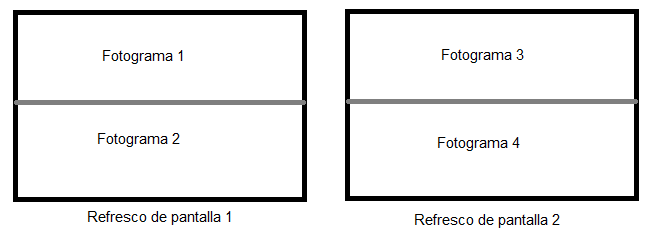
If instead of using a frame rate of double, you use quadruple, 4 cuts will appear on the screen and so on.
On the other hand, if you use a submultiple (eg: 30fps on a 60Hz screen), during two screen refreshes a single frame will be shown, so there will be "no" tearing.
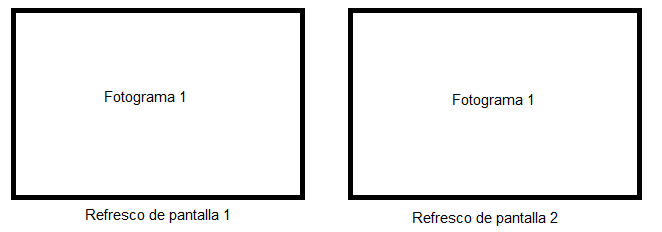
This assuming that the frame generation and screen refresh are perfectly synchronized. If both the GPU and the screen work at 60fps but there is no synchronization, tearing will appear. In this case, the screen will always appear split in the same place:
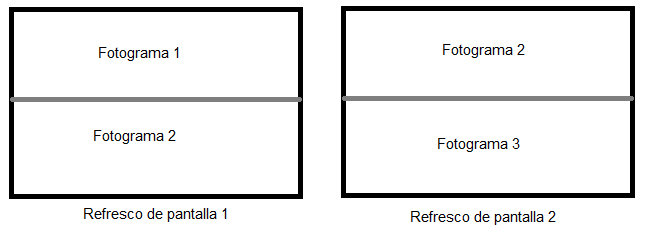
If the frame change catches you in the middle of the screen, it will be clearly seen. If it catches you very high or very low, it will hardly be noticed. I think V-Sync did exactly this: to match the beginning of both cycles, but I'm not really sure.
The point is that if both refreshes go their own way, the line that separates both frames will appear in random places and that is really annoying. But then again, maybe I'm just swinging because it's been a while since I've been up to date on this.